
Rick Doble coined the term
WOVEN-FIBER TECHNOLOGY
seven years ago to define and describe
the skill of weaving with fibers
over thousands of years
in a pioneering blog post

FROM BASKETS TO SHIPS:
IT MAY HAVE TAKEN 100s OF THOUSANDS OF YEARS
IT MAY HAVE TAKEN 100s OF THOUSANDS OF YEARS
[TOP] A carry basket. using a simple design, made by the Xerente (Sherenté),
an indigenous people in Brazil.
an indigenous people in Brazil.
It may have taken more than half a million years for the skills needed to make this basic basket [TOP] to evolve into the skills needed to make this seagoing ship [BOTTOM] made of reeds that could carry 50 tons of cargo and sail the Persian Gulf
[BOTTOM] "Model of the reed boat Tigris, boat of Thor Heyerdahl."
This recreation of a Mesopotamian reed ship could carry 50 tons of cargo. Thor Heyerdahl built the full-scale ship to prove the seaworthiness of reed ships. He sailed the Tigris with no problems for 5 months in the Persian Gulf.
https://commons.wikimedia.org/wiki/File:Tigris_Model_Pyramids_of_Guimar.jpg
https://commons.wikimedia.org/wiki/File:Tigris_Model_Pyramids_of_Guimar.jpg
When I queried Google AI, this phrase about basketry,"Woven-Fiber Technology" that I coined, came up over and over again. Based on this response, this phrase and terminology have now become the major term for studying baskets and woven fiber constructions, both in the past and in the present. The term applies to basket weaving (the old term) but also includes hundreds of other items and objects, from small baskets to large seafaring boats and huge community centers in the Paleolithic and Neolithic eras, for example.
Here is one response and a quote from Google AI about this. Accessed April 17, 2026.
---------
"Woven-Fiber Technology" is a modern, interdisciplinary research term that refers to the advanced, systematic integration of fibers—both natural and synthetic—into complex, functional structures. This technology spans from the re-evaluation of prehistoric basketry in anthropology to the development of cutting-edge smart textiles and wearable electronics.
Please see more Google AI responses at the bottom of this article.
When I posted this blog on September 22, 2019, I specifically stated that this was a term I invented and had researched to include all aspects of weaving things with fibers.
----------------------
HERE IS WHAT I WROTE SEVEN YEARS AGO
September 22, 2019
EVIDENCE FOR A BASKET WEAVING
AND WOVEN-FIBER TECHNOLOGY
IN THE PALEOLITHIC ERA
A TERMINOLOGY FOR THESE KINDS OF ARTIFACTS
To avoid ambiguity I have settled on the term Paleolithic Woven-Fiber Technology to describe everything from baskets to hammocks to boats to textiles and cloth. I see them all as part of the same general weaving method, which was part of an evolving technology.
And it is important to understand that all of these products (to use the modern word) were made with processes that involved a large number of steps.
----------------------
ABOUT MY RESEARCH
When I published this long, detailed blog in 2019 about the skill of basket weaving and the many other items that could be made with these techniques, I had been working on this blog and this idea for about six months. I wanted to show that not only was the craft and technology of fiber weaving used in a variety of ways, it has also progressed and developed over time.
So when I had finished my draft of the article, I wanted to find a term that included what I had found and my ideas about widespread fiber weaving. And this is what led me to come up with the term "Woven-Fiber Technology".
Here is the link to my first article in which I spelled out this complete idea and also illustrated it with a large number of photographs.
September 22, 2019
Evidence for a Basket Weaving
and Woven-Fiber Technology
in the Paleolithic Era
May 17, 2023
Should "The Stone Age" Be Called "The Stone and Basket Age?"
--- this includes a section on Woven-Fiber Technology
March 9, 2021
The Need to Change
the Term 'Basket Weaving'
to the Term
'Woven-Fiber Technology'
-- A DOWNLOADABLE PDF FILE --
The Need to Change
the Term 'Basket Weaving'
to the Term 'Woven-Fiber Technology
I believe I am the first person to specify that this term needed to be accepted as a major term that began in Paleolithic times, dating back as far as 2.5 million years, but which also continues to today with hi-tech applications of weaving with fibers and to the development of cloth and the clothes we wear.
I decided that phrase "Woven-Fiber Technology" should be an inclusive term for all woven items such as baskets, textiles, cordage, nets, and clothing such as hats and sandals. The term would even cover early random basket making in the Lower Paleolithic, and then later the development of right-angle construction which revolutionized the technology.
But the term would not dismiss the possibility that fiber construction might have been a fundamental technology, potentially dating back 2.5 million years. This could have happened when early proto-humans observed weaverbirds who made strong, intricate nests and lived in the same environments.
But it is important to add that while weaverbird nests suggest it is *possible* that proto-humans learned basic construction from these birds, researchers should avoid the word *probable* until more research is done.
THE PROCESS OF CREATING AN ACCURATE SIMPLE PHRASE
I thought about Einstein (a childhood hero) and his way of going to the core of a problem. His ideas about theories have been boiled down to these two paraphrases based things that he said.
"Everything should be made as simple as possible, but not simpler."
"Make things as simple as possible, but no simpler."
I first thought about the current accepted term 'basket weaving', which everyone believed they understood. The basic idea was clear enough although I suspect few people understood the basket making process or the hundreds of styles and types of baskets because basket making is not simple.
So for a variety of reasons I felt 'basket weaving' had to be replaced as a term:
#1. It was a limited term that did not include the many other items that could be made with the same skills such a fish traps or hats.
#2. Basket weaving was seen as unimportant and often seen as a humble craft not worthy of respect.
#3. It was not considered essential to Paleolithic survival, unlike stone tools.
#4. It was never considered a technology but rather a mundane and simple craft.
#5. It was often considered 'women's work' which in past ages often was dismissed as insignificant.
#6. Pottery was seen as a major technological advancement over basketry, and thus, basket weaving was seen as primitive. This was a clear bias and a clear mistake because basketry was more appropriate, useful, and practical for many purposes. Furthermore, basketry and woven-fiber articles continued to be made and were essential long after pottery was developed.
So I wanted to create a term that was
* short
* simple
* easy to understand and clear
* accurate and precise
* inclusive of all types of variations of weaving with fibers
* gave the various skills a technology status
* included the idea that different skills had developed over time
But it was a tall order. I also wanted to make the point that basket-making skills with fibers, along with the creation of nets, mats, fish traps, cordage, textiles, hats, shoes, and small boats, were all part of the same skill set, the same technology.
So I wanted to create a simple phrase that would encompass all of this and that was inclusive, general, and concise.
It was clear from the beginning that the word weaving would be part of the phrase, and since I believed it was a technology this had to be clear as well. Weaving also suggests human creativity along with human exactness.
This left the material that needed to be woven. As I read general descriptions about making baskets and fish nets and hats around the world, the word fiber kept jumping out. So I put these words all together to see how they fit together, and I think they fit quite well.
Woven-Fiber Technology.
This felt right to me: weaving asserts that it is a human creating something that can be both creative and/or exact.
There was also a general agreement that baskets and other related items were made with fibers. Fiber was a general term that covered a wide range of natural materials that were very different in different parts of the world.
And then the combination of weaving fibers and their implied and continuing development led to the assertion that this was a technology
Then I thought perhaps I should add more. But nothing I added made it clearer.
ABOUT RESEARCH
In the process of doing research, I gradually realized I was doing more than coming up with a name for Paleolithic weaving. I was expanding and reshaping our understanding of the past. Like many bold ideas, I was connecting things that had not been connected. A good example of a major breakthrough like that was James Clerk Maxwell's theory that connected electricity, magnetism, and light into a continuous spectrum, which is now crucial to modern science. The same could be said of Charles Darwin, who connected the development of life into his theory of evolution, or Albert Einstein, who connected time with space into a space-time continuum. Or Isaac Newton, who connected a falling apple on Earth with the orbits of the moon and planets in the heavens.
I am, of course, not comparing myself to these geniuses, but these examples clarify what I was attempting to do.
So what was I connecting? In my view, the misunderstood basket weaving skills were also used for fish traps, for example, for nets, hats, sandals, rafts, all purpose mats, cordage, textiles and the list goes on and on. In other words, anything made with woven fiber. But in addition, I was connecting the earliest beginnings of woven fiber skills with their evolution and development right up to today. I am also guessing that once the door has been opened to these connections, other researchers will see more connections and interconnections.
When I dug further and to my surprise, I found that woven fiber became highly developed. By the end of the Neolithic era, Woven-Fiber Technology was almost hi-tech. It was used to make seafaring large ships, huge ceremonial buildings, flood control and irrigation devices, canal dredging tools, furniture, fences, roofing and a host of different woven tools for agriculture for planting, harvesting and storing food. In other words the Neolithic revolution could not have happened without Woven-Fiber Technology and neither could the growth of the first cities.
And there is more, much more. As Joseph Stalin said "quantity has a quality all its own" when thousands of his T34 tanks rolled onto the battlefields and defeated Nazi Germany.
In the case of the first cities in Mesopotamia, the second largest industry was reed technology (a subset of Woven-Fiber Technology). I proved this with evidence from port receipts and the hundred words relating to reed working skills and more (see my blog). So Woven-Fiber Technology not only developed the skills needed for the large cities, it was able to produce huge amounts of material that was essential for these cities. Reed bundles, in a sense, were the basic lumber for building these cities and the supporting farm areas outside the cities.
I also found that what had been called basket weaving in the past was practiced worldwide. This technology was used by virtually all human cultures using local plants. There is no known culture that did/does not employ some form of basketry and basket weaving, along with many other applications of weaving and fiber. And yet, at the same time, fiber material decays quickly and leaves little evidence. It was for this reason that this technology was ignored, as there was no solid proof that it had developed before the Neolithic era.
But why has this not been noticed earlier? Do you remember the crib course in college, Underwater Basket Weaving? This was supposed to be simple and easy -- really? But in fact making a basket required many steps. The maker had to imagine what the finished basket would look like, he or she then had to gather local materials, process them (which often took longer that it took to make a basket) and then create the basket which could take months. The basket had to be useful, sturdy, and light.
The reasons that its importance has been diminished relates to a number of biases that have never been properly recognized. These combined biases have prevented basket weaving and the much larger category of Woven-Fiber Technology from being considered a major technology. However, it is possible that this technology was just as important as stone tools, and some have suggested maybe even more important than stone tools.
Perhaps, the worst bias was that past evaluations of baskets did not consider them tools -- which they clearly were.
*****************************************
THE FOLLOWING ARE QUOTES FROM SEVERAL QUERIES TO GOOGLE'S AI
Accessed April 17, 2026.
Rick Doble proposes that basket-weaving and, by extension, Woven-Fiber Technology (including cordage and textiles) was a foundational technology developed early in human history—potentially over 2 million years ago—rather than in the Neolithic period. He argues this technology was crucial for foraging, transport, and survival, and enabled significant cognitive growth.
Replacing the term "basket weaving" with "Woven-Fiber Technology" in archaeological contexts recognizes prehistoric fiber construction as a sophisticated, crucial, and, in some cases,Paleolithic-aged industry rather than just a simple craft. This shift, proposed in academic work, accurately reflects the technological complexity, cognitive skills, and diverse, non-basket applications of these materials, such as, for instance, early textiles.
DEFINITION & SCOPE: Proponents advocate using "Woven-Fiber Technology" over "basket weaving" to encompass the full range of interconnected fiber products, including nets, matting, wickerwork, and twine.
Recent research is now pushing for a reclassification of these items [ED: baskets, containers, domestic items] as "Woven-Fiber Technology" to properly reflect their importance in early human survival and resource management.
ANTHROPOLOGICAL RECLASSIFICATION: Researchers are changing the term "basket weaving" to "Woven-Fiber Technology" to better represent its importance in early human survival and evolution, encompassing items like nets, textiles, and storage traps.
"WOVEN-FIBER TECHNOLOGY" IS A SUGGESTED MODERN, BROADER TERM FOR "BASKET WEAVING," emphasizing the engineering, varied materials, and critical, diverse applications (storage, construction, transport) used in prehistoric and early civilizations. While "basket weaving" implies making only baskets, the technology involved complex, often sacred, structures.
SIGNIFICANCE: Considered vital for the transition to agricultural life, enabling the storage and transportation of food.
TERMINOLOGY: "Woven-Fiber Technology" expands the definition to recognize sophisticated prehistoric engineering, whereas "basket weaving" is considered outdated or too narrow by researchers, as detailed in this academia.Edu paper.
"WOVEN-FIBER TECHNOLOGY" IN PREHISTORY
refers to the combined study of basketry, cordage, and textiles—often termed "perishable industries"—that predate pottery. This term highlights the crucial, non-lithic technologies used by nomadic hunter-gatherers, challenging the assumption that complex weaving required sedentary neolithic cultures.
SIGNIFICANCE: it is argued that these technologies, used for foraging, storage, and water transport, potentially predate pottery by thousands, if not millions, of years.
COGNITIVE IMPLICATIONS: The creation of complex, woven items implies that early hominini possessed the ability to visualize a final product before beginning construction, providing insight into the cognitive evolution of, for example, early hunters.
This technology is viewed as the "first" technology that may have been a "tribal-wide" activity, involving all members of a group.
This quote is not from Google AI but is to the point.
"Relatively few tribes of American Indians understood pottery, except in the crudest form. As for basketry, it may be said that every Indian from the land of the Esquimaux down through Mexico was a basket weaver.
American Indians: first families of the Southwest by Huckel.
*****************************************
________________________________
A BRIEF PICTURE SUMMARY OF WOVEN-FIBER TECHNOLOGY
The following pictures of weaverbirds and nest building show that it was *possible* that early proto-humans learned basic basket weaving skills from these birds. But it does not prove that it was probable as new research and new researchers will need to explore that possibility.
Early hominini were nomadic hunter-gatherers. This way of life continued for millions of years until about 10,000 years ago. Basketry and woven-fiber items might have made a huge difference to their survival during their nomadic hunter-gatherer way of life.

Weaverbird nests. Two different types.
Weaverbirds could have taught proto-humans several things such as knot making, how to make the basic stiff initial skeleton structure and also that a basket could be free standing so that it was portable and could travel with a person.
The fossil record confirms that early humans, 2.5 million years ago, lived at the same time as weaverbirds and in the same environment. Further research revealed that the two often were in close association because they both lived around Baobab trees. This makes it likely that early humans were familiar with weaverbird nests and nest building.

LEFT: Different knots weaverbirds can make.
RIGHT: A weaverbird starting a nest by making the interior skeleton structure.
LEFT: Friedmann, Herbert. "The Weaving of the Red-Billed Weaver Bird in Captivity." Zoologica:. Scientific Contribution of the New York Zoological Society,
Volume II, Number 16, page 363. The Society, The Zoological Park,, New York, 1922.
Early baskets were most likely made with a random design which was quite sturdy and useful.

LEFT: Weaverbird nests are well-designed and strong. Abandoned ones fell down from Baobab tree limbs (trees where hominini often camped) which early hominini could have collected. "Weaverbird (Southern Masked Weaver) nest of dry grass, near Pretoria, South Africa"
RIGHT: A random weave basket made from vines by Nan Bowles. It was constructed with flexible green vines that later dried to make a light, stiff, strong basket. (Basket/Photo by Nan Bowles)
In any case, it seems likely that proto-humans would have known how to make random weave baskets by the early Middle Paleolithic.
Then, in a recent discovery, evidence was found that confirmed that by the early Middle Paleolithic proto-humans understood about right angle construction. A right angle device was found dating back to almost 500,000 years ago.
After a long time early weaving may have developed into a highly sophisticated, regular, evenly spaced construction that was made at right angles or with opposing strands. This technology was a breakthrough. It was versatile and scalable. The weaving could be open or closed, soft or hard, used in conjunction with wood, and much more. Both small and quite large items could be made.

Making a basket out of bamboo.
The photo clearly shows the wide stiff vertical spokes around which the weaver strands are interlaced at right angles to the spokes.
The photo clearly shows the wide stiff vertical spokes around which the weaver strands are interlaced at right angles to the spokes.
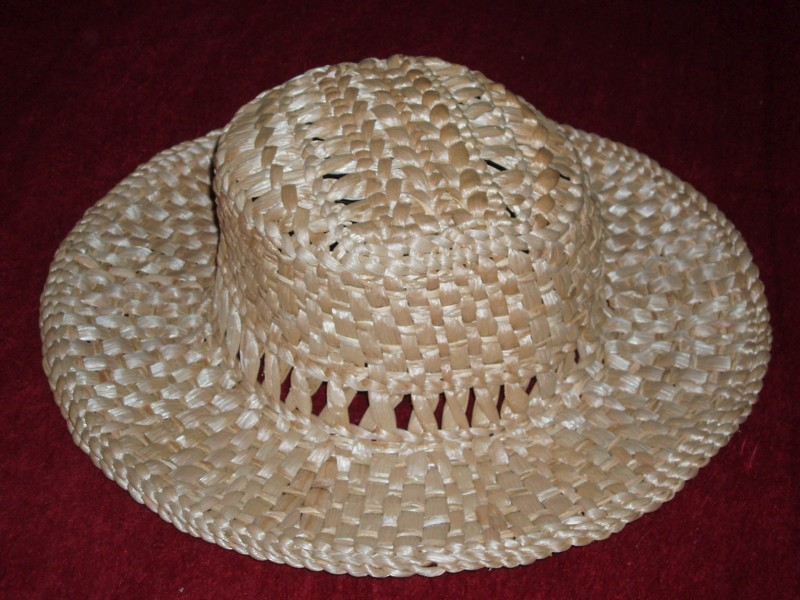
Traditional Ukrainian hat with a 'wide gauge' strands.
Sophisticated weaving skills also allowed the creation of custom designs for different applications such as this photo of a woman using a custom made paddle to beat seeds from a plant into a large basket.

AA.jpg)
This Native American Indian Coastal-Pomo woman is gathering seeds
using a paddle made with woven-fiber technology.
This paddle is a tool designed to hit and free the seeds
on the plant so that they fall into the large basket.
using a paddle made with woven-fiber technology.
This paddle is a tool designed to hit and free the seeds
on the plant so that they fall into the large basket.
Called a twined fish trap, this maze of woven nets caught fish so that they could not escape once they had entered it.
A Native American Indian Twined Fish Trap Around 1588.Called a twined fish trap designed by Native American Virginia Indians, this drawing was made after Thomas Hariot who made the original drawing around 1588. https://jenikirbyhistory.getarchive.net/amp/topics/a+b+alexander

Most experts agree that small reed boats were probably built in the Upper Paleolithic because reed materials were well suited for boat building. Boats were made of buoyant reeds (like papyrus) that were tied into tight bundles, thus making them almost water-tight. Here are pictures of some current reed boats that are being made today.

Traditional reed/fiber boats from around the world.
TOP LEFT: "Tankwa or tangwa: Traditional Ethiopian embarcation from Lac Tana, made of papyrus by Nagades people."
TOP RIGHT: "Reed boat at Ekehagen Prehistoric village outside Åsarp, Falköping Municipality, Västergötland, Västra Götaland County, Sweden."
BOTTOM LEFT: "Reed boat; exhibition in the Doria Castle of Castelsardo, Sardinia, Italy"
BOTTOM RIGHT: "Traditional reed boat on Lake Titicaca, Bolivia."
While this is a guess, it is likely that huge baskets carried on the back were used in the Neolithic era before the domestication of pack animals. Baskets them were strapped to these animals such as donkeys.

Large back baskets for agriculture in Slovenia ca. 1963.
I believe that large back-baskets such as these were widely used in the Neolithic era before the invention of pottery. In some areas of the world, they continue to be used today.

A donkey with traditional panniers (side-saddle-type baskets).
Even after the domestication of pack animals, baskets were essential. Heavy-duty reed baskets were used to transport agricultural goods, dredge the channels, carry clay to make bricks, and carry bricks to build buildings.
Civilizations required tens of thousands of sacks to carry and store grain, many of which were made out of fibers such as linen. These early cities with tens of thousands of people required many things in quantity. Large cities could not function without this fiber technology.

Civilization mass-produced what the Neolithic had developed.
While often overlooked, both the Mesopotamians and the Egyptians depended on huge numbers of woven-fiber sacks for holding and transporting grain along with baskets carried by pack animals.
LEFT: Picture from the Sumerian Standard of Ur.
of a person carrying a sack, circa 2600 BCE.
RIGHT: Picture of an Egyptian carrying a sack
from Tombe d'Oumsou, circa 1450 BCE.
At the height of fiber development, large reed seafaring ships (confirmed by experts) and huge community buildings made entirely of reeds (even the rope), still made today, were constructed.

Reed and woven-fiber technology at its height.
[TOP] This large reed boat is an artist's conception of a boat docking at a Mesopotamian city around 5000 years ago. While a fanciful painting, it is probably not an inaccurate representation of the highly developed reed technology at that time.
While still in the public domain, the link to this picture is no longer available.
[BOTTOM] Like reed cathedrals, large vaulted mudhifs, as they are called, were made entirely from reeds, including the rope. The largest and best-made ones were used for ceremonial purposes and community gatherings. The interiors often displayed dazzling patterns of light as the light came through the intricate weaving work.
https://commons.wikimedia.org/wiki/File:Mudhif_Reception_Hall_(30943793762).jpg
https://commons.wikimedia.org/wiki/File:Mudhif_Reception_Hall_(30943793762).jpg


_(14775904322).jpg)
_male_nest_building.jpg)


.jpg)

.jpg)


.jpg)
No comments:
Post a Comment