
A MAJOR DISCOVERY OF DIRECT EVIDENCE:
Well-Preserved Baskets Are Found To Be
2000 Years Older Than Previously Thought
&
The Ideas of Rick Doble who predicted this
New radiocarbon dating has determined that prehistoric artifacts, based on a basket weaving technology, found in the 'Bat Cave' in Spain (Cueva de los Murciélagos, Albuñol, Granada) are 2,000 years older than previously believed. The oldest are about 8,500 BP and related to early nomadic Holocene hunter-gatherers in Europe.

Baskets/containers made by pre-Neolithic nomadic hunter-gatherers
found in the dry 'Bat Cave' in Spain.
https://commons.wikimedia.org/wiki/File:Cestillos_de_esparto_(29319999262).jpg
found in the dry 'Bat Cave' in Spain.
https://commons.wikimedia.org/wiki/File:Cestillos_de_esparto_(29319999262).jpg

Detail of above.

Detail of above.
SUMMARY OF THE SIGNIFICANCE OF THIS DISCOVERY
-- This new dating means that a kind of threshold has been crossed; it means that the oldest artifacts were made by nomadic hunter-gatherers and not Neolithic people as had been previously thought.
-- Until recently it was assumed that basket weaving and woven-fiber technology began in the sedentary Neolithic time period and that this kind of advanced technology would not have been possible for nomadic hunter-gatherers.
-- The sophistication of the oldest baskets also indicates that this technology had been developing in the Paleolithic era for a long time, as it would taken many years for this kind of craftsmanship to develop.
-- It also means that at the beginning of the Neolithic era, the technology was already quite sophisticated. The Neolithic people inherited a woven-fiber technology that had been well developed by nomadic hunter-gatherers and which they could add to or improve upon and which was also crucial for the establishment of the Neolithic way of life.
-- In both cases, it shows considerable skill and good designs.
-- Having direct evidence of complete well-preserved artifacts means that this technology can now be studied in great detail which will also reveal a good deal about the abilities of nomadic hunter-gatherers.
“The quality and technological complexity of the basketry makes us question the simplistic assumptions we have about human communities prior to the arrival of agriculture in Southern Europe,” the study's leader, Francisco Martínez Sevilla, said and was quoted in the original SCIENCE ADVANCE article.
A complex and skilled process:
"The ancient humans crushed the grass to make twine to braid baskets, bags and sandals. The grass had to be dried for 20 to 30 days before it was rehydrated for 24 hours to make it pliable — a complex and skilled process."
THE DISCOVERY IN DETAIL
Anthropologists have known about these various woven-fiber items for decades but they were believed to be Neolithic. Now, however, this new dating shows that the oldest items were made by nomadic hunter-gatherers before the Neolithic era and are direct evidence of that fact. These items are well made and show a highly advanced technology.
This is extremely important because it places the time of the production of sophisticated basket weaving and woven-fiber technology long before the Neolithic era. The discovery of an advanced technology means that it usually came from a technology that had been developing for many years prior. This indicates that an earlier version was probably available to nomadic hunter-gatherers and suggests that well-made items could have been designed and created tens of thousands of years earlier than previously thought.
This discovery changes our understanding of the time period before the Neolithic era, e.g., the Upper Paleolithic and also the Mesolithic period just before the Neolithic. Prior to this, only indirect evidence had been found in the form of basket weaving impressions in small bits of clay which were even much older. This current find provides direct evidence of well-preserved complete intact artifacts which greatly supports the earlier indirect evidence.
This discovery applies to the largest and most comprehensive group of baskets found so far that are intact and from the nomadic hunter-gatherer era. This means that the method of weaving and of processing the fibers, and the sturdiness of the design can all be studied in detail. Most of these baskets used fibers from the esparto plant which was highly valued for its many uses and properties.
This technology was probably valued by nomadic hunter-gatherers because woven fiber items were light, strong, and durable and could be made in a wide variety of shapes and sizes for a wide variety of purposes including large burden baskets, containers, cooking baskets, bowls, plates, and very large and small water carrying baskets. They could also be designed to store grain for long periods of time.
In this recent discovery complete well-made woven-fiber containers, baskets, bowls, plates, and shoes are some of the artifacts that were found in this dry cave along with fragments of cloth and mats. Normally fiber-based items decay quickly but in this case, the cave was quite dry and preserved these items. This find is rare and provides major evidence that usually is lost.
Furthermore, the discovery shows that at the very beginning of the Neolithic era this technology was already highly advanced. It is my belief that because it had been so well developed it provided Neolithic cultures with the early necessary tools for their sedentary way of life to take hold.
While the Neolithic is famous for the invention of pottery and the domestication of animals, these only came during the last third of the Neolithic era. Basket weaving (woven-fiber) technology was needed for thousands of years before pottery was perfected and long before pack animals were domesticated. So woven-fiber technology was a crucial key industry.
Furthermore, pack animals still required baskets to carry loads and light strong durable baskets were still essential for other work. Woven-fiber technology continued to advance so, for example, when reed fibers were combined with naturally occurring bitumen, small boats, and large sea-faring ships were built in the Persian Gulf area as well as large and smaller 'grass' (reed) buildings.
SUPPORT FOR DECONSTRUCTINGTIME'S IDEAS
I have written several full-length articles that predicted and supported the idea that nomadic hunter-gatherers had a fully developed highly advanced woven-fiber technology that was both versatile and complex. This idea goes against the previously commonly held belief that hunter-gatherers were not capable of such a technology.
I am especially pleased about this find of direct evidence because it confirms many of my ideas and predictions that I have been suggesting for the last four years in this blog. Furthermore, it fits very nicely into my ideas for a revised much longer timeline of how woven-fiber technology developed. Until recently, researchers believed that basketry had begun in the Neolithic era. Now with this and other evidence, it appears that the development could have happened over tens of thousands of years or more. And this, again, is what I have suggested and predicted. Another recent discovery, that I reported in the last blog-article, confirms that early hominins had sophisticated plant material skills and even engineering skills half a million years ago.
OTHER ANTHROPOLOGISTS AND ARCHAEOLOGISTS HAVE OFFERED SIMILAR IDEAS BEFORE I DID
I need to point out that several other anthropologists and archaeologists, years ago, offered the same idea of basketry being made in the Upper Paleolithic and before the Neolithic Most of them have many more credentials than I do.
Nevertheless, I feel that I have added something significant to this discussion. I believe that woven-fiber technology was a key technology beginning perhaps at the same time as Oldowan or Acheulean stone tools. I also believe that baskets and woven-fiber items are tools and need to be thought of as such. My theory about basket weaving technology goes back hundreds of thousands of years so it is important to me to place each step at the right point in time, as much as possible.
The sophistication of these recently dated nomadic hunter-gatherer artifacts suggests that the technology was very old and that basket technology worked well with nomadic people who needed tools that were strong, light, and portable and that could be made from local plants. Furthermore, I believe that Neolithic societies inherited a fully developed technology from the Paleolithic era and did not invent it as was previously thought. Then the Neolithic cultures passed their even more developed technology down to the great emerging civilizations such as those in Mesopotamia that I believe had a large reed and fiber industry that was critical for the rise of their civilizations.
DOBLE'S ARTICLES ABOUT THIS
September 2019
Evidence for a Basket Weaving
and Woven-Fiber Technology
in the Paleolithic Era
VIEW OR DOWNLOAD A PDF
January 2022
The Development Of Advanced
Woven-Fiber Technology
In The Paleolithic Era
Insights from Paleo-Indian artifacts and
Ethnoarchaeology
VIEW OR DOWNLOAD A PDF
AND
While this article is about gender bias, it discusses basket weaving technology by women who were members of nomadic hunter-gatherer tribes.
------------
December 2020
OVERCOMING GENDER BIAS
IN PALEOLITHIC RESEARCH:
Gender Bias May Have Prevented
Paleolithic Basket-Weaving Technology
from Being Recognized and Accepted
VIEW OR DOWNLOAD A PDF
April 2021
The Crucial Importance
of Basket Weaving Technology
for the World's First Civilizations
VIEW OR DOWNLOAD A PDF
DID THE EMERGING NEOLITHIC WAY OF LIFE DEPEND ON BASKET WEAVING TECHNOLOGY DEVELOPED EARLIER BY HUNTER-GATHERERS?
I BELIEVE IT DID.
The Neolithic way of life may have depended on the sophisticated advanced development of basket weaving technology (what I have renamed woven-fiber technology) because it could create a wide variety of well-made light-weight rugged items that were necessary for the Neolithic lifestyle of planting, harvesting, and storing. I believe all of these essential technologies were initially accomplished with basket weaving skills.
See my article where I explain the skills of nomadic hunter-gatherers and how these skills were probably passed on to Neolithic cultures.
----
February 2022
Pre-Pottery Neolithic Basket Weaving
VIEW OR DOWNLOAD A PDF
I argue that for the first two-thirds of the Neolithic era, basketry was the key technology that allowed the Neolithic system to take hold. It was only in the last third of the Neolithic era (approx.) that domestication of animals and the use of pack animals replaced people carrying harvested crops in large 'burden' baskets on their backs, that pottery was developed, and that fabric for clothing and other uses, such as sacks, was perfected. And while these new technologies gave the Neolithic societies a major boost, they did not replace the use of woven-fiber technology which continued to be widely used for many different purposes such as the manufacture of small and large boats made of reeds and fibers.

Large 'burden baskets' that may have been used
in the Neolithic era to bring in the harvest.
in the Neolithic era to bring in the harvest.

A domesticated donkey that was used to transport produce
but still required woven-fiber baskets to carry the load.
https://commons.wikimedia.org/wiki/File:Donkey_panniers.jpg
https://commons.wikimedia.org/wiki/File:Donkey_panniers.jpg
THE ORIGINAL ARTICLE ABOUT THIS NEW DISCOVERY
The earliest basketry in southern Europe: Hunter-gatherer and farmer plant-based technology in Cueva de los Murciélagos (Albuñol). Francisco Martínez-Sevilla, Maria Herrero-Otal, Raquel Piqué Huerta. SCIENCE ADVANCES, 27 Sep 2023, Vol 9, Issue 39. DOI: 10.1126/sciadv.adi3055
A GOOD EXPLANATION
Earliest Baskets in Europe, From Almost 10,000 Years Ago, Found in Spanish Cave. Ruth Schuster, Sep 27, 2023.
CONCLUSION
While we can be delighted that this recent direct evidence has been found, unfortunately, the central problem still remains, which is that while natural fibers and wood probably were the largest materials used by early humans as all researchers agree, almost all evidence has decayed and thus is very hard to find. But now, at least, we are beginning to know what to look for
_________________________________
AFTERWORD
ESPARTO WOVEN-FIBER ARTIFACTS
From an earlier DeconstructingTime blog-article
before the discovery that these artifacts were 2000 years older.
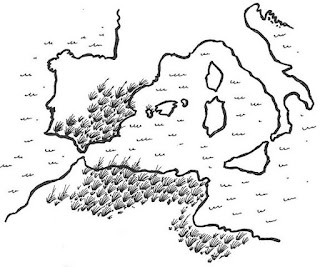
Just how versatile was this technology? What kind of products could it provide? Woven-fiber technology was dependent on the plants that grew wild locally. So reeds were plentiful and versatile around Mesopotamia, papyrus was widely used in Lower Egypt, and in Spain and in North Africa the esparto plant was valued for its many uses.
Fortunately, in the case of esparto, we have direct evidence since many baskets, shoes, and mats have survived intact. The existence of these items also shows that basketry and weaving technologies were being widely used in the Neolithic and earlier.
The following is quoted from:
Traditional Craft Techniques of Esparto Grass (Stipa tenacissima L.) in Spain
"Numerous archaeological artifacts and remains of esparto basketry have been discovered that date from the Neolithic period in southeast Spain. THESE PIECES DEMONSTRATE HIGH STANDARDS OF QUALITY COMPARED WITH MORE MODERN PIECES. [ED. My emphasis]... These pieces represented clothes, hats, tunics, sandals, baskets, and ropes—ALL MADE WITH THE FINEST TECHNIQUES. [ED. My emphasis] In some cases, the artifacts included colored espartos." (Fajardo et al. "Traditional Craft Techniques of Esparto Grass...")
The authors list all the things that can be made with esparto:Baskets (wide variety), Beehive, Belt for mules and donkeys, Bottle and container covers, Bowls, Canteen, Chair, Cheese mold, Clothing, Covered basket, Donkey pannier, Dough basket, Espadrilles Esparteñas, Fan, Ferret basket, Fishing net, Fish trap, Fodder basket to feed animals, specially mules and horses, Hat Sombrero, Long rug, Net for fishing or to carry straw in the cart, Oil mill basket for pressing olive pulp, Pitcher, Rope, Round rug, Saddle, Saffron basket to collect saffron flowers, Sandals, Shepherd spoon, Provisional spoon to eat curd, Shutters to keep the home fresh, Shepherd’s slings, Snail basket to catch snails, Sowing basket, Stool, Swarm catcher to catch bee swarms, Table mat, Toys and ornaments, Tunics.
Baskets, Shoes, And Mats From The 'Bat Cave'
Found In Los Murcielagos Cave, Albunol, Province Of Granada, Andalusia, Spain.

LEFT: Bowl RIGHT: Detail of bowl
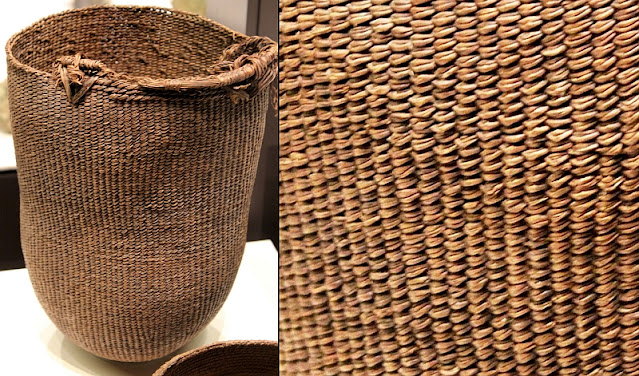
LEFT: Basket RIGHT: Detail of basket
 LEFT: Mat fragment. RIGHT: Detail of mat fragment.
<https://commons.wikimedia.org/wiki/File:Fragmento_de_estera._Neol%C3%ADtico._Museo_Arqueol%C3%B3gico_Nacional_de_Espa%C3%B1a.jpg>
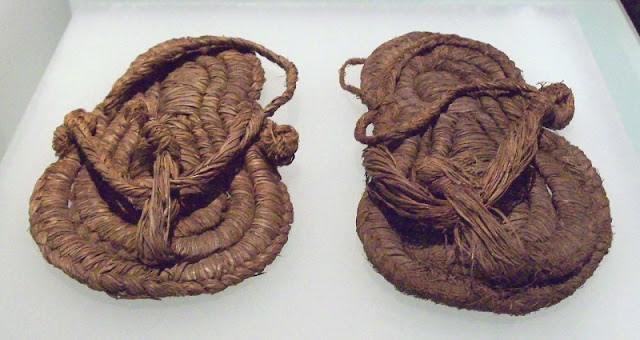
Neolithic Sandals

LEFT: Recreation of a Neolithic snail basket,
a traditional basket for collecting and gathering snails
RIGHT: Detail snail basket
a traditional basket for collecting and gathering snails
RIGHT: Detail snail basket
There are also many ways of processing the esparto plant and many ways of weaving the plant for various purposes which show the depth of knowledge people had.


