Thursday, October 24, 2013

Part 2: Science vs. Faith, Religion and Belief

Get the free 2-year set of blogs from DeconstructingTime in a PDF eBook. 
Click now to view a PDF version online and/or to download the PDF file.

Please read my first blog on this subject, Part 1, in which I explain the fundamental connection between science, faith, religion and belief.
science-vs-faith-religion-and-belief.html

What do this and my previous blog have to do with time? Quite simply time is often at the center of disputes between religion and science. The scientific discovery that the Earth was billions of years old and humans millions of years old upset the accepted religious understanding as interpreted from the Bible, for example. At the same time religion often spoke/speaks of a supreme being who lived in a world independent of time or spoke about immortal gods or spiritual realms outside of time -- concepts which scientists often dismissed.
Religion and science go together. As I've said before, science without religion is lame and religion without science is blind. They are interdependent and have a common goal -- the search for truth. Hence it is absurd for religion to proscribe Galileo or Darwin or other scientists. And it is equally absurd when scientists say that there is no God. The real scientist has faith, which does not mean that he must subscribe to a creed. Without religion there is no charity. 
Albert Einstein
It is also important to remember that the classic battle between science and religion, i.e., the arrest and imprisonment of Galileo by the Catholic Church was not religion vs. science but rather a battle between two different scientific theories. Yet this battle seemed to set the stage for today's conflicts between religion and science, such as those involving human evolution and the Big Bang Theory.


The Earth centered, geocentric, system held that the Earth was at the center of the Universe. Refined by Ptolemy it was quite accurate.  (Wikimedia.org)
Galileo promoted the new idea that the Earth revolved around the Sun while the Catholic Church held with the earlier scientific theory that the Earth was at the center of the solar system, known as geocentric. The older theory had been in place for about two thousand years; in addition, over the centuries, this Earth centered system had been refined to be quite precise with the Ptolemaic model. It was not nonsense (as some modern commentators have stated) but good science in that it explained the movement of the sun, moon and planets very well up to a point. 
http://en.wikipedia.org/wiki/Geocentric_model

And while not widely known, the geocentric system is still useful and used today under various circumstances:
The geocentric (Ptolemaic) model of the solar system is still of interest to planetarium makers, as, for technical reasons, a Ptolemaic-type motion for the planet light apparatus has some advantages over a Copernican-type motion. 
http://en.wikipedia.org/wiki/Geocentric_model
Zeiss Planetarium Projector in Montreal. (Wikimedia.org)
It is also used by NASA when it makes some calculations easier. 


NASA uses the Geocentric Solar Ecliptic (GSE) system for some applications. The GSE is now the preferred system for depicting vector quantities in some space physics situations. (Wikimedia.org)  
The conflict between science and religion is often one of older ideas or an old science vs. new concepts. Ideas once held by religion such as lightning bolts being thrown by an angry god have been replaced by a scientific understanding of electricity in the atmosphere. Few people would argue with this today. As a result some ideas in religion need to give way to well established scientific understandings.
It can scarcely be denied that the supreme goal of all theory is to make the irreducible basic elements as simple and as few as possible without having to surrender the adequate representation of a single datum of experience.
Albert Einstein
Science, on the other hand, needs to acknowledge that it cannot know everything. There is a limit -- as I have suggested in my earlier blog. Science, for example, relies on its ability to measure. Measurement is at the heart of the scientific method. Yet there are things, critical things, that cannot be measured.
Measure what is measurable, and make measurable what is not so. 
Galileo Galilei 
Everything that can be counted does not necessarily count; everything that counts cannot necessarily be counted. 
Albert Einstein  
 I do not believe that science can explain, for example, why there is such wide ranging diversity in the Universe if the Universe is solely governed by predictable laws.

Every snowflake, every person, every galaxy is unique. If this were simply a scientific world of laws of cause and effect, then it would also be a cookie cutter world of duplicate people and galaxies -- a Universe of clones. Yet it is our uniqueness that science cannot explain, which is essential to life and a fundamental mystery.


Snow crystals photographed by William Bentley (wikimedia.org). While subatomic particles, the building blocks of nature, are exactly alike, and water molecules are, for the most part, exactly alike, every snow crystal is different. "The water molecules in an ice crystal form a hexagonal lattice..." "it is indeed extremely unlikely that two complex snowflakes will look exactly alike"  http://www.its.caltech.edu/~atomic/snowcrystals
And there is more. The diversity in the Universe is a delicate balance. Too much diversity would cause galaxies to shred apart and many people would be born with three eyes. It appears that the Universe has just the right mix of predictable laws along with a sprinkle of diversity that seems to defy those laws.

We know with nature, in particular, that diversity is a survival strategy. Diversity gives a species the advantage of responding differently to changing environmental conditions, for example.  
Evolutionary processes give rise to diversity at every level of biological organisation, including species, individual organisms and molecules such as DNA and proteins. 
http://en.wikipedia.org/wiki/Evolution
This principle of change or movement prevents nature from ever really repeating herself... 
The History of Scientific Ideas, Charles Singer 
Even something as simple as green seaweed as seen through the natural mosaic of endlessly diverse water surface ripples shows the infinite variations created by nature.  (Wikimedia.org)
The soul given to each of us is moved by the same living spirit that moves the universe. 
Albert Einstein
This idea was also expressed by the poet/painter/photographer who went by the name of Wols. In 1944 when looking out at the Mediterranean at Cassis, France, he wrote:

... eternity
in the little waves of the harbor
which are always the same without being the same...
All loves lead to one love, and
beyond all personal loves,
there is the nameless love,
the great mystery,
the Absolute,
X
Tao
God
the cosmos ...

Wols (Alfred Otto Wolfgang 
Schulze)  Watercolors, Drawings, Writings by Wols


 (Wikimedia.org)

To see a World in a Grain of Sand
And a Heaven in a Wild Flower,
Hold Infinity in the palm of your hand 
And Eternity in an hour.
William Blake


Electron microscope photograph of an "antenna of common wasp, Vespula vulgaris" magnified 3000 times. Scale is about 30 micrometers or about 1/1000 of an inch. (wikimedia.org)

The Millennium Simulation, an extremely sophisticated computer simulation of the large structure of the cosmos -- showing the filaments that the Universe is made of -- is a "model... of the Universe in a cube over 2 billion light years on a side, holding 20 million galaxies." (wikimedia.org)

See a full video of the structure of the Universe, the largest detailed structure ever visualized by humans based on scientific data put together by the 
Max-Planck-Institute for Astrophysics.   


Friday, October 4, 2013

Science vs. Faith, Religion and Belief


Scientists often scoff at what they call 'primitive belief systems' such as those with medicine men and shamans. Yet the roots of science come from the same  fundamental human impulses that formed these beliefs.
All religions, arts and sciences are branches of the same tree. 
Albert Einstein
For example, history of science professors James E. McClellan and Harold Dorn wrote, “In the case of Neolithic astronomy, we are dealing not with the prehistory of science, but with science in prehistory.”

And going back even further to animistic beliefs, the roots of science are still visible. 
"Animism" is said to describe the most common, foundational thread of indigenous peoples' "spiritual" or "supernatural" perspectives.Animism encompasses the belief that there is no separation between the spiritual and physical (or material) world, and souls or spirits exist, not only in humans, but also in some other animals, plants, rocks, geographic features such as mountains or rivers, or other entities of the natural environment, including thunder, wind, and shadows.
Wikipedia
The return of the Pleiades every year was a major event in many cultures as it often marked the beginning of the rainy season and for some was the beginning of the new year. Since there was a distinct seasonal change when it appeared, it was also given godlike powers and treated with reverence in many religions. According to Wikipedia, the Pleiades was known to "the Maori, Aboriginal Australians, the Persians, the Chinese, the Japanese, the Maya, the Aztec, and the Sioux and Cherokee." as well at the Greeks. When the Pleiades first appeared in the night sky -- which lasted only a few minutes at the beginning of its annual reappearance -- indigenous tribes often greeted it with wild celebrations. Yet their ability to mark time was sophisticated enough that they knew exactly when to look for the Pleiades -- even though appeared over the horizon very briefly at first. (Wikimedia.org)
 (Wikimedia.org)
The time of the rains was announced to the Hottentots by the rising Pleiades, whose reappearance was hailed at the annual festival. The first missionary to the Khoi-Khoi, George Schmidt, (1737), relates that, 'At the return of the Pleiades these natives celebrate an anniversary; as soon as these stars appear above the eastern horizon, mothers will lift their little ones on their arms, and running up to elevated spots will show to them those friendly stars, and teach them to stretch their little hands towards them. The people of a kraal will assemble to dance and sing according to the old customs of their ancestors. The chorus always sings, "O Tiqua! our father above our heads, give rain to us, that the fruits (bulbs, etc.), may ripen, and that we may have plenty of food and a good year."' 

It is now believed that the 1600 BCE Bronze Age Nebra Sky disk, with pictures of the sun, moon and Pleiades was used astronomically to determine the fall and spring solstices and also had religious importance. (Wikimedia.org)
An essential part of many animistic religions was the role of the shaman. 
Shamanism among Eskimo peoples refers to those aspects of the Eskimo cultures that are related to the shamans’ role as a mediator between people and spirits, souls, and mythological beings. Most Eskimo groups had such a mediator function, and the person fulfilling the role was believed to be able to command helping spirits, ask mythological beings to ... enable the success of the hunt, or heal sick people by bringing back their "stolen" souls.
Wikipedia
The above definition of the role of the shaman is not unlike the Greek hero: 
In Greek mythology heroes are regarded as mediators between gods and mortals...
presentationsistersunion.org
Tylor, the anthropologist who coined the term animistic, was quite condescending:
Tylor believed that animistic beliefs were "childish" and typical of "cognitive underdevelopment", and that it was therefore common in "primitive" peoples such as those living in hunter gatherer societies.
Wikipedia
And what does all this have to do with science? Well, it's really quite simple, but hard to see from our modern technological and scientific perspective: 


In the beliefs of all cultures 
-- from the most 'primitive' to the most modern -- 
across the globe, there was/is an underlying uniquely human logic: 
There are forces outside of human beings 
which can be known 
and once known can be influenced.

This idea is so much a part of us and our cultures that we take it for granted. And more than that, we are still driven to better understand these outside forces and to learn how these forces can be tamed or used to our benefit.

This idea is at the heart of science. Rather getting the help of a shaman or making offerings to gods and goddesses, with science we now look for laws of nature which once understood can often be controlled or harnessed for our own good. But the basic impulse is the same.

And BTW just how far removed is science from previous ideas about gods and goddesses? 

Commenting on the Western fascination with technology and science, Dr. Eugen Weber in his conclusion of the entire history of the West (52 1/2 hour lectures) pointed out the importance of Greek mythological ideas which led to today's obsession with modern technology. Weber believed that modern science is, in a sense, stealing fire from the gods and putting this power that the gods formerly controlled into our own hands.
Really when you think about it, our patron saint is Prometheus who stole fire from the gods.
Eugen Weber
Professor of History, UCLA

Public Television Series

The Western Tradition
However, science was designed to answer some questions but not others. 
Science, natural philosophy, proceeds on the information given by the senses. This line of its attack is thus limited and we cannot hope that anything but limited objectives can be reached. Science does not profess to solve ultimate problems. On the other had it does seek to solve its limited problems with a known degree of accuracy and a known margin of error.
Charles Singer
A History of Scientific Ideas
There are many things beyond our understanding -- and always will  be beyond our understanding -- which is the realm of religion. And yet there are things that we now do understand -- such a earthquakes, storms and disease -- that used to be part of religion. Nevertheless science will always be limited and religion will always speak to that part of our soul that craves a connection to a huge universe that fills the sky  with hundreds of billions of galaxies that contain hundreds of billions of stars.

It is also important to note that the father of the Big Bang theory was a Catholic Priest,  Georges Lemaître -- so a religious view point led directly to our modern understanding of the creation of the Universe.
Lemaître explored the logical consequences of an expanding universe and boldly proposed that it must have originated at a finite point in time. If the universe is expanding, he reasoned, it was smaller in the past, and extrapolation back in time should lead to an epoch when all the matter in the universe was packed together in an extremely dense state. ...Lemaître argued that the physical universe was initially a single particle -- the “primeval atom” as he called it -- which disintegrated in an explosion, giving rise to space and time and the expansion of the universe that continues to this day. 
www.amnh.org
In 1931 Georges Lemaître, a Catholic Priest, was the first to propose that the Universe began with the Big Bang. (Wikimedia.org)
In a recent article in the New York Times, a scientist, Adam Frank, bemoaned the fact that the truths of science such as evolution theory were not more widely accepted:
"This is not a world the scientists I trained with would recognize. Many of them served on the Manhattan Project. Afterward, they helped create the technologies that drove America’s postwar prosperity." Yet as we know, the Manhattan project brought us the ever present threat of nuclear war as well as nuclear reactor accidents  -- so perhaps a blind faith in science is not always a good idea.

Science and the institutions of science should not become a kind of unquestionable priesthood that is as inflexible as the Catholic church of the 1600s that tried and imprisoned Galileo.
Charles Singer
A History of Scientific Ideas
Knowledge for knowledge sake has created an imbalance in our worldview. Human knowledge should progress evenly on all fronts. When our understanding of the physical universe far surpasses our understanding of ourselves a great disequilibrium occurs. It isn't as though we don't need to know all this stuff. It is simply that there are other things we need to know in order to make sense out of all this physical knowledge we have gathered. 
Dr. John M. Artz 
 (Wikimedia.org)

As you look through the veil of stars in our Milky Way Galaxy to our companion galaxy, Andromeda -- with its billions of stars aligned in a majestic order -- it is hard to not believe in something much greater than ourselves. If you ever get a chance, look at it through a telescope. It will take your breath away.

A religion old or new, that stressed the magnificence of the universe as revealed by modern science, might be able to draw forth reserves of reverence and awe hardly tapped by the conventional faiths. Sooner or later, such a religion will emerge.
Carl Sagan

Tuesday, September 24, 2013

The Limits of Our Scientific Knowledge


True wisdom is knowing what you don't know.
 Confucius
As I pointed out in my birthday blog, we have come a long way baby in the last 50 years. Our understanding of the Universe today is far ahead of our mid-20th century ideas.

However, there are limits. And, moreover, there will always be limits. The idea of limitations is hard to accept. But oddly, once we accept these limits we may be able to see much farther.

Let me explain: 

Some ideas about limits are already part of science such as Heisenberg's "Uncertainty Principle" that asserts we can know the position of a particle or its momentum, but not both at the same time. 
...the uncertainty principle is any of a variety of mathematical inequalities asserting a fundamental limit to the precision with which certain pairs of physical properties of a particle...can be known simultaneously.
Wikipedia
And this just scratches the surface. Today with our advanced understanding of the Universe -- the Big Bang and all that -- we now realize how little we know. Our current understanding is based on astronomy in the visible light spectrum -- i.e., ordinary matter, meaning things like us, the Earth, the Solar System and the galaxies -- which makes up only 4% of the Universe. Most of the Universe, that is 96%, is not visible or easily measurable and quite mysterious, such as dark matter and dark energy. Today astronomers have no idea what these are.

So limits are a part of science. But there is still more.
Science does not rest upon solid bedrock. The bold structure of its theories rises, as it were, above a swamp. It is like a building erected on piles. The piles are driven down from above into the swamp, but not down to any natural or 'given' base; and when we cease our attempts to drive our piles into a deeper layer, it is not because we have reached firm ground. We simply stop when we are satisfied that they are firm enough to carry the structure, at least for the time being.
Karl Raimund Popper, The Logic of Scientific Discovery
I believe that all our ideas, mathematical formulas and even our perceptions are limited and limited by our humanity. Everything we understand and all our knowledge  is based on concepts thought up by humans.  For example, humans invented the notions of gravity, acceleration and space-time. And while these ideas are useful, they may only be scratching the surface of *REALITY*.


Could Even Our Perceptions Be Limited?

In a famous example, the Ames trapezoid when rotated continuously in a circle is seen as a rectangle that oscillates back and forth by Westerners, but not by those in other cultures. It appears that Westerners are so used to seeing a trapezoid as a perspective drawing of a rectangle, they cannot see a real trapezoid when it is presented to them. I challenge you to see the following YouTube video as a rotating trapezoid.


It is as though our human understanding is and will always be surrounded by a thin film. Or to use another metaphor, human investigators will always be wearing gloves. We can grasp many objects with these gloves and see many marvelous things  through this film. but we will never be able to hold these things in our bare hands or see them directly without the film being in the way.  

Gravity is a good example: We know how gravity operates, but we do not know what it is -- yet it holds the entire Universe together and without it there would be no Earth or Solar System or Universe. Newton was able to describe this force precisely so  that we can now predict the tides and send rockets to the moon. Einstein was able to add significantly to these ideas with the concept of space-time. Yet we still have no idea of the fundamental nature of gravity. See the USA NASA article about gravity.

How does all of this relate to time, which is the subject of this blog? As I have said, we are surrounded by time, submerged in time -- there is nothing that exists independent or apart from time. 

When Newton had his great revelation about gravity -- when he watched an apple fall and then looked at the moon orbiting the Earth -- he was able to move his imaginary perspective out into space and see that these two seemingly different forces were the same -- both were a result of gravity. 

Yet when considering time, we cannot move our point of view out beyond time -- time is always there.

Anthropologists know that each person's culture will always be part of their point of view. There is no getting around this -- even trained scientists may not realize their own cultural bias. Yet this awareness -- that when a culture is studied the observations by an outside anthropologist may be biased -- results in better data and better ideas.

While Einstein was able to see further than any other scientist of his time, he was also keenly aware of his limitations.
Once we accept our limits, we go beyond them. 
Albert Einstein
If we want to understand time, then we must realize we are bounded by time from the moment we are born to the moment we die. Many if not most of our human ideas about time come from our human experience.

Thursday, September 19, 2013

Pure Speculation About the Physics of Time


While the focus of this blog is the human experience of time, I could not help wondering about quantum mechanics and Einstein's ideas. 

While I admit to being a rank amateur when it comes to modern physics, I have taken 6 semesters of physics and also 6 semesters of higher math, i.e., algebra, trigonometry and calculus.

So at the risk of getting way over my head, the following idea occurred to me as I worked on this blog.

#1. Everything is in motion

Atoms vibrate, your heart beats, your blood flows, the Earth turns on its axis, the Earth circles the Sun, the Sun's hydrogen atoms become helium atoms in a fusion reaction, the Solar System orbits around the center of our Milky Way Galaxy, our galaxy is moving toward the Andromeda Galaxy, and the Universe itself is expanding. Nuff said.

#2. Motion by definition requires time

Merriam-Webster's dictionary defines motion as "an act, process, or instance of changing place" and changing place can only happen over time. Since motion means that something went from one point to another, movement can only happen during a period of time. 

#3. Time is part of matter, not separate from it

Since time is a requirement of movement and everything moves -- from atoms to the Universe -- it is quite likely that time itself is an integral part of matter, not just something that exists separately from matter. In other words time is not something that matter moves through, time is an essential element of matter.

#4. A concept of matter-time might bring new insights

While most of us have gotten accustomed to the Einsteinian term 'space-time', we might want to consider a new term, 'matter-time'. And if time were factored into the equations of modern physics as part of matter, the results might be quite interesting.


Sunday, September 15, 2013

Free eBook: The Story of the Big Bang for Children

The Big Bang for Children:
A Modern Creation Story
Based On the Latest Scientific Knowledge

For a limited time you can download my eBook for children for free. Children can view it on their iPads, tablets, computers and cell phones. There are no strings attached -- I do not want your email address or anything else -- just download the eBook, open it  and enjoy!

Here is the download link for this eBook:


At the bottom of the following page, you will also find links to free eBook readers; there are free eReaders for just about any computer, tablet or cell phone.


My eBook maps out the billions of years it has taken for the universe to evolve into its present form and for humans to populate the Earth. So don't just think of this as a children's eBook since adults will learn a few things too. 

Children who are exposed to these basic scientific ideas will be given the gift of time -- that is they will be given an understanding of time. I believe they will become more grounded, as they will comprehend better the long history and process that has led to civilization today.

And while my story starts with the Big Bang, it continues up to the beginning of human civilization,


I wrote this book because I felt there was a need to explain the scientific view of the universe, as we now understand it, in simple terms. And I also felt that children could grasp these ideas more easily at a young age and perhaps understand even better than adults the incredible beauty of cosmos.

Other thinkers and scientists have expressed a need for such a story.

A religion old or new, that stressed the magnificence of the universe as revealed by modern science, might be able to draw forth reserves of reverence and awe hardly tapped by the conventional faiths. Sooner or later, such a religion will emerge.
Carl Sagan
...people everywhere are searching, asking: What is the new mythology to be, the mythology of this unified earth as of one harmonious being?
Joseph Campbell
 A page from my eBook: The Big Bang for Children 


Saturday, August 17, 2013

Limited Time: Free eBook, Deconstructing Time


You can download the first six months of this blog, Deconstructing Time, in a 200+ page fully illustrated eBook format. 


For a limited time, the download is free. 
No strings of any kind.


To download this eBook immediately, click on this link:
http://rickdoble.net/ebooks/doble_rick_deconstructing_time_final.epub

The book is in epub format, which is the standard and most common format for eBooks.  Free eReaders are available for most computers, tablets and cell phones from Sony, Adobe and Barnes & Noble. If you do not have an app that views this type of eBook, I have listed a number of links to free eReaders at the bottom of the following page: 
http://rickdoble.net/ebooks/index.html#ereader

Once you have installed the eReader, simply drag and drop the eBook file onto the eReader and the book will open up.

Putting the first 6 months into an eBook, allowed me to change the order of these blogs, and to create a more coherent organization. The sections now are:


Introduction
Understanding Time
The Past
The Present
The Future

In my introduction, I wrote:

We are immersed in time. We take time as a fact of life and think very little about its workings, yet we are at its mercy. In a sense time is all you have: on your gravestone will be your name and the date you were born and the date you died. 

What could we gain by obtaining a perspective, by standing a bit outside of time? Although the clock will still continue to tick, your relation to time will be changed. It is the modern human -- i.e. Homo sapiens sapiens -- sense of time that is the key difference between humans and other animals. And further I believe that time, as we experience it, is created by our uniquely human brains and is critical to our sense of consciousness.


Wednesday, July 24, 2013

A Day in My Life -- The Birthday Cycle


Like sands through the hourglass, so are the days of our lives. :)
Quote from the opening of the long running soap opera, Days of our Lives
Today on my birthday, having turned 69 years old and now staring 70 in the face, I marvel at our current human understanding and our moment in time.

While it is fashionable to complain about the troubles of our day, from a historical perspective, we live in a remarkable time.

Today science has confirmed what seemed impossible just a few short years ago: that the universe began with the Big Bang -- starting from something smaller than an atom. And we have cracked the code of life with DNA, mapped the human genome and know where we as humans came from -- we evolved from tiny microorganisms. We now know that there are more than a hundred billion galaxies each with a hundred billion stars. And we have landed humans on the Moon, landed robotic instruments on Mars and explored all of the planets with our probes. Plus taking half of my lifetime, the Voyager 1 spacecraft just became the first man-made object to go beyond the edge of the solar system and into interstellar space (see photos at the bottom).


Planck Satellite Image: A map of the entire universe; this is a map of the Cosmic Microwave Background Radiation (CMBR) from the Big Bang. (NASA)

Electron microscope photos of microscopic organisms that led, over billions of years, to the human species. (commons.wikimedia.org)
If a person had suggested any of these ideas at the time I was born, they would have been labeled off-their-rocker. To suggest that all these things could be true would have been total madness.


At age 13, I made a notebook. I essentially copied drawings from George Gamow's book One Two Three ... Infinity in which he explained time & space-time in diagrams and terms I could understand. (Rick Doble)
Yet this is the brave new world we find ourselves living in. In short, we can see where we came from, how we got here and where we are going -- answering all those childish questions. 

When I was growing up, I did ask these questions, but there were few answers -- only doomsday forecasts about the future. Books and movies like On the Beach or Dr. Strangelove envisioned a world in which no one survived a nuclear war. Others such as Orwell's 1984 imagined a world of 'no exit' in which the individual would be crushed. Huxley's Brave New World foresaw a well ordered but quite Draconian and sterile modern civilization. 

Today there are regional wars and conflicts, but the World Wars are memories. Thousands of years of prejudice and intolerance also seem to be on the decline. In the 1960s I was in the Civil Rights Movement as a white guy and never thought I would see the day when a black man would be nominated for president -- yet he was elected and reelected. 


That's really me in the Civil Rights Movement, in Chapel Hill, NC, 1963. I am on the far right, in front, holding up the end of the banner. (NC State Government)
 Just 60 or so years ago, when I was born, women were essentially second class citizens. Women did not go to college. A woman was expected to be a housewife or, if she wanted to work, be either a secretary, a nurse or a teacher -- those were the only choices. So today, this is perhaps the most important social change: the unequal treatment of women is fading.

Plus we are on the verge of creating a truly global culture that recognizes we are all citizens of the Earth. Yet at the same time we can be loyal to our own nation and traditions while respecting others whose nations and cultures are different.


Electric lights at night on the Planet Earth -- showing the extent of human civilization and development. (commons.wikimedia.org)
Okay -- I get it -- the world is not perfect and never will be. The environmental problems will take all of our attention for the next several hundred years, I believe. The inequality of world living standards may take just as long. And very soon there will be more people on the Earth than the Earth can reasonably sustain, according to the United Nations.

But today, like never before, we have developing technologies that could solve many of these problems -- imagine low cost electricity from decentralized solar panels, for example. 

And it is quite certain that as our technology improves we will explore our solar system and beyond -- that the human race will continue, expand and survive.

So today we stand on a mountain top where we can see where we have come from and where we are going. The view from here is really stunning. Lets take a moment and enjoy the scenery -- let the *now moment* take over and be glad we were given this gift.


A Titan rocket takes off with Voyager 1 in 1977. (commons.wikimedia.org)

Series of photos taken by Voyager 1 as it approached Jupiter -- which were turned into a time-lapse GIF image. (commons.wikimedia.org)

Color photo of Jupiter's atmosphere, sent back by Voyager 1.  (commons.wikimedia.org)

Diagram that shows where Voyager 1 is now (2013) in relation to the solar system. It is the first man-made object to leave our sun's system and go out into interstellar space.  (commons.wikimedia.org)

Friday, June 28, 2013

The History of the Future


Before we could go to the moon, we had to imagine that we could go to the moon.

This 'work of the imagination' was essential to finding the will, the funds, the talent and the tenacity to accomplish this task. And while the moon mission was accomplished with state-of-the-art technology, the fundamental thrust that led to the moon launch was one of collective imagination.

In this blog-article I will use the moon mission as an example of how ideas move from fiction to reality, how the future can be shaped by human beings -- and how this might apply to ideas that we are coping with today, such as global warming.

In 1865 Jules Verne wrote the novel From the Earth to the Moon followed by a sequel. Using available data, Verne made a number of calculations so that his story would be as realistic as possible. Surprisingly many of his predictions were quite accurate.
In the following illustrations you will see remarkable similarities between the imaginary ideas of sci-fi visionaries and the actual space travel equipment used and space environment encountered many years later.
During the return trip to Earth on July 23, 1969 after the first landing on the moon, astronaut Neil Armstrong said, "A hundred years ago, Jules Verne wrote a book about a voyage to the Moon. His spaceship...took off from Florida and landed in the Pacific Ocean after completing a trip to the Moon." Which was exactly what Armstrong's first moon mission, Apollo 11, had done and was about to do.

TOP: Still from the Méliès 1902 sci-fi film: A Trip to the Moon. Based on Jules Verne's story, the space command module landed in the ocean and then was tugged to shore by a paddle wheel steam ship.  (commons.wikimedia.org) BOTTOM: Helicopter from the ship the USS Hornet picks up the astronauts from the Apollo 12 mission. The splashdown of the astronauts was in the Pacific Ocean as Verne had predicted a 100 years earlier. (NASA)
There was a bit more that 100 years between Jules Verne's novel and the actual moon landing (1865-1969). It took this long for the collective imagination to accept that such a venture was possible and then to commit to a long term program. Even then it took the cold war between the United States and the Soviet Union to force the issue, as the race to the moon became a competition between the two countries.

But I am getting ahead of the full story -- during those 100 years, there were a number of steps both forward and back. Yet in the end the public's imagination had been captured.

In 1902 Georges Méliès produced the first science fiction movie, A Trip to the Moon. It was based on Verne's novel and also H.G. Wells novel The First Men in the Moon. It employed special effects and animation -- and sent the public's imagination into outer space.


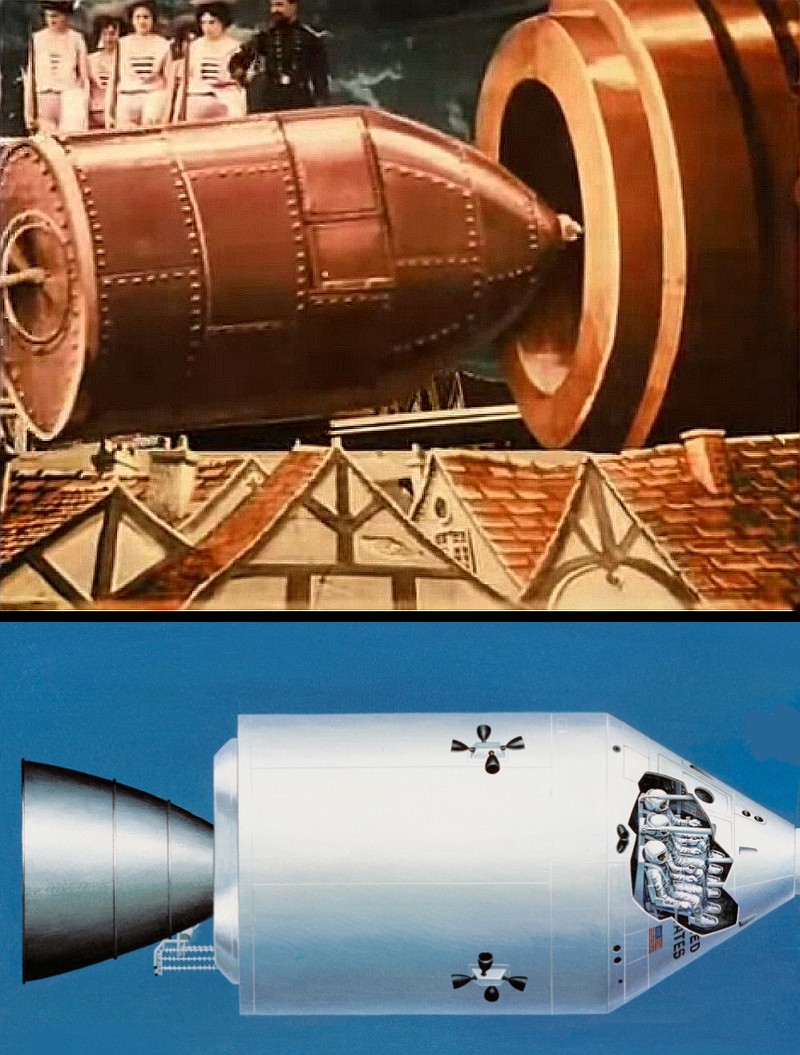
TOP: Still from the Méliès 1902 sci-fi film: A Trip to the Moon. The command module that holds the astronauts was inserted into a super-gun to send it to the moon. (commons.wikimedia.org) BOTTOM: A 1964 NASA drawing of the command module that would take astronauts to the moon. The similarity in the shape between the 1902 film fantasy and the actual NASA design is remarkable. (NASA)
Apollo 17 command module floating above the moon in 1972. Notice the similarity in shape and even the similarity in construction between the module in the Méliès 1902 sci-fi film: A Trip to the Moon (above) and the actual module that went to the moon. (NASA)
LEFT: Still from the Méliès 1902 sci-fi film: A Trip to the Moon. The Earth people (left) who have landed on the moon watch the Earth floating up in the sky. (commons.wikimedia.org) RIGHT: Known as 'Earthrise' this shot by an Apollo astronaut shows the Earth floating above the moon's surface. (NASA)
In 1898, at the age of 16, Robert Goddard read H.G. Wells' The War of the Worlds which inspired him to think about space flight. He began to experiment with rocketry and by 1914 had registered two of the key patents for successful rocket flights -- a multi-stage rocket design and a liquid fuel method of propulsion. 

In 1924 Robert Goddard illustrated how a rocket could reach the moon from the Earth. (commons.wikimedia.org) 
But soon he hit a brick wall known as the media. When he suggested that a rocket could go to to the moon, the New York Times printed the following unsigned editorial, ridiculing his ideas. 
That Professor Goddard, with his "chair" in Clark College and the countenancing of the Smithsonian Institution, does not know the relation of action and reaction, and of the need to have something better than a vacuum against which to react -- to say that would be absurd. Of course he only seems to lack the knowledge ladled out daily in high schools. 
Unsigned editorial, New York Times, January 13, 1920
This condescending yet ignorant opinion from the prestigious New York Times dealt the idea of a moon mission a severe blow as others in the American press took the cue and also mocked his efforts. (In 1915 Goddard had tested his rockets in a vacuum and had proven that they worked.) As a result Dr. Goddard's work lost credibility in the US and was virtually ignored.
Don't you know about your own rocket pioneer? Dr. Goddard was ahead of us all.
Wernher von Braun, the key German and later US rocket scientist who designed the Apollo Saturn rockets that sent men to the moon
Nevertheless, the public's fascination only continued to grow as it began to envision a world in space. Science fiction stories about rocket and space travel continued in movies, magazines, comics, books and on radio and television from the 1920s through the 1950s -- although without much attention or respect from the authorities. 

A number of movie serials (shorts shown every week before the main feature) were quite popular such as the Flash Gordon and the Buck Rogers film series. During the radio era, there were shows such as Dimension X and X Minus One, devoted to thoughtful adult science fiction plots. The popular Twilight Zone TV series in the early sixties often featured well crafted stories about space travel. Even the notorious tail-fins on 1950s American automobiles were based on rocket fins.
This pop phenomenon [ED: of Buck Rogers] paralleled the development of space technology in the 20th century and introduced Americans to outer space as a familiar environment...
wikipedia.org/wiki/Buck_Rogers


LEFT: In a 1929 story, Buck Rogers in a future world watches a TV-like screen while operating controls. (commons.wikimedia.org) RIGHT: A NASA lead space flight officer keeps track of information coming from a space mission in 2009. (NASA)
The dream of yesterday is the hope of today and the reality of tomorrow.
Robert Goddard

Cover from Amazing Stories magazine in 1947. (commons.wikimedia.org)
In the early 1950s German-turned-US rocket expert Wernher von Braun wrote a series of articles for Collier's magazine called  Man Will Conquer Space Soon! and collaborated with Walt Disney Studios on TV films about space exploration which drew large audiences. 


1953 cast photo for the popular ABC TV sci-fi space adventure series: Space Patrol.  (commons.wikimedia.org)
On October 4, 1957, the Soviet Union launched Sputnik, the first man made satellite. The successful launch of the rocket and then the deployment of Sputnik meant the Soviets were far ahead of the United States in rocketry.


A replica of of Sputnik in the National Air and Space Museum. (NASA)
This prompted President Eisenhower to create NASA (The National Aeronautics And Space Agency) in 1958. As a former general and the Supreme Allied Commander of Allied Forces in World War II, he deliberately created an agency that was independent and separate from the military and that would have a peaceful and scientific orientation. Three years later President Kennedy committed NASA to a moon landing.
I believe that this nation should commit itself to achieving the goal, before this decade is out, of landing a man on the Moon and returning him safely to the Earth. No single space project...will be more exciting, or more impressive to mankind, or more important...and none will be so difficult or expensive to accomplish...
President John F. Kennedy, 1961
Kennedy announcing his plans to fund a moon mission in a speech to the US Congress in 1961.
While couched in peaceful terms, the space race was in effect an arms race between the two most powerful countries -- which was a key reason why the public supported the cost of this program. 


LEFT: Robert Goddard in 1926 with an early rocket. The rocket was held in the middle of a frame until it was fired. RIGHT: The Apollo 11 rocket that took astronauts to the moon in 1969. (NASA)
When Neil Armstrong stepped down onto the moon's surface on live TV in 1969, it was a moment that most people will never forget. I certainly never have. And although the Apollo program ended 40 years ago, the International Space Station (ISS) is now part of everyday life. Among young people, the hunger for further exploration has only begun -- with a Mars mission in the foreseeable future along with planned landings on asteroids. Now that we know space travel is possible, the thirst to explore will only keep growing.


Live TV shot of Neil Armstrong taking his first step onto the moon on July 20, 1969. (NASA)
Neil Armstrong took this photograph of his fellow astronaut Buzz Aldrin during the first lunar landing. Armstrong is reflected in Aldrin's face mask. (NASA)
In hindsight, the creation and success of the moon mission was a century long effort which took imagination, technology and a cold war threat to become a reality. And once the goal of landing on the moon had been achieved, there was little public support for more expensive manned space exploration projects.
Fast forward to today and our future: While global warming poses a great risk, it does not have the same hold on our imaginations. But we have been through this before. 

During the energy crisis in 1977, President Carter said that curtailing our energy imports and reducing our energy use, was the "moral equivalent of war." This phrase was borrowed from  William James in 1906. "James considered one of the classic problems of politics: how to sustain political unity and civic virtue in the absence of war or a credible threat..." (Wikipedia.org) As we know, Carter was not successful in convincing people of the seriousness of the threat and as a result lost the presidency and the effort to make the US less dependent on foreign oil. 

If we are to deal with global warming, we must give it the same urgency as war.

As I wrote over ten years ago in my essay entitled The World Environmental Crisis Today (which is/was ranked in the top ten search results from Google for most of those ten years):
As Hans Blix, the United Nations weapons inspector before the second American-Iraq war, has pointed out, these environmental questions are much more dangerous than weapons of mass destruction.
Rick Doble
In hindsight, the moon mission, gave us something few of us had imagined:  It showed dramatically that Earth was our home -- for all of us together. Seeing it alone in empty space evoked a sense of awe and a global perspective -- that could only have been achieved by viewing the Earth from tens of thousands of miles in outer space.


This photograph of the Earth, known as Blue Marble, was taken during the last manned lunar mission in 1972 from a distance of about 20,000 miles (about 32,000 km) from Earth. (NASA)
We went to explore the Moon, and in fact discovered the Earth.
Eugene Cernan (Apollo Astronaut)