Showing posts with label cognition. Show all posts

Monday, May 11, 2020

New Ideas About the Old Stone Age

New Ideas About the Old Stone Age
and Human Evolution


Drs Sonia Harmand & Jason Lewis
Rewrite The Story of Human Evolution


Overturning widely held beliefs with new evidence

ABSTRACT:
Preconceptions often stand in the way of new discoveries. This article discusses the problems with widely held assumptions and then provides examples of assumptions that were recently overturned and which have now led to a possible new understanding of human evolution. Drs Sonia Harmand & Jason Lewis found stone tools much older than the generally accepted earliest Oldowan tools in a wooded terrain rather than the generally accepted savanna environment. They also hypothesized that the tools were made by an earlier hominid, Australopithecus, who had not been considered a likely candidate for stone tool making. And finally, they proposed a new understanding relating to the evolution of the human brain. Instead of assuming that it was a larger brain that kick-started human tool making, it may, instead, have been the prefrontal cortex.


When the paintings in the Cave of Altamira in Spain were made public, experts assumed that primitive man was not capable of such skills and therefore rejected their authenticity. 

INTRODUCTION
Men who have excessive faith in their theories or ideas are not only ill-prepared for making discoveries; they also make very poor observations. Of necessity, they observe with a preconceived idea, and when they devise an experiment, they can see, in its results, only a confirmation of their theory. In this way, they distort observations and often neglect very important facts because they do not further their aim.
Bernard, Claude. An Introduction to the Study of Experimental Medicine (1865). New York: Dover Publications, Inc., 1957.  
As I have written before, assumptions often stand in the way of scientific facts. Often these ideas are hidden or embedded in a way of thinking. And because of that, they are hard to identify.

EXAMPLES OF ASSUMPTIONS

When I have read about the earliest known (that is the earliest until now) stone tools, the Oldowan tools, I have consistently come across descriptions of the technology as simple or crude

-- "The extreme crudeness of most Oldowan choppers"[1]
-- Oldowan were "crude stone tools, essentially broken river cobbles"[1]
-- "Oldowan industry, toolmaking tradition characterized by crudely worked pebble (chopping) tools"
-- "The tools...are chipped in two directions to form simple, rough, all-purpose tools."[2]
-- "The more primitive tools, typically chunks of stone with crudely-chipped edges, belong to the earlier Oldowan toolkit."[3]

But Alison Brooks, Professor of Anthropology, Center for the Advanced Study of Human Paleobiology, George Washington University and Research Associate, Human Origins Program, Smithsonian Institution said this about Harmand's work:
"It...confirms an assertion we made in a 2002 paper ["Older than the Oldowan," Panger et al. Evolutionary Anthropology] that the oldest Oldowan artifacts at 2.5+0.15 Ma were too sophisticated to represent the dawn of human technology.[4]


An Oldowan chopper.

In this example, Oldowan tools might look simple and crude to our modern eyes, but from an evolutionary standpoint, they were a remarkable achievement which had taken perhaps a million years to achieve. So I believe it is a mistake to characterize Oldowan tools as simple & crude when speaking about them in a paleoanthropological sense.
"Giambattista Vico [ED: a philosopher of history] believed that every theory must start from the point where the subject of which it treats began to take shape."[5] 
These tools needed to be looked at from the point of view of an early hominid, millions of years ago, learning to understand the properties of stone and different types of stone with a specific purpose in mind, such as creating a sharp cutting edge. And when looked at this way, the achievement was quite significant.
About AssumptionsMany if not most assumptions are valid. However, it is important to be aware of those assumptions and to probe them when new facts or data bring them into question.
Now to be fair -- there are many new and unusual ideas that will not past muster. Each needs to be looked at carefully. As Carl Sagan said about scientific ideas, "Extraordinary claims require extraordinary evidence." Or as Pierre-Simon Laplace said in the 1700s, "The weight of evidence for an extraordinary claim must be proportioned to its strangeness." Yet each work needs to be judged on its merits but not because it is different or because something like it has never been seen before. 

THE NEW STORY OF HUMAN EVOLUTION

Dr. Sonia Harmand and her research team have questioned many current assumptions and as a result, have made a breakthrough. 
"Our finding disproves the long-standing assumption that Homo habilis [ED: who made Oldowan tools] was the first tool maker."[4]
"Conventional wisdom in human evolutionary studies...has supposed that the origins of knapping stone tools was linked to the emergence of the genus Homo, and this technological development was tied to climate change and the spread of savannah grasslands," says Dr. Lewis, co-director of the fieldwork.[4]
Read their full article online:
An Earlier Origin For Stone Tool Making:
Implications For Cognitive Evolution And The Transition To Homo
OR
Download the PDF version. {13]

Dr. Harmand's team has proposed a new paradigm involving the timeline and development of stone tool making. Their ideas go to the heart of human evolution and the creatures who were part of that evolution -- ideas which are very different from the paleoanthropological model that has been in place for the last 80 years.

The ideas, like many great ideas, are quite simple and profound. It seems that these ideas came about because the team asked some basic questions and/or was open to discoveries in places and in time periods that were outside the normally accepted zones of paleoanthropology.

When Dr. Harmand realized that some stone tools had been found that were older than the earliest homo fossils, e.g. Homo habilis, she began to wonder if the tools might have been made by an earlier species. And although most of the previous finds and excavations were located in the savannas, she also thought there could have been some earlier human-like development in wooded areas that were apart from the savannas.

Both of these ideas have turned out to be true. She found a full set of stone tools that had been crafted by hominids before the genus Homo, presumably Australopithecines, in a wooded environment in Kenya. And these tools were 700,000 years older than the oldest Oldowan tools -- which paleoanthropologists had assumed were the oldest such tools.

She called the newly discovered tool technology Lomekwian after the location where the tools were found, Lomekwi. While some people have suggested the tools should be called pre-Oldowan because they were tools that preceded the better crafted later Oldowan stone tools, Dr. Harmand maintains that the Lomekwian method for knapping the stones was so different that it needed its own unique name.

And there was another aspect to this remarkable discovery. These simpler and more basic Lomekwian stone tools, which nevertheless had been carefully made, fit nicely into a continuum of stone tool use from the ape world to the genus homo world.

And again, this was another conventional assumption.
The seemingly punctuated appearance of rather well-controlled stone knapping capabilities in the early Oldowan leads to it being characterized as a ‘cognitive leap’ or ‘something from nothing’ [ED: as stated by paleolithic technology experts]. [4]
But Dr. Harmand showed that this technology did not come out of nowhere although this had been the opinion that had prevailed for almost a century.


Some primates use stones to break open nuts.

Chimpanzees, for example, use stones to break open nuts. Most of their stone tool use involves percussive actions such as smashing a nut with a large stone. Knapping, or deliberately striking one stone with another stone to create sharp flakes or to shape a core stone, is only a human activity. And while quite basic, that is what the Lomekwian stone tools showed with a variety of artifacts including flakes, cores, hammers, and anvils.
"Lomekwian tools were made by bashing two rocks together to create flakes with sharp edges -- which primates do not do." Yet “the material from 3.3 million years ago [ED: Lomekwian] looks a lot more like the materials that we see even made by modern primates,” said archaeologist David Braun of George Washington University. [7]
"Stone tool making might no longer be considered characteristic only of Homo. It could now also be attributed to earlier hominins like Australopithecus...having developed from pre-existing stone manipulation and tool-use behaviours of our primate ancestors," wrote Dr. Sonia Harmand. [4] 

THE TOOL MAKING PROCESS 


A general illustration of stone tool making steps, but not intended to illustrate Lomekwian tools.

Next Dr. Harmand examined the tool making process which required a number of cognitive skills -- skills which Australopithecines or pre-genus homo were not supposed to have. Also, her description of the process points out the inaccuracy of the earlier descriptions that characterized Oldowan as crude and simple.

________________________________________________________________
FROM THE ARTICLE BY DRS HARMAND AND LEWIS

The development of any technical system involves an increasing number of steps. Each step consists of a chain of actions, underpinned by decision-making; the second step is a consequence of the first and allows the third and so on, until the anticipated goal is achieved. The success of hominin stone knapping specifically requires:

[ED: These steps would have required a rudimentary sense of linear time such as "before" and "after" because this process or any process with steps requires this.]

(1) an understanding of the fracture mechanics of the available stone raw materials, and most preferable sizes and shapes of the initial blocks for knapping;

(2) sensorimotor control over the force and accuracy involved in the percussive gestures required to strike off flakes from the stone block, and;

(3) a visuo-spatial understanding of the locations and angles at which to strike the core and detach flakes such that each removal doesn't alter the core's morphology in such a way that further detachments are not possible (core maintenance). [6]
________________________________________________________________


THE IMPORTANCE OF PROCESSES

Over the years, I have written detailed articles about processes that are similar to the above description. 


The Importance of Processes in the Paleolithic Era

So the creation of even these very basic Lomekwian stone tools required a human-like intelligence but at the same time, these tools appear to be a bridge between animal behavior and human behavior.
"It seems plausible that the ability to create stone tools requires some additional cognitive abilities: not just recognizing what would be a useful tool, but also creating it," said Alexandra Rosati at Harvard University in Cambridge, Massachusetts. [8]
"The study of the Lomekwian artifacts suggest they could represent a transitional technological stage -- a missing link -- between the pounding-oriented stone tool use of a more ancestral hominin and the flaking-oriented knapping of later, Oldowan toolmakers." [4]
But even after establishing and proving these claims, there was still one more assumption that needed to be dealt with. That assumption was that brain size was the critical factor when it came to intelligence. 
"A paleoanthropologist who studies the evolution of human cognition at the University of Colorado, Colorado Springs, ...[said]. “There’s nothing about the stone tools that requires big brains,” he said. “And it’s big brains that are really the major defining characteristic of the genus homo.” ([He] argues that humans subsequently made superior tools because their brains were better able to process how to hit a stone to give it the desired shape.)"[9]
An artist's imaginative concept of Australopithecines.

But now there was another possibility. Other parts of the brain, such as the prefrontal cortex, might have become more developed even though the brain size remained about the same.

DEFINITION
The prefrontal cortex functions in cognitive control (e.g. planning, attention, problem-solving, error-monitoring, decision-making, social cognition, and working memory).
Definition: Prefrontal cortex, Nature, https://www.nature.com/subjects/prefrontal-cortex [10]

"Perhaps the most extreme example of short-term memory [ED: which involves the prefrontal cortex] is a chess master who can explore several possible solutions mentally before choosing the one that will lead to checkmate." [11] 
SHORT-TERM MEMORY': McGill University, Montreal, Canada
http://thebrain.mcgill.ca/flash/d/d_07/d_07_cr/d_07_cr_tra/d_07_cr_tra.html


And this is where my work comes in. In 2014 I wrote an article in which I explained that a sense of linear time (i.e., just like a sense of smell or taste) was unique to humans and that this sense came in part from the prefrontal cortex which was more developed in humans than in any other species. Since I wrote that article, it has been read by about 8,000 people and is my most popular post. In it I attempted to prove that a concept of linear time -- which included past, present, future, and duration -- was central and critical to our human ability to control and master the world around us.


Animal Senses Compared to the Human Sense of Time

So I find it fascinating that Dr. Harmand and her team decided the prefrontal cortex was a key factor in the earliest stone tools made by bipedal Australopithecines even though their brains were no larger than that of a chimpanzee. Admittedly this is speculation but it does merit exploration into another widely held assumption.
Dr. Harmand wrote, "The origins of stone knapping [ED: breaking a stone with another stone using deliberate controlled force] may have been associated with increased development of prefrontal, motor and parietal cortex asymmetries, and their consequent cognitive and physical capabilities, but not with the drastic increases in absolute and relative brain size seen after 2 ma with the genus homo."[6]
These ideas were given support in a separate study entitled, "Interpreting sulci on hominin endocasts." Author, Dr. Dean Falk, wrote, "Compared to great apes, Australopithecus endocasts reproduce a clear middle frontal sulcus in the dorsolateral prefrontal cortex that is derived toward the human condition.... The comparative and direct evidence ...suggests that hominin brain reorganization was underway by at least the time of Australopithecus africanus (~2.5 to 3.0 mya), despite the ape-sized brains of these hominins."[12]
From my perspective, i.e., the human experience of time, this puts the human sense of time at the forefront of human evolution. It seems that we may have begun to perceive linear time right from the start as this sense may have been there long before our brains grew to the enormous size that they are today. So it appears possible that a sense of time was fundamental, perhaps even leading the way from the very beginning, for us to evolve.


______________________________________________________________
FOOTNOTES


"Experiments by anthropologists show that fossil footprints made 3.6 million years ago are the earliest direct evidence of early hominids using the kind of efficient, upright posture and gait now seen in modern humans." [14]

1. Oldowan Tools, University of California San Diego. Pages.ucsd.edu. <https://pages.ucsd.edu/~dkjordan/cgi-bin/moreabout.pl?tyimuh=oldowan> Accessed 5/11/2020.

2. "Oldowan industry."  Britannica. Britannica.com. 
<https://www.britannica.com/topic/Oldowan-industry> Accessed 5/11/2020.

3. Kaplan, Matt. "Stone tools shed light on early human migrations." Nature: International weekly journal of science. Nature.com. <https://www.nature.com/news/2011/110831/full/news.2011.511.html> Accessed 5/11/2020.

4. Stony Brook University. "Archaeologists find earliest evidence of stone tool making." ScienceDaily. ScienceDaily, 20 May 2015. <www.sciencedaily.com/releases/2015/05/150520131659.htm>  Accessed 5/11/2020.

5. Whitrow, Gerald James. Time in History: Views of Time from Prehistory to the Present Day. Oxford, UK, Oxford University Press. 1988, page 150.

6. Lewis, Jason E, and Sonia Harmand. “An earlier origin for stone tool making: implications for cognitive evolution and the transition to Homo.” Philosophical transactions of the Royal Society of London. Series B, Biological sciences vol. 371,1698 (2016): 20150233. doi:10.1098/rstb.2015.0233
<https://www.ncbi.nlm.nih.gov/pmc/articles/PMC4920290/> Accessed 5/11/2020.

7. Lewis, Dyani. "For those about to rock: the birthplace of humanity’s tool kit found." Cosmos Magazine, June 2019. Cosmosmagazine.com. <https://cosmosmagazine.com/archaeology/for-those-about-to-rock-the-birthplace-of-humanity-s-tool-kit-found> Accessed 5/11/2020.

8. Barras, Colin. "Chimpanzees and monkeys have entered the Stone Age." BBC, August 2015. BBC.com. <http://www.bbc.com/earth/story/20150818-chimps-living-in-the-stone-age> Accessed 5/11/2020.

9. Zorich, Zach. "Which Came First, Humans or Tools?" The New Yorker, May 2015. Newyorker.com. <https://www.newyorker.com/tech/annals-of-technology/which-came-first-humans-or-tools>  Accessed 5/11/2020.

10. Definition: "Prefrontal cortex." Nature. Nature.com. <https://www.nature.com/subjects/prefrontal-cortex

11. "SHORT-TERM MEMORY." McGill University, Montreal, Canada.
Mcgill.ca. 
<http://thebrain.mcgill.ca/flash/d/d_07/d_07_cr/d_07_cr_tra/d_07_cr_tra.html> Accessed 5/11/2020.

12. Falk, Dean. “Interpreting sulci on hominin endocasts: old hypotheses and new findings.” Frontiers in human neuroscience vol. 8 134. 1 May. 2014, DOI:10.3389/fnhum.2014.00134
<https://www.ncbi.nlm.nih.gov/pmc/articles/PMC4013485/> Accessed 5/11/2020.

TO DOWNLOAD THE PDF FILE:
13. Harmand, Sonia; Lewis, Jason." 3.3-million-year-old stone tools from Lomekwi 3, West Turkana, Kenya." Nature, May 15, 2015. doi:10.1038/nature14464. 
<https://geology.rutgers.edu/images/Publications_PDFS/Harmand_et_al_2015_short.pdf> Accessed 5/11/2020. 

14. University of Arizona. "Evidence indicates humans' early tree-dwelling ancestors were also bipedal." ScienceDaily. ScienceDaily, 20 March 2010. <www.sciencedaily.com/releases/2010/03/100319202526.htm>. Accessed 5/11/2020.

Saturday, November 23, 2019

The Importance of Processes in the Paleolithic Era

The Importance of Processes
in the Paleolithic Era

    Free Download    
A PDF of this blog-article at: 

https://unc.academia.edu/RickDoble/DRAFTS#drafts

   ALSO FREE:   
 The Illustrated Theory 
 of Paleo Basket-Weaving Technology 

 by Rick Doble 
 Download a 200-Page PDF eBook 
 -- no ads/no strings -- 
 DOWNLOAD NOW 
  Figshare  
  Academia.edu  

ABSTRACT: A sense of linear time with a past, present, and future plus a sense of duration was an essential element of behavioral modernity. Modern human behavior could not have occurred without it. This sense of time was necessary for planning and coordination. But how did Homo sapiens develop this sense of time that was so different from the animal world that they were a part of? In this paper, I argue that the hominin sense of time developed over millions of years and developed because of their familiarity with processes such as stone-tool making. I am assuming that they developed a variety of other processes as well and each process had a step-by-step way to proceed. I am also assuming that as processes developed, they became more complicated and in addition, a proto-language and a concept of time immerged which gave them greater control and also the conceptual tools to modify and improve these processes. In short processes with their step-by-step structure became the model for linear time and time duration.

NOTE: This blog repeats a number of ideas about processes that were touched on in previous blogs, but goes into much more detail about the nature of Paleolithic processes.


INTRODUCTION

The role of processes in the life of hominins in the Paleolithic era is one of the key factors that influenced increasingly complex cognition, planning, sharing and communication and eventually led to modern human behavior that is known as behavioral modernity. 

While I have suggested in previous articles that weaving processes began early on, this is theoretical. It does not matter which processes were involved. It is the nature and the dynamics of processes that are important and not any particular one or kind.

Processes have a dynamic all their own. They can start very simply with just a few steps and eventually evolve into complicated procedures with many steps and conditions. And this is exactly what happened with the one Paleolithic process we do know a lot about, that of stone-tool technology.

Google Word Definition
Process:
-- a series of actions or steps taken in order to achieve a particular end --

This short definition says it well. A process requires a series of actions in a sequence that must be learned and then executed. And at the same time, the practitioner must have a clear idea of the end result. This, among other things, requires a sense of time and procedure. It also requires planning. In addition knowledge of a process must be taught to the next generation if the use of the process is to continue.

Example Of How Processes Expand 
And Become More Complex With More Steps
PROCESS DIAGRAM: PROJECT TINKERTOY (Early 1950s)
https://commons.wikimedia.org/wiki/Category:Project_Tinkertoy
Project Tinkertoy facility - "Code-named Project Tinkertoy, the major objective of the program was the design and construction of a pilot plant compatible with the principles of modular design and mechanized production of electronics... NBS intended to develop a process for automated manufacture of electronic equipment and to demonstrate it on a pilot production line."
National Institute of Standards and Technology
See a full video about Project Tinkertoy


THE EVIDENCE FOR STONE-TOOL PROCESSING 
IS CLEARLY ESTABLISHED

We do know for certain that Homo habilis (perhaps the earliest hominin) had mastered an initial process, what we might call an entry-level process, i.e., that of Oldowan stone-tool making. And they were able to teach and communicate this skill from generation to generation. 

While the Oldowan stone-tool technology has often been characterized as crude, it nevertheless required a number of specific steps, in order, to make useful tools. And these required a good deal of skill to get the desired results.

HOW MUCH SKILL WAS INVOLVED?
"Recent studies have shown, however, that even among the oldest sites flakes do indicate high levels of skill. For example, at Gona, Ethiopia, material dated to 2.5-2.6 myr represented skillfully flaked lava cobbles (Schick and Toth, 2006; Semaw, 2000)...Evidence suggests that skillful flaking and forethought were components of human tool production even as early as 2.5 million years ago..."
Turcotte, Cassandra M. "Oldowan Stone Tools." The Center for the Advanced Study of Hominid Paleobiology (CASHP). http://www.bradshawfoundation.com/origins/oldowan_stone_tools.php
 "A juvenile capuchin monkey (Sapajus libidinosus) using a stone as tool to open a seed."
Some animals use basic tools such as a rock or a twig. 
But they do not have the ability to make a complex tool when many steps are required.


ABOUT OLDOWAN STONE-TOOL TECHNOLOGY

The simple Oldowan stone-tool technology marked a major step, if not the crucial step, which eventually resulted in culture and civilization today.

If we are to understand that this technology was a *process* as I have said, we need to understand the steps that were involved. And this is especially important because this initial process became the underlying structure that led to many more processes in the Paleolithic era.

Hammerstone (left), striking the core with the hammerstone (middle), 
the core and a flake (right) in a later stone-tool process.
To begin the stones that were often used were river pebbles. Choosing the right stones was crucial and it appears that Homo habilis became quite skilled at this.
Hammerstone: This was the stone that was used to strike the core and break off a flake. This stone was round, fat, hard and could be easily held in the hand. It also would not shatter.
Core: The core was the stone that was struck. The core was generally a crystalline stone such as quartz, basalt, flint or chert. Obsidian was particularly desired as it made the sharpest edge. Naturally, it depended on what was available. The abundance of these kinds of rocks that were used for these tools shows that Homo habilis knew the difference between rocks. They understood which stones were best for holding a cutting edge.
Striking the Core: The core had to be hit at just the right angle, at a certain point and with the correct amount of force. Hitting the core could produce sharp flakes that became tools in themselves or the core could be hit in such a way that when a flake was removed, the core was left with sharp cutting points. This was then called a chopper and may have been used to cut plants or chop a tree or butcher an animal.
Flake: The flake was the fragment that split off from the core. Producing a flake with a sharp edge was often the reason for hitting the core. A flake was then a tool in itself which could be quite sharp, as sharp as a surgical knife today, depending on the core's material.
Handling these tools: The blunt side was called the proximal surface and the sharp surface was called the distal surface. The proximal surface was held in the hand and then the sharp distal surface was used to cut.
Conchoidal fracture: The fracture this process produced is known as a 'conchoidal fracture' which does not happen in nature and can only be produced by a deliberate sharp impact. This kind of fracture makes a solid tool that keeps its integrity and is not prone to breaking apart. And because this does not occur in nature, it is clear that these tools were man-made.
The general name for this kind of technology is percussion technology.
Examples of choppers made from the core.

Homo habilis - forensic facial reconstruction (left). 
One of the ways that the chopper might have been used (right).
"The Oldowan represents the first instances of technological innovation in human history, wherein our ancestors first began to enhance their biological abilities with the manufacture of stone tools...Tool production and use is thought to be intimately linked to, if not the instigator of, major changes in cognitive development..."
Turcotte, Cassandra M. "Oldowan Stone Tools." The Center for the Advanced Study of Hominid Paleobiology (CASHP). http://www.bradshawfoundation.com/origins/oldowan_stone_tools.php
EARLY STONE-TOOL PROCESS EVOLUTION
The initial Homo habilis stone-tool process: 
The Oldowan Technology
"These early tools were most likely used to help these humans butcher animals...cut up plants, and even do some woodworking...Stone is simply pretty good at standing the test of time, but it would not have been the only thing these people used in their daily lives. It is likely that a whole range of material spanning from skin and bark [were] used to create containers; wood used to create digging sticks, spears or clubs; and digging tools made out of horn or bone were also used."
The next and more complex Homo erectus process: 
The Acheulean Technology
"While the Oldowan was still in full swing...Africa became the initial host to a second tool industry: the Acheulean (c. 1,7 million years ago to c. 250,000 years ago)...It saw the development of tools into new shapes: large bifaces like hand axes, picks, cleavers and knives enabled the contemporary Homo erectus...to literally get a better grip on the processing of their kills and gatherings. More precisely shaped tools meant a more delicate technique was needed; and indeed, softer materials such as wood, bone, antler, ivory, or soft stones, were now used as percussors in what is known as the soft hammer technique."
Groeneveld, Emma. "Stone Age Tools." Ancient History Encyclopedia Limited, 21 December 2016. https://www.ancient.eu/article/998/stone-age-tools/
It is important to note that In the Acheulean stage, stone-tool making had now developed so that hominins were making tools to make the tools, known as meta-tools -- a critical meta-step in the technology. So this process was not only more complicated but it included another level of cognition and planning.

OTHER PROCESSES

While we do not know exactly what other processes Homo habilis and the later Homo erectus used, we can be reasonably sure that these early hominins did use other processes in their daily lives. We know for certain that they mastered the process of Oldowan stone-tool making and then later the more advanced Acheulean technology, therefore it appears likely that they would have created other processes as well.

These processes would have probably involved wood and vegetation, for example. Unfortunately, we do not have direct evidence of this due to their decay -- although cut marks on stone-tools, when viewed through a microscope, indicate that stone-tools were often used to cut plants.
"In whichever way archaeological remains are interpreted, one must always be aware that the vast majority of the materials with which prehistoric people were surrounded and with which they worked is lost to us today. ...organic materials start to decay as soon as they are deposited in the ground."
Grömer, Dr. Karina. "An Introduction to Prehistoric Textiles" Brewminate.com, Natural History Museum, Vienna, March 01, 2016, https://brewminate.com/an-introduction-to-prehistoric-textiles.
Dr. Adovasio has made the point that there is "ample ethnographic evidence that perishable technologies form the bulk of hunter-gatherer material culture even in arctic and sub-arctic environments (e.g. Damas 1984; Helm 1981). Archaeologists working with materials recovered from environmental contexts with ideal preservation clearly confirm that this is also true for the past as well. Taylor (1966:73), for example, notes that in dry caves he recovered 20 times more fiber artifacts than those made of stone, Croes (1997:536) reports that wet sites yield inventories where >95% of prehistoric material culture is made of wood and fiber, and Collins (1937) confirms the same for sites in Alaskan permafrost."
Soffer O, Adovasio JM, Hyland DC, Klíma B, Svoboda J. "Perishable Industries from Dolní Vestonice I: New Insights into the Nature and Origin of the Gravettian." Paper Prepared for the 63rd Annual Meeting of the Society for American Archaeology Seattle, Washington, 25–29 March 1998. DolniVestonice.pdf. 
I suggest that if Homo habilis could invent the Oldowan stone-tool process, they could also have created a number of other processes using natural fibers, wood, bone, etc. 

And once Homo habilis had established a life-style that relied on processes, it set hominins on a path of working with processes that would become more complicated and therefore required larger brains and the use of more areas of the brain. 

In the beginning, the skill of using these processes could have been taught through imitation and learned and repeated via "muscle memory" but later, as the processes became more complex, other areas of the brain probably became involved and eventually some form of basic proto-language developed.
According to The Evolution of Culture, very few animals possess the ability to learn via imitation. But the genus Homo was/is one of them. (The Evolution of Culture, Volume 4. Linquist, Stefan, Editor. Rutledge, 2017.)"The first obvious signs of imitation are the stone tools made by Homo habilis about 2.5 million years ago, although their form did not change very much for another million years. It seems likely that less durable tools were made before then, possibly carrying baskets, slings, wooden tools and so on." 
Blackmore, Susan. "Evolution and Memes: The human brain as a selective imitation device." Cybernetics and Systems, Vol 32:1, 225-255, 2001,Taylor and Francis, Philadelphia, PA.
THE INCREASING COMPLEXITY OF PALEOLITHIC PROCESSES
"Stone toolmaking action analyses...demonstrate the presence of cumulative cultural evolution in the Lower Palaeolithic and suggest that this accumulation displays an accelerating rate of change continuous with that seen in later human history. This should encourage interest in intrinsic processes of cultural evolution that might tend to produce such a uniform curve, including the potentially autocatalytic effects of increasing technological complexity...Lower Palaeolithic technologies clearly do increase in hierarchical complexity through time, raising the possibility of important interactions with the evolution of human cognitive control..."
Stout, Dietrich. "Stone toolmaking and the evolution of human culture and cognition." Philos Trans R Soc Lond B Biol Sci. 2011 Apr 12; 366(1567): 
https://www.ncbi.nlm.nih.gov/pmc/articles/PMC3049103/
PROCESSES LED TO LARGER BRAINS AND MORE COMPLEX COGNITION

In a landmark experiment, Dr. Dietrich Stout designed a study in which modern people who were skilled at making stone-tools in the manner of the Oldowan and Acheulean technology were observed via brain imaging as they made these tools. 
"Increasing levels of abstraction in action organization place demands on increasingly anterior portions of frontal cortex [22] and precisely this pattern of increased anterior activation has been observed in a brain imaging study comparing late Acheulean versus Oldowan toolmaking [29].This is consistent with the possibility that evolving neural substrates for complex action organization could have interacted with autocatalytic increases in technological complexity to produce a ‘runaway’ process of biocultural evolution [8,65]."
Stout, Dietrich. "Stone toolmaking and the evolution of human culture and cognition." Philos Trans R Soc Lond B Biol Sci. 2011 Apr 12; 366(1567).https://www.ncbi.nlm.nih.gov/pmc/articles/PMC3049103/

PROCESSES AND THE UNDERSTANDING 
OF LINEAR TIME

The use of processes played a critical role in the human understanding of time, an understanding that was/is unique among animals.
"Our sense of time involves some sense of duration and also of the differences between past, present and future. There is evidence that our sense of these distinctions is one of the most important mental faculties distinguishing man from all other living creatures. For we have good reason to believe that all animals except man live in a continual present."
"It must have required enormous effort for man to overcome his natural tendency to live like the animals in a continual present."
Whitrow, Gerald James. Time in History: Views of Time from Prehistory to the Present Day. Oxford, UK, Oxford University Press. 1988, pages 7 & 22.
How and why did humans leave the immediacy and comfort of their animal existence and invent language, culture, and a sense of linear time with a past, present, and future? Did it require enormous effort? I would say no.

I would argue that this transition took place gradually over millions of years. And that rather than being difficult and painful, the break with our animal past, that led to our acquisition of behavioral modernity and the modern sense of time, occurred quite naturally.

After perhaps two million years, we know for certain that the skill and technology of stone-tool making had become quite complex. And because of this, we can perhaps assume that other processes based on natural fibers and wood, etc. had also become equally complex.

The progression of stone technology during the Paleolithic era
showing the evolution of stone tool processing.
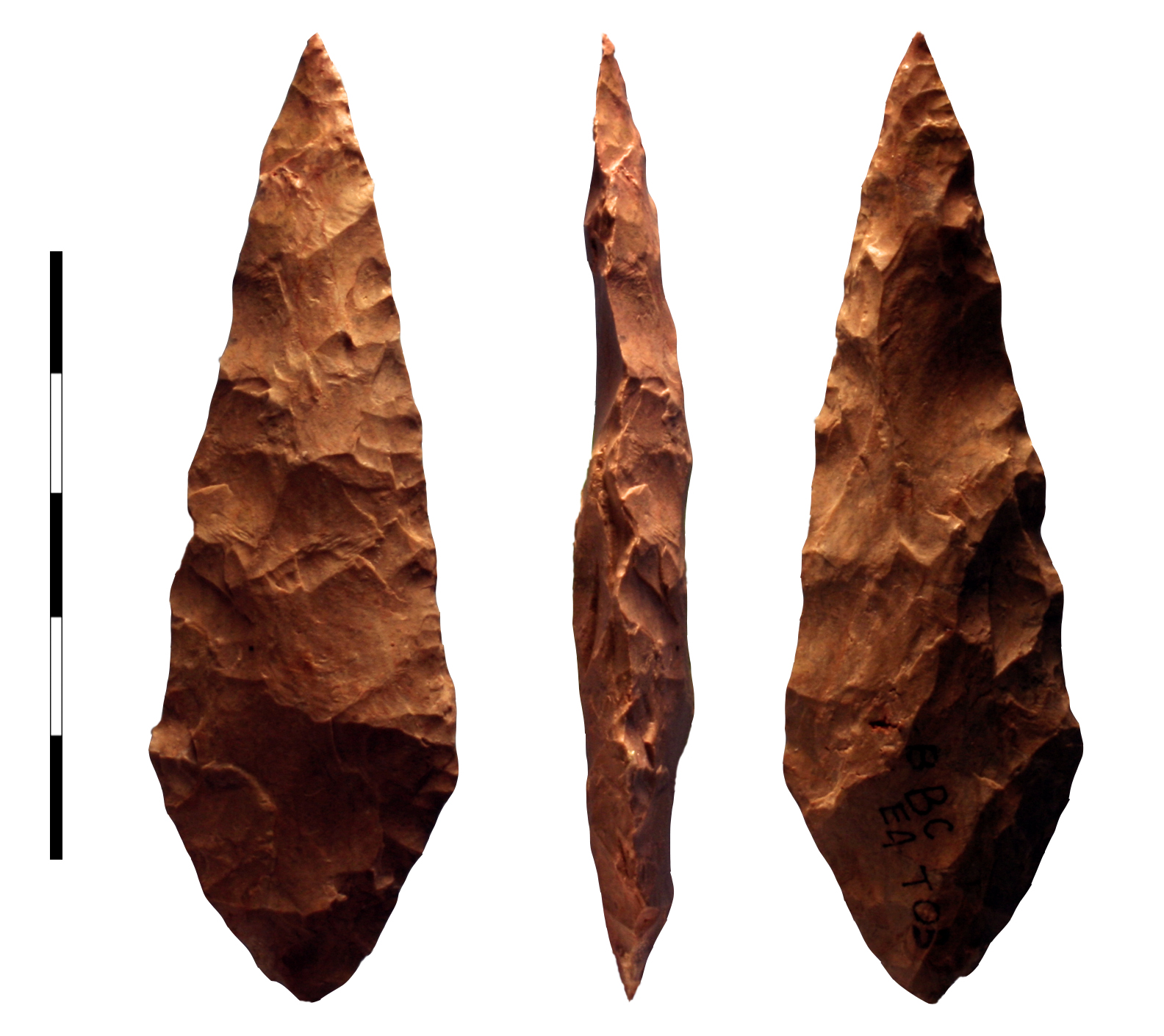
(Left) Acheulian flint chopper, North Somerset, UK; ca. 750 kya.
(Middle) Lower Paleolithic flint stone tool, Egypt; ca.200 kya.
(Right) Bifacial silcrete point; Blombos Cave, South Africa; 71 kya.
In the late Paleolithic period, tools became even more sophisticated. As many as 80 different types of implements have been unearthed for what are called the Perigordian and Aurignacian industries in Europe. It is believed that these tools were used for hunting and butchering, clothes making, and a great variety of other tasks that moved early humankind closer to modern life. In all, hundreds of highly complex tools have been found, some of which are the prototypes for modern tools.
STONE TOOL INDUSTRY
https://www.britannica.com/topic/stone-tool-industry
While understanding an individual process was limited to particular materials and desired results, all processes involved a sense of time. Each step had to be done in a certain order, for example, and the eventual outcome was dependent on past steps that had been done correctly. Advanced processes often required precise conditions for specific durations of time -- such as the exacting heat treatment of silcrete (see below) to make it as workable as flint. The resulting stone was essentially an "artificial flint." 

AN EXAMPLE OF A LATER COMPLEX PROCESS WHICH CONTINUED TO DEVELOP

The Heat Treatment Of Silcrete For Stone Tools
Approx 130 - 60 kya

About 130 kya Paleolithic people learned to heat treat certain kinds of locally available stones. Instead of needing to use flint, for example, they, in a sense, made their own "artificial flint" by treating silcrete so that it had flint-like properties, which made it an excellent material for tools and arrows. The heat treatment made the stone harder, less prone to fracturing and easier to shape. Over perhaps 70,000 years into the Middle Paleolithic era (the time before the Upper Paleolithic cultural explosion), this technique became quite sophisticated. 

Beginning with an above-ground method of placing stones in a pile of embers, it evolved into a well crafted controlled method that used "underground heating in an earth-oven like fire-pit. (sciencedaily.com -- see reference next)" This is a good example of the evolution of a Paleolithic process and the increasing complexity, precision, and sophistication that was achieved.
The "silcrete heat treatment...may provide the first direct evidence of the intentional and extensive use of fire applied to a whole lithic chain of production."
"This heating process marks the emergence of fire engineering as a response to a variety of needs that largely transcend hominin basic subsistence requirements,"
"Early humans used innovative heating techniques to make stone blades." Science Daily. October 20, 2016.
https://www.sciencedaily.com/releases/2016/10/161020092107.htm
It was familiarity with a wide variety of processes, including stone-tool making, that eventually led to an understanding of linear time. This was crucial for the transition from animal behavior to behavioral modernity and for the development of language. 

Working with processes led to the development of a number of cognitive skills that were essential for behavioral modernity. Memory, a sense of time in terms of past, present and future along with a sense of time duration, goal-directed behavior, cognitive skills, and decision making came together as a result of managing a variety of complex and changing processes. In addition, there developed a way to teach and train each generation in these skills. Eventually, this culminated in modern human behavior including a full early language and a way to express linear time.

Example of heated silcrete stone that was then shaped 
(the same stone seen from different angles).


THE PREFRONTAL CORTEX

The Homo sapiens brain was more than twice as large as the brain of Homo habilis and 1.5 times bigger than the brain of Homo erectus. But in addition, Homo sapiens had a distinct part of the brain that was unlike that in any other animal. This part is called the prefrontal cortex. And it is only in the last decade that we have begun to understand that this recently discovered area was critical when it came to planning, cognition and understanding the linear progression of time.

I believe an ability to work with complex processes and then to innovate came about because both the larger brain and the prefrontal cortex given to Homo sapiens allowed them to do so.

A full description of the prefrontal cortex is best left to scientific sources, so what follows are descriptions from scientific websites.
"This part of the association cortex, which is implicated in higher cognition and affect, is thus disproportionately large in humans relative to other primates."
Stern, Peter. The human prefrontal cortex is special. Science. Science22 Jun 2018 : 1311-1312.
https://science.sciencemag.org/content/360/6395/1311.7
"This brain region has been implicated in planning complex cognitive behavior, ... [and] decision making...The basic activity of this brain region is considered to be orchestration of thoughts and actions in accordance with internal goals." [ED: i.e., the future]
Prefrontal Cortex. The Science Of Psychotherapy. 2017.
https://www.thescienceofpsychotherapy.com/prefrontal-cortex/
I was one of the first writers in 2014 to focus on the prefrontal cortex as a critical component in our ability to understand and conceptualize linear time. We are the only animal that has this capability. See my most popular article (more than 10,000 readers since 2014) about the prefrontal cortex: 

Animal Senses Compared to the Human Sense of Time

PROCESSES, TIME AND PROTO-LANGUAGE

After two million years, with their increased brain size and the added abilities of the prefrontal cortex, hominins began to develop a language and a set of conceptual tools that gave them greater control over their use of processes. 

In particular, language gave humans the tools to work with time. Language could express basic linear time concepts that allowed them to imagine processes, the order of the steps involved and the duration of each step. It also allowed them to imagine different outcomes and to share and discuss processes. And, of course, language was used to instruct the next generation.

Linguists and anthropologists assume that a fully developed language, even the most basic language, would have had words that expressed concepts of time. 

Anna Wierzbicka made a list of what are known as Semantic Primitives as listed by the Natural Semantic Metalanguage. The following are universal words for time that occur in all languages:  
when/time, now, before, after, a long time, a short time, for some time, moment

It is important to note that language and time concepts are closely linked. 

"Time reference is a universal property of language..."
Jacqueline Lecarme, Ph.D., Linguistics

And since processes proceed step-by-step, they became a model and metaphor for time, not unlike a clock which advances step-by-step as the hands of the clock move forward.

We can find examples of this today such as in this expression:
Your idea is half-baked. 
This comes from the process of cooking where the bread was not given enough time to bake.


CONCLUSION

Since hominins had been working with processes for millions of years, they were familiar and comfortable with them. So the eventual awareness of linear time that processes involved and the conscious understanding of the process steps evolved naturally. 

And this is why an understanding of processes is so important. Processes became the model and the metaphor for linear time along with duration. And once language and modern human behavior was achieved, humans had even greater control over their processes and their ability to control their environment. This eventually led to the Upper Paleolithic, the Neolithic and then to civilization.

________________________________________

AFTERWORD

ABOUT PROCESSES

I am quite familiar with processes. I processed my own black and white photographic negatives and then developed prints from those negatives for fifteen years. Negative processes involved time, temperature and proper handling, such as agitation. The initial spooling took place in the pitch dark.

I soon learned that what I did at the beginning greatly affected the end result. So as time went on, I became more precise. I learned to make accurate photographic exposures before developing so that the chemical process of developing produced a fine-grained thin negative with a full range of tones. And I added a couple of steps to standard developing that improved the results such as using distilled water as a pre-soak and diluting the developer for more control over the development time. 

Then I developed my own black and white slides which was even more exacting.
And finally, I developed color slides. This process was the most involved and the most precise. Color slides, for example, required that the developing solution had to be 100 degrees F +/- 1/2 degree for a very specific duration of time. 

I say all of this because I do understand how processes work and how they evolve. Whether I am talking about photographic processing or making stone-tools in the Paleolithic era or preparing esparto grass for basket weaving or for making rope, basic step-by-step procedures are common to all.

THINKING OUTSIDE THE BOX?

I realize that my ideas may seem a bit different and unusual to Paleoanthropologists, but consider:
"Tools are the products of our brains, and we have millions of stone tools," Wynn added. "What we need are more creative ideas on how to extract understanding from them, and what they tell us about our evolution." Quotation from paleoanthropologist Thomas Wynn of the University of Colorado at Colorado Springs.
Choi, Charles. "Human Evolution: The Origin of Tool Use." LiveScience, November 11, 2009. https://www.livescience.com/7968-human-evolution-origin-tool.html. Accessed 10/26/2019.
A Caveat: While I believe that Homo sapiens became aware of linear time and were able to use it to their advantage, their sense of time was quite different from our own. I discuss this in other articles I have written.


Monday, July 29, 2019

The Origins of Language: When, Why and How


The Origins of Language: 
When, Why and How


Abstract:
Although Homo sapiens were anatomically able to talk 150,000 years ago (150 kya), it appears that they did not until about 40 kya when the Upper Paleolithic cultural and symbolic explosion occurred. To date, there has been no satisfactory explanation. This blog-post attempts to provide an answer as to when a fully developed G1 language came into being and the reasons for the emergence of such a language plus the reasons why the later Paleolithic explosion took so long to develop. Specifically, the abilities of the Homo sapiens' prefrontal cortex, the planning involved with various tool-making and other processes, the development of episodic memory, the growing use of spoken words, and a new understanding of time -- all came together about 100 kya. It then took another 60 ky before this new sensibility led to an established belief system which resulted in the Upper Paleolithic cultural explosion.


Why Didn't We Speak Sooner

"Human beings were anatomically ready to speak more than 150 kya but clear evidence that they were doing so does not appear for 100 ky afterward." 

The famous American science journalist, Constance Holden, wrote this and the following about the development of language in her article entitled, No Last Word on Language Origins
https://science.sciencemag.org/content/282/5393/1455.abstract

Fossils show that the raw brain capacity for complex language, along with the necessary mouth and throat anatomy, were probably in place before 150,000 years ago. But most of the behaviors thought to depend on language did not appear until 40,000 years ago--the so-called Upper Paleolithic explosion that is manifested most strikingly in Europe. That was when tools, burials, living sites, and occasional hints of art and personal adornment reveal beings capable of planning and foresight, social organization and mutual assistance, a sense of aesthetics, and a grasp of symbols. "Everybody would accept that by 40,000 years ago, language is everywhere," says Stanford University archaeologist Richard Klein.
Unfortunately, "speech does not fossilize," notes anthropologist John Shea of the State University of New York, Stony Brook...noting that an archaeologist "is like the drunk in the old joke who looks where the light is good" for his lost keys. 
Thus paleoanthropology is a game for philosophers as well as scientists, and there is plenty of room for free play of the romantic imagination.

Read the full article online:
https://web.archive.org/web/20050404112132/http://cas.bellarmine.edu/tietjen/images/anthropology(NoLastWordOnLanguageOrigins.htm

Since I am not a linguist but I minored in Anthropology for my Master's Degree in Communication, I fall, perhaps, into the philosopher category as mentioned above. And since Constance Holden, the author, has given me permission here, I will try my hand at solving this puzzle.


Setting The Stage For Language

I believe five key elements came together about 100 kya that led to the start of a fully developed language. The linguist, Dr. Daniel Everett, has called this hypothetical first language, a G1 language. 

Yet after it was in place 100 kya, I believe it took another 60 ky for the full consequences of this development to occur and for the rich creation of human culture which then led to the Upper Paleolithic explosion 40 kya. 

#1. The Prefrontal Cortex
The concepts in language and an ability to work with processes came about largely due to a unique part of the genus Homo brain, called the prefrontal cortex. This recently discovered area of the brain was critical when it came to planning and cognition.

A full description is best left to scientific sources, so what follows are descriptions from scientific websites.

"This part of the association cortex, which is implicated in higher cognition and affect, is thus disproportionately large in humans relative to other primates."
Stern, Peter. The human prefrontal cortex is special. Science. Science22 Jun 2018 : 1311-1312.
https://science.sciencemag.org/content/360/6395/1311.7

"It’s responsible for planning and decision-making and, according to the new findings, has no equivalent in the monkey brain."
Engelking, Carl. Brain Area For Decision-Making And Planning Is “Uniquely Human.” Discover Magazine. 2014.
http://blogs.discovermagazine.com/d-brief/2014/01/30/brain-area-for-decision-making-and-planning-is-uniquely-human/#.XR8X5utJHgw

"This brain region has been implicated in planning complex cognitive behavior, personality expression, decision making, and moderating social behaviour. The basic activity of this brain region is considered to be orchestration of thoughts and actions in accordance with internal goals."
Prefrontal Cortex. The Science Of Psychotherapy. 2017.
https://www.thescienceofpsychotherapy.com/prefrontal-cortex/

In other words, the conceptions of language and a proficiency for using and then improving and modifying processes was possible due to this unique part of the human brain. However, it took a million years or more for all of the 'prefrontal cortex' abilities to come into play and to be fully utilized.


See my most popular blog about the prefrontal cortex, I wrote in 2014: 
Animal Senses Compared to the Human Sense of Time


#2. Processes
Anthropologists do agree that for over a million years the genus Homo used a series of processes to make stone cutting tools such as hand axes. Over time these processes were refined and expanded and new processes were developed. By 100 kya Homo sapiens used a huge variety of processes, some of which we can only guess about because the materials have decayed, such as the treatment of animal skins and the building of houses with branches and leaves. 

“In reality, we know very little. What is conserved in the ground? Stone, bronze, ivory, bone, sometimes pottery. Never wood objects, no fabric or skins. That completely skews our notions about primitive man.”
Pablo Picasso
https://timelineforhomosapiens.com/2013/12/11/picasso-quotes-and-primitive-art/
Excerpted from pages 92-102 of Conversations with Picasso by Brassaï, translated by Jane Marie Todd, published by the University of Chicago Press. ©1999 by the University of Chicago.

While we can only guess at the 'softer' technologies that have left little evidence from the Middle Paleolithic era. Here is what a weaving website had to say.
Weaving (a soft technology): The art of weaving...involves the production of fabric or cloth by interlacing two distinct sets of yarns or threads in a right angle...Early civilization called for temporary shelters to be built, so knowing how to twine, plait, knot and weave materials such as grass, twigs, string and twine together, in order to build walls, roofs, bedding, baskets and doors, was imperative. The idea of interlacing materials together to create a weave was probably inspired by nature; by observing birds’ nests, spider webs and various animal constructions...A distinct fabric impression in an archaeological find (Dolni Vestonice), has led scientists to the conclusion that the discovery of weaving actually took place as early as the Paleolithic era. [ED: My emphasis.]
The History of Weaving. 2014.  https://wildtussah.com/history-weaving-2/

However, scientists can confirm that many of the processes we do know about were quite sophisticated such as the complex and exacting underground heat treatment of silcrete which turned silcrete into a material that was as workable and useful as flint. But like flint, heat-treated silcrete had properties that meant it could be shaped in predictable ways. (See the Afterword.)

I believe that after more than a million years a sense of linear time developed as the skill of working with processes became increasingly complex, precise, sophisticated and varied. It is quite likely that by 100 kya Homo sapiens were using dozens of processes to make various stone tools and weapons, treat animal fur and skins, sew skins together, fabricate clothes from natural fibers, and make shelters, mats, and baskets.


The progression of stone technology during the Paleolithic era
showing the evolution of stone tool processing.
(Left) Acheulian flint chopper, North Somerset, UK; ca. 750 kya.
https://commons.wikimedia.org/wiki/File:583_three_handaxes_ventral_(FindID_101523).jpg
(Middle) Lower Paleolithic flint stone tool, Egypt; ca.200 kya.
https://commons.wikimedia.org/wiki/File:Tool_MET_06-322-21.jpeg
(Right) Bifacial silcrete point; Blombos Cave, South Africa; 71 kya.
https://commons.wikimedia.org/wiki/File:Blombos_point_white.JPG

While understanding a process was limited to particular materials and desired results, all processes involved a sense of time. Each step had to be done in a certain order, for example, and the eventual outcome was dependent on past steps that had been done correctly. Later processes were almost always more complicated and required more precise conditions for specific lengths of time -- such as the precise heat treatment of silcrete to make it more workable. (See the Afterword.)

I believe that over the years, the different orderly steps in a process became the model for time in general but more about this in my next blog.

#3. Memory
While we cannot know the exact memory abilities of Paleolithic people, we do know this. Processes would need to be memorized and then younger members of the tribe would need to learn the processes and memorize the steps. So the teacher would have to be able to remember all the steps, describe them as needed, and then communicate this to an apprentice. Then as time went on the steps became more complicated and more exacting requiring more memory skills. 


"The ability to remember has been linked with the ability to perceive time in the past and has been seen as a crucial threshold for a sense of time." 
Pathman, Thanujeni et al. “Young Children's Memory for the Times of Personal Past Events.” Journal of cognition and development : official journal of the Cognitive Development Society vol. 14,1 (2013): 120-140. doi:10.1080/15248372.2011.641185https://www.ncbi.nlm.nih.gov/pmc/articles/PMC3653335/

NOTE: We do have clear evidence that the memory of some Upper Paleolithic people was remarkable. The painting of a rhino in the Chauvet Cave in France, for example, has been dated to more than 30 kya and the remarkably accurate drawing of a bison in the Cave of Altamira has been dated to about the same period. Both of these paintings were painted from memory as the paintings were created by artists inside deep dark caves


See my popular blog: 
The Genius of Cavemen

By the Upper Paleolithic, Homo sapiens had remarkable memories. This top picture of a bison was painted from memory using multi-color air brush techniques in the dark Cave of Altamira, about 15 kya. The bottom photo is of an actual bison today.

#4. Early Words
Words must have taken a while to develop and most anthropologists would agree. However, the point of the earliest beginnings has become a heated argument. Dr. Daniel Everett has suggested that its earliest and limited beginnings may have occurred at least a million years earlier than previously thought with Homo erectus. Homo erectus was capable of making sounds, but not with the wide and varied flexibility of Homo sapiens and the complex grammar of modern languages. But, in any case, it seems likely that long before there was a fully developed language, there was a time period when words were evolving and shared verbal communication was developing.

#5. Linear Time 
The last and most recent critical element was a sense of time. During the Lower Paleolithic era, an understanding of time by Homo sapiens began to diverge from the animal sense of time, i.e., animal time which was living in the moment and responding to cyclical changes such as sunrise and sunset or changes in the seasons. 
Homo sapiens were the first species (and still the only species) to understand 'when' in time -- when in the past, when in the near present and when in the future. No other animal has this capacity according to the following study.
People can time-travel cognitively because they can remember events having occurred at particular times in the past (episodic memory) [ED: e.g., the sense of when] and because they can anticipate new events occurring at particular times in the future. The ability to assign points in time to events arises from the human development of a sense of time. [In this paper] the hypothesis is advanced that animals are cognitively stuck in time; that is, they have no sense of time and thus have no episodic memory or ability to anticipate long-range future events. Research on animals’ abilities to detect time of day, track short time intervals, remember the order of a sequence of events, and anticipate future events are considered, and it is concluded that the stuck-in-time hypothesis is largely supported by the current evidence.
Roberts, William. Are Animals Stuck in Time? 
Psychological Bulletin 2002, Vol. 128, No. 3, 473–489.  American Psychological Association. 2002.  https://www.msu.edu/course/psy/962/snapshot.afs/Roberts%20(2002)%20-%20Are%20animals%20stuck%20in%20time_epidodic%20memory.pdf

In the modern world, we take time for granted what with watches and clocks everywhere and even time stamps on receipts, but to early humans, linear time was quite magical, mysterious and fearsome.


"It must have required enormous effort for man to overcome
his natural tendency to live like the animals in a continual present."
Gerald James Whitrow.
Time in History: Views of Time from Prehistory to the Present Day. 
Oxford, UK, Oxford University Press. 1988

For a language to be considered fully developed a basic vocabulary that could express time concepts was essential. So during the same period that an early fully developed language was born, time concepts also came into being.


"Time reference is a universal property of language..."
Jacqueline Lecarme, Ph.D., Linguistics

The basic and universal time words, known as Semantic Primitives, as listed by the Natural Semantic Metalanguage originated by Anna Wierzbicka, suggests the essential words and concepts that the earliest languages may have used. She chose these words because they can be translated into any known language and are understood in all languages.
What Is NSM? 
https://intranet.secure.griffith.edu.au/schools-departments/natural-semantic-metalanguage/what-is-nsm

UNIVERSAL WORDS FOR TIME IN ALL LANGUAGES: 
when/time, now, before, after, a long time, a short time, for some time, moment


A Fully Developed Language By 100 Kya

Recent archaeological evidence now points to the start of a fully developed language at about 100 kya. 

This is the date of the oldest undisputed Homo sapiens burial and also the date of a 'paint kit' which was probably used for ceremonial purposes but in any case, was carefully put together with considerable forethought. 

100 kya – The oldest known ritual burial of modern humans was at Qafzeh in Israel. It was a double burial of what is thought to be a mother and child. The bones have been stained with red ochre. 
https://en.wikipedia.org/wiki/Paleolithic_religion

Also 100 kya – 
The first confirmed burial also coincides with the first confirmed paint kit found at the archaeological site of Blombos Cave in South Africa. This find indicates the beginning of symbolic thought either as body paint or paintings.
The hoard includes red and yellow pigments, shell containers, and the grinding cobbles and bone spatulas to work up a paste - everything an ancient artist might need in their workshop.
"There is a view that this behaviour is linked with complex language. So, it may indicate these people were communicating in a fully modern way,' said Prof. Chris Stringer from London's Natural History Museum.
Amos, Jonathan. Ancient 'Paint Factory' Unearthed. BBC News. 2011.
https://www.bbc.com/news/science-environment-15257259
 Middle Paleolithic shells with drilled holes. It is assumed these were early beads.

The five key elements 'jelled together' when they reached a critical point about 100 kya. 
"The similarity of cognitive processes and cortical networks involved in speech and tool use suggests that these behaviours are best seen as special cases in the more general domain of complex, goal-oriented action. This is exactly what would be predicted by hypotheses that posit specific co-evolutionary relationships between language and tool use..."  
Stout, Dietrich, and Thierry Chaminade. “Stone tools, language and the brain in human evolution.” Philosophical transactions of the Royal Society of London. Series B, Biological sciences vol. 367,1585 (2012): 75-87. doi:10.1098/rstb.2011.0099 https://www.ncbi.nlm.nih.gov/pmc/articles/PMC3223784/

These findings satisfy many of the criteria outlined by Constance Holden's article,  No Last Word on Language Origins, quoted at the beginning of this blog-post. She wrote that anthropologists believe that a full language first happened when there was evidence of, "tools, burials, living sites, and occasional hints of art and personal adornment reveal[ing] beings capable of planning and foresight..."

But this still leaves the nagging question of why the 'Upper Paleolithic explosion' did not happen for another 60,000 years.


Why Was There A 60,000 Year Gap
Between The Start Of A Fully Developed Language
And The Upper Paleolithic Cultural Explosion?


Making the switch from living in the moment to living with a sense of time was a momentous change. A person would realize that their death was inevitable along with that of their mate and their children, for example. They could now imagine that terrible events which had occurred in the past might be repeated in the future -- such as floods, disease, invasions, fires, starvation, earthquakes and volcanoes. And along with this new understanding of time came the new emotions of worry and hope. While a belief in time as a linear continuum gave humans great power, it also gave them great anxiety. Cultures would have to find ways to cope with these fears which were usually dealt with through religious rituals -- or, we might say, religious processes.


This ornament (left) is one of two at the entrance gate (right) for the 200 year-old Oudewater Reformed Cemetery in Holland. This cast-iron funerary art expresses the universal angst and dread about linear time and the inevitability of death. This fear was as true then as it was to Paleolithic Homo sapiens 100 kya. The hour glass in the middle is a symbol for the passage of time and the wings represent "time flies" or in Latin "tempus fugit." 

For Paleolithic peoples, this new sense of time was a 'brave new world.' It must have been a bit like Alice in Wonderland. It signaled the beginnings of consciousness, for example, and probably belief systems that involved animism, totemism, and magic.  

It is very important to not see these beliefs as 'primitive' or backward, but instead to see them as functional for the people at the time and for the environment they lived in. A hunter-gatherer way of life had entirely different demands from neolithic farming which was entirely different from a complex civilization.

As Jacques Cauvin has said, religion came first before technological advances. He suggested that a belief system had to be in place before the building of civilizations, for example, because a culture first needed to reflect the beliefs of the people. The belief system came first and was fundamental because it gave the culture its raison d'etre.


See my blog about Cauvin's ideas
The Mystery of Gobekli Tepe: The World's Oldest Temple

In other words, rather than religion reflecting and emerging from the new technology and way of life, as previously thought, religion came first. The culture and the technology instead reflected the religious beliefs that were already in place. However, it is likely that once cultures and civilizations were established, they, in turn, modified the existing religion. 

So the reason for the Paleolithic 'language and culture gap' was that Paleolithic people had to become comfortable with their belief system before they could create symbols, art, tools and social activities that reflected that their beliefs.

I would suggest that when linear time, in general, had become part of the human way of life, the Paleolithic system of processes was extended to religion. Religious rituals were derived from an understanding of processes, and so became processes themselves. They were designed to bring favorable outcomes in the future and to retain favor with natural and supernatural forces. And once these religious processes were in place, the stage was set for the Upper Paleolithic explosion.

Then once a belief system was in place and people finally felt comfortable with their newly expanded understanding of time, they used the tremendous power that it gave them to plan, to organize, and to build, which led to the Upper Paleolithic cultural explosion and then to farming and eventually to civilization.


_________________________
AFTERWORD


Examples Of Two Advanced Processes 
That Were Being Used Before
The Upper Paleolithic Cultural Explosion


Here are two examples of processes which occurred during this gap. They show how sophisticated the Paleolithic technology had become yet these were done during the time before the Upper Paleolithic explosion of creativity. It seems very likely that language must have developed by this time in order to execute these processes and to instruct others in the procedures. In my next blog, I will go into more detail about how an understanding of time and an understanding of processes were closely related.

The Heat Treatment Of Silcrete For Stone Tools
Approx 70 kya for the advanced process

About 130 kya Paleolithic people learned to heat treat certain kinds of locally available stones. Instead of needing to use flint, for example, they, in a sense, made their own "artificial flint" by treating silcrete so that it had flint-like properties, which made it an excellent material for tools and arrows. The heat treatment made the stone harder, less prone to fracturing and easier to shape. Over perhaps 60 ky into the Middle Paleolithic era (the time before the Upper Paleolithic explosion), this technique became quite sophisticated.
Beginning with an above-ground method of placing stones in a pile of embers, it evolved into a well crafted controlled method that used "underground heating in an earth-oven like fire-pit. (sciencedaily.com -- see reference next)" This is a good example of the evolution of a Paleolithic process and the increasing complexity, precision, and sophistication that was achieved.
The "silcrete heat treatment...may provide the first direct evidence of the intentional and extensive use of fire applied to a whole lithic chain of production...This heating process marks the emergence of fire engineering as a response to a variety of needs that largely transcend hominin basic subsistence requirements."  
University of Bergen. "Early humans used innovative heating techniques to make stone blades." ScienceDaily. ScienceDaily, 20 October 2016. www.sciencedaily.com/releases/2016/10/161020092107.htm.
71  kya silcrete stone tools


Stolarczyk, Regine; Schmidt, Patrick. Is early silcrete heat treatment a new behavioural proxy in the Middle Stone Age? 2018.
https://journals.plos.org/plosone/article?id=10.1371/journal.pone.0204705

Bicho, Nuno, Editor. Early Evidence for the Extensive Heat Treatment of Silcrete in the Howiesons Poort at Klipdrift Shelter (Layer PBD, 65 ka), South Africa. 2016.
https://www.ncbi.nlm.nih.gov/pmc/articles/PMC5070848/

Schmidt,Patrick; Sanchez, Océane; Kind, Claus-Joachim. Stone heat treatment in the Early Mesolithic of southwestern Germany: Interpretation and identification. 2017.
https://journals.plos.org/plosone/article?id=10.1371/journal.pone.0188576#sec001


Detailed Example
Of A Late Middle Paleolithic Process For
The Construction Of A Bow And Arrows

About 60 kya
Using archaeological finds and ethnological parallels, the two researchers reconstructed the steps needed to make a bow and arrows. These are complimentary tools -- separate, but developed interdependently. The bow is the controlling element, while the arrows can be used more flexibly and are interchangeable. About 2.5 million years ago, humans first used tools to make other tools then to make tools assembled from different parts to make a unit with particular qualities, such as wooden spears with stone spearheads (ca. 200,000-300,000 years ago.) The bow and arrow and other complementary tool sets made it possible for prehistoric humans to greatly increase the flexibility of their reactions.
There are many basic complementary tool sets: needle and thread, fishing rod and line, hammer and chisel. The bow and arrow are a particularly complex example. The reconstruction of the technique shows that no less than ten different tools are needed to manufacture a simple bow and arrows with foreshafts. It takes 22 raw materials and three semi-finished goods (binding materials, multi-component glue) and five production phases to make a bow, and further steps to make the arrows to go with it. The study was able to show a high level of complexity in the use of tools at an early stage in the history of Homo sapiens.
Universitaet Tübingen. "Complex thinking behind the bow and arrow." ScienceDaily. ScienceDaily, 25 June 2012.   www.sciencedaily.com/releases/2012/06/120625064620.htm