Showing posts with label linear time. Show all posts

Friday, March 1, 2024

Manifesto Study of Time Department at a University

A SCIENCE MANIFESTO:
Why Is There No
University Department for
The Study of Time?
By Rick Doble


THE PURPOSE OF THIS MANIFESTO

The point of this manifesto is very simple. We evolved from animals who lived in the moment, yet today we work with time, manage time, schedule time, and coordinate time in a linear fashion. Time for us is the past, the present, and the future plus duration. Our civilizations could not exist or function without this sense of time.

Since this is so critical, why is there no department at a university that deals with the nature of time as it relates to humans and civilization?

Therefore the first question is how did we develop a totally different sense of time? My guess is that this took millions of years and happened in stages.

"It must have required enormous effort
for man to overcome his natural tendency
to live like the animals in a continual present."
Whitrow, Gerald James. Time in History:
Views of Time from Prehistory to the Present Day.
Oxford, UK, Oxford University Press. 1988, page 22.

Why is this important? We could not have created civilizations and technologies without understanding linear time. We have become the dominant species on the planet because we can manage time, plan with time, build with time, and coordinate with time. Time is crucial to our power.

If we are to understand how we developed and came to be who we are, we must study and investigate many different aspects of time.

Then the next question is how should we deal with the future because our understanding of time will be a major factor?

This is not an academic exercise. An understanding of time and how things will occur in the future will be crucial in our efforts to deal with climate change and global warming. To put it bluntly, our survival may depend on it.

A Department for 'The Study of Time' or 'Time-Studoes' at a university could delve into these subjects and shed light on these important questions.


WHY IS THE STUDY OF TIME IMPORTANT?

Nothing in life exists or has existed or will exist that is independent of time. (We'll leave the black hole questions to physicists but anyway, we are talking about life.) We live our lives according to the passage of time. 

Our civilizations could not function without our synchronized clocks, time zones, and time stamps. The world we live in could not operate without a shared understanding of time.

"Is 'time' the most commonly used noun in the English language?
"...an Oxford dictionary...announc[ed] that the word is the most often used noun in the English language." 
Study: 'Time' Is Most Often Used Noun - CBS News. Jun 22, 2006.

When you die, the date you were born and the date you died will be on your gravestone. 

Time is fundamental and vital to each of us individually, to our families, to our communities, our nations, and our planet. 


WHAT HAS PREVENTED
THE STUDY OF TIME?

The answer is simple: Most people believe that time is, well, just time and there is very little that can be said about it or done about it. Furthermore, they don't believe that cultures shape and mold our understanding of time. Time is so much a part of what we do every day, every year, every lifetime, that it is like asking a fish to describe water.

"A deep-sea fish has probably no means of apprehending the existence of water; it is too uniformly immersed in it..."
Lodge, Sir Oliver. Ether and Reality: A Series of Discourses on the Many Functions of the Ether of Space, (1925), 28.


I believe the complexity of time is, in a sense, hiding in plain sight. Time is here all around us and always a part of us, but thinking about it is difficult.


EXAMPLES OF HIDDEN TIME

I searched the Internet for articles about what is unique about human beings, i.e., what separates us from animals. It is clear that our ability to conceive and work with linear time is one of our unique characteristics. We are the only animal that has a sophisticated concept of linear time and as a result, we can design and build and cooperate.

However, I read numerous articles from prestigious universities about what is uniquely human, and not one mentioned our concept of time. Here is an example.

The following statement from Harvard University involves time and does not make sense without an understanding of time, but time itself is never mentioned. Time is embedded but not obvious.

"The unique brain mechanisms underlying human language also enhance human cognitive ability, allowing us to derive abstract concepts and to plan complex activities."
Uniquely Human - Harvard University Press. Jacket description of the book.  Lieberman, Philip. Uniquely Human: The Evolution of Speech, Thought, and Selfless Behavior. Harvard University Press. 1993.

Planning requires an understanding of time. And planning complex activities requires an advanced and sophisticated understanding of time.

Here is another example from Oxford University.
"We tend to think that being able to plan into the future, be flexible in our approach and learn from others are things that are particularly impressive about humans," says senior researcher Professor Matthew Rushworth of Oxford University's Department of Experimental Psychology.
---------------------------
"Brain area unique to humans linked to cognitive powers." Published: 28 Jan 2014.
https://www.ox.ac.uk/news/2014-01-28-brain-area-unique-humans-linked-cognitive-powers

While this article mentions planning into the future, it does not deal with how time, itself, is understood. Yet planning and many other activities are based on an understanding of time which is fundamental.


TIME IS A FACT OF LIFE
BUT CULTURES SHAPE
OUR UNDERSTANDING

It is important to say from the outset that time is an objective fact of life.

"Time and tide wait for no man."
Geoffrey Chaucer (born 1343 - died 1400),
Prologue to The Clerk's Tale, Canterbury Tales. 1395.

But the way we conceive of time and coordinate time is very human. Time is not only an objective reality but also a human concept. How we understand time today and how we may have understood it in the past are probably quite different. I believe that the ways it was understood by hunter-gatherers in the 3 Paleolithic eras and people in the Neolithic era, in the Ancient, Classical, and Medieval eras were all very different.

I think a culture shapes and indoctrinates a shared concept of time. For example, a contemporary hunter-gatherer tribe, the Piraha tribe in the Amazon, thinks of time in immediate terms. Dr. Daniel Everett, the acknowledged expert on this culture, calls it the Immediacy of Experience Principle. Their window of time conception is about two days in the past and two days in the future. Beyond those points, they don't imagine, plan, or conceptualize. But don't think of them as being primitive. They have a complex language that identifies time and reality, such as who saw something and when did they see it. There are over 65,000 possible ways to express such things in this language.

This is just one example of how a culture can shape an understanding of time. There are others. For example, some cultures today see the past as ahead of us instead of behind us.

Now, you might disagree that cultures can shape our understanding of time. But this is a perfect example of why there needs to be a Department of Time-Studies. This hypothesis needs to be explored and researched and this should be done by knowledgeable academic professionals.


10 AREAS THAT NEED TO BE RESEARCHED
AT A UNIVERSITY DEPARTMENT FOR
'THE STUDY OF TIME'

Time, like any subject, has a history, a history of time concepts by humans, a history of time-keeping methods and devices, a history of time coordination, and also a history of how time has been thought of. Plus there are many other areas that need to be studied such as how the brain processes time considerations. 

These different areas need to be studied from a time point of view. This means that researchers, scientists, and scholars must walk a fine line. They need to look at subjects from a time POV but not be biased and 'read in' facts and results that are not warranted.


#1. THE BRAIN:
Our human brain is unique both in size and its cognitive abilities. I maintain that both our perception of time, our memories, and our ability to manage time are only possible because of the way our brains are put together. With cutting-edge brain research that is now possible all of these areas need to be explored. 

For example, how does the brain handle a simple sentence like this "When I complete this job that I am working on, I will be done for the day." It sounds simple but it involves imagining a future in which the present and the associated future activity, i.e., the job, is past.


#2. CONSCIOUSNESS:
I think it is clear that an understanding of time is a major part of consciousness. But furthermore (and this is just a guess) an understanding of time is/was integral to the development of consciousness. I believe that our sense of time developed in tandem with the development of consciousness. In my study of time during the last eleven years, this was one idea that jumped out at me. 

I found one example that pointed in this direction. When blind/deaf Helen Keller suddenly understood words for the first time, she went from an unconscious state to a conscious state and also became aware of time.


#3. PROCESSES AND TECHNOLOGIES:
A sense of time and an understanding of time may have taken several million years to develop. During this time the size of the brain grew larger as memory and imagination abilities increased along with manual and cognitive skills. At the same time, basic technologies emerged and evolved such as stone tools. 

My research led me to believe that basket-making or woven-fiber technology was also one of the early technologies. Creating woven-fiber tools (a basket is a tool!) became increasingly complex which required greater cognitive skills. Making a basket (just one example of a woven-fiber tool) required imagining the basket, finding the materials for the design, processing those materials, and then making the basket. The design of a basket needed to be such that it worked for the purpose for which it was designed, Step by step processes were early examples of the use and understanding of linear time since a process is linear. 
 
"Man must have been conscious of memories and purposes long before he made any explicit distinction between past, present, and future."
Whitrow, Gerald. Time in History: Views of Time from Prehistory to the Present Day. Oxford, UK, Oxford University Press. 1988, pages 21-22.

The key to working with processes was to understand and plan the necessary steps in linear terms. This was, I believe, the beginning of thinking about time with a past, present, future, and duration. This does not mean that all time had to be thought of this way, but processes and planning needed to be thought of like this.

Processes invariably became more advanced as additional steps were added which required more complex cognitive skills and a more nuanced understanding of time. Archaeologists have found millions of stone tools from the earliest ones in the Paleolithic era to the most recent in the Neolithic era. Each stage indicated a more advanced and complex process to make the tools. 


#4. LANGUAGE:
Words are the main tools we humans use to imagine and manage time. Most languages have a full set of verb tenses although some do not. Yet all can covey a full and complex picture of time.

When language emerged and developed, it added another set of tools to the ability to communicate and teach about time plus it added tools for planning, managing, and working with time.

"For words are to thought what tools are to work; 
the product depends largely on the growth of the tools."
Durant, Will. The Story of Civilization: Vol. 1, p. 71, 1935.

"Time reference is a universal property of language..."
Lecarme, Jacqueline, Ph.D. Linguistics. "Nominal Tense and Tense Theory." Academia.edu, 1998.  https://www.academia.edu/2486019/Nominal_Tense_and_Tense_Theory


As I quoted earlier:
"The unique brain mechanisms underlying human language also enhance human cognitive ability, allowing us to derive abstract concepts and to plan complex activities."
Uniquely Human - Harvard University Press . Jacket description of the book.
Lieberman, Philip. Uniquely Human: The Evolution of Speech, Thought, and Selfless Behavior. Harvard University Press. 1993.

A study of languages with the POV of how time is conceptualized, worked with, and shared along with how children learn language and time concepts (next) might yield important insights. This is a key area for research.


#5. CULTURE:
While time is real and relentless in its march forward, our cultures shape how we understand time, communicate about time, coordinate time, plan time, etc. Our understanding of time is, in many ways, learned. 
For example, time management is one of the main skills that is taught in schools, i.e., how to meet deadlines, show up to class on time, pace yourself to complete a complex job, plan how to manage a project, etc.


#6. CHILDHOOD:
How do children acquire a sense of linear time? How much is cultural? For example, most children speak in the present tense until they are about 8-10 years old. What happens when they begin to use the past tense? What are they taught about time, and what do they learn and when? 

Studying the way children learn time concepts, along with the way they work with time, might shed light on our modern sense of time along with ideas about how prehistoric cultures might have developed and used their sense of time.

"Unfortunately, we are not very well informed in the psychology of primitive man, but there are children all around us, and it is in studying children that we have the best chance of studying the development of logical knowledge, physical knowledge, and so forth."
Piaget, Jean. "Genetic Epistemology." Columbia Forum, (1969), 12, 4. 

$7. THE DIMENSIONS OF TIME
We can think of time as having three dimensions. Immediate time is one-dimensional and without it, nothing would exist. Cyclical time is two dimensional with repeating cycles such as sunrise and sunset, spring and autumn, birth and death. And finally, there is linear time with the past, present, and future always moving forward. 

While the modern world has adopted linear time, we still have a deep need to experience time in the moment. We can do this and become excited in the moment with live sports events and live music. These have the immediacy that we crave. We also need to experience cyclical time. And we do this every year, for example, with annual repeating points in time such as Christmas and New Year's Day or Halloween.

This could be another area of research for a time-studies curriculum at a university.


#8. TIME IN PREHISTORY AND ANCIENT TIMES:
-- Animal existence and the Lower & Middle Paleolithic:
Since we began as animals who lived in the present, how did we acquire a linear sense of time? How is the human brain different? How did our memory develop? How did planning develop? How long did this take?
Scientists have reenacted tool-making at their different stages and then measured brain activity. These experiments have given these researchers a general idea of early hominin cognitive abilities and how they developed over millions of years.
-- The Upper Paleolithic
By the Upper Paleolithic, when the human brain was fully developed and as advanced as our brains today, a conscious understanding of linear time may have evolved that was almost immediate. This was possibly a window of time that was only a day or two. This later may have developed into a sense of time that we have evidence for. The contemporary nomadic hunter-gatherer Piraha tribe in the Amazon has an immediate sense of time with a window of about five days: the present and two days before and two days in the future. Their way of thinking suggests that Upper Paleolithic nomadic hunter-gatherers may have functioned this way as well.
-- The Neolithic:
The change from a momentary sense of time, that probably occurred during the Paleolithic era, to a linear year-long sense of time in the Neolithic era, was as revolutionary as the change to a sedentary agricultural lifestyle that occurred in the Neolithic. What can we understand from the Neolithic evidence that has been left? There are, for example, many structures that were built to determine the time of the winter solstice such as Newgrange in Ireland and more than a hundred 'circular enclosures' in Germany and Central Europe. It appears that knowing a precise point in time during the year's cycle was important.
In the Neolithic era when yearly planting was essential, long-term linear time probably developed, i.e., it was time based on the seasons but probably within a cosmic view that was cyclical, since the seasons repeated every year.
-- Ancient and Classical Civilizations:
To govern a large civilization in Mesopotamia and Egypt, there had to be a way to gauge time, to track time, to standardize time, to schedule and coordinate time, to plan, and to keep a record of time. How did this start, develop, and work after thousands of years? Researchers can study many records that are available for this time period.
-- Medieval Clocks and the Industrial Age:
While not often appreciated, many large complex clocks were built in the Middle Ages using the gearing geometry of Ptolemy who had created the most accurate Geocentric (earth-centered) astronomy. While his astronomy was superseded by Heliocentric (sun-centered) Copernican astronomy, his gearing worked extremely well and was used to build these clocks. These clocks became the basis for industrial machinery and so led directly to the Industrial Revolution.

"The clock, not the steam engine, is the key machine of the modern industrial age."
Mumford, Lewis. Technics and Civilization. Harcourt, Brace and Company, 1934, Ch. 1, sct. 2.

#9. THE MODERN UNDERSTANDING OF TIME:
Our modern sense of time is, in a sense, the reverse of the Neolithic cosmic view of time that was primarily cyclical. Now cyclical time (New Year's Day, Halloween) exists within linear time, i.e., year 2023, year 2024, year 2025. Round cyclical clocks that emphasize the repeating nature of time are being replaced by linear digital clocks whose numbers only go forward.

In the mechanized consumer world of today, time is a commodity. Time is sliced into exact sections of seconds, minutes and hours. We think of time as a resource. We can save time, spend time, or waste time, for example. Time is money, as the saying goes.

Time today is a product of the Industrial Revolution and is machine-based. At the heart of all computers is a clock. Our lives are run by the clock: from the alarm ringing in the morning to that extra drink Friday night because the workweek has finally ended. The time we live with now is mechanical.

How can we learn to be comfortable with time instead of feeling trapped by time? Today there are many different time styles.


#10. TIME, THE FUTURE, AND THE ENVIRONMENT: 
To survive as a species, we need to develop a new understanding of time. While we have enjoyed the immediate benefits of our advanced technology, we have ignored the long-term consequences. Furthermore, this new way of thinking needs to be a shared global effort. 

Our first job in developing this new understanding is to study how the environment will change based on what we have done so far. If our assessment is accurate, it would allow planning for things such as sea level rise or the possible change in worldwide ocean currents that could radically alter the climate in some countries. Understanding how quickly or slowly changes will occur will be critical. 

Next, we need to design technologies that have no impact on the environment. We need to take the time to design, plan, and manufacture so that the consequences, by-products, and side effects do not affect the environment. And this needs to be done on a global scale.

Finally, we need to build for the future even though we may not see the benefits in our lifetime. Called cathedral thinking, we may need to design and start building for the long term future. We need to do this so that we can reverse some of the damage we have done and prevent further damage to the environment.

For these ideas to be persuasive, research needs to determine the best ways to communicate this need, how to convince people of its importance, and then how to get people and industries to adopt a long-term point of view.


_____________________________________________
For In-Depth Articles
About These Topics 
Go To
The DeconstructingTime Blog

The DeconstructingTime Blog Web Address
Most articles are available as PDF files you can view or download.
You can download PDF's at:

The following is a sample 
of the over 125 in-depth articles 
about the Human Understanding of Time (HUT)

Key Ideas About the Evolution of the Human Understanding of Time (HUT)

Should "The Stone Age" Be Called "The Stone and Basket Age?"

Time & Consciousness and Helen Keller

Animal Senses Compared to the Human Sense of Time

How the Discredited Geocentric Cosmos Was a Critical Component of the Scientific Revolution
OR 
How Ptolemy's Geocentric Astronomy Helped Build the Modern World

How Language Began And the Human Understanding of Time:
Daniel Everett's New Theories About the Evolution of Language 

The Neolithic Cognitive Leap:
More Than a Revolution the New Stone Age
Involved a New Understanding of Time

Evidence for a Basket Weaving
and Woven-Fiber Technology
in the Paleolithic Era

The Importance of Processes in the Paleolithic Era

Rick Doble's Theory About 
The Human Understanding of Time (HUT)
AN OVERVIEW


Saturday, November 23, 2019

The Importance of Processes in the Paleolithic Era

The Importance of Processes
in the Paleolithic Era

    Free Download    
A PDF of this blog-article at: 

https://unc.academia.edu/RickDoble/DRAFTS#drafts

   ALSO FREE:   
 The Illustrated Theory 
 of Paleo Basket-Weaving Technology 

 by Rick Doble 
 Download a 200-Page PDF eBook 
 -- no ads/no strings -- 
 DOWNLOAD NOW 
  Figshare  
  Academia.edu  

ABSTRACT: A sense of linear time with a past, present, and future plus a sense of duration was an essential element of behavioral modernity. Modern human behavior could not have occurred without it. This sense of time was necessary for planning and coordination. But how did Homo sapiens develop this sense of time that was so different from the animal world that they were a part of? In this paper, I argue that the hominin sense of time developed over millions of years and developed because of their familiarity with processes such as stone-tool making. I am assuming that they developed a variety of other processes as well and each process had a step-by-step way to proceed. I am also assuming that as processes developed, they became more complicated and in addition, a proto-language and a concept of time immerged which gave them greater control and also the conceptual tools to modify and improve these processes. In short processes with their step-by-step structure became the model for linear time and time duration.

NOTE: This blog repeats a number of ideas about processes that were touched on in previous blogs, but goes into much more detail about the nature of Paleolithic processes.


INTRODUCTION

The role of processes in the life of hominins in the Paleolithic era is one of the key factors that influenced increasingly complex cognition, planning, sharing and communication and eventually led to modern human behavior that is known as behavioral modernity. 

While I have suggested in previous articles that weaving processes began early on, this is theoretical. It does not matter which processes were involved. It is the nature and the dynamics of processes that are important and not any particular one or kind.

Processes have a dynamic all their own. They can start very simply with just a few steps and eventually evolve into complicated procedures with many steps and conditions. And this is exactly what happened with the one Paleolithic process we do know a lot about, that of stone-tool technology.

Google Word Definition
Process:
-- a series of actions or steps taken in order to achieve a particular end --

This short definition says it well. A process requires a series of actions in a sequence that must be learned and then executed. And at the same time, the practitioner must have a clear idea of the end result. This, among other things, requires a sense of time and procedure. It also requires planning. In addition knowledge of a process must be taught to the next generation if the use of the process is to continue.

Example Of How Processes Expand 
And Become More Complex With More Steps
PROCESS DIAGRAM: PROJECT TINKERTOY (Early 1950s)
https://commons.wikimedia.org/wiki/Category:Project_Tinkertoy
Project Tinkertoy facility - "Code-named Project Tinkertoy, the major objective of the program was the design and construction of a pilot plant compatible with the principles of modular design and mechanized production of electronics... NBS intended to develop a process for automated manufacture of electronic equipment and to demonstrate it on a pilot production line."
National Institute of Standards and Technology
See a full video about Project Tinkertoy


THE EVIDENCE FOR STONE-TOOL PROCESSING 
IS CLEARLY ESTABLISHED

We do know for certain that Homo habilis (perhaps the earliest hominin) had mastered an initial process, what we might call an entry-level process, i.e., that of Oldowan stone-tool making. And they were able to teach and communicate this skill from generation to generation. 

While the Oldowan stone-tool technology has often been characterized as crude, it nevertheless required a number of specific steps, in order, to make useful tools. And these required a good deal of skill to get the desired results.

HOW MUCH SKILL WAS INVOLVED?
"Recent studies have shown, however, that even among the oldest sites flakes do indicate high levels of skill. For example, at Gona, Ethiopia, material dated to 2.5-2.6 myr represented skillfully flaked lava cobbles (Schick and Toth, 2006; Semaw, 2000)...Evidence suggests that skillful flaking and forethought were components of human tool production even as early as 2.5 million years ago..."
Turcotte, Cassandra M. "Oldowan Stone Tools." The Center for the Advanced Study of Hominid Paleobiology (CASHP). http://www.bradshawfoundation.com/origins/oldowan_stone_tools.php
 "A juvenile capuchin monkey (Sapajus libidinosus) using a stone as tool to open a seed."
Some animals use basic tools such as a rock or a twig. 
But they do not have the ability to make a complex tool when many steps are required.


ABOUT OLDOWAN STONE-TOOL TECHNOLOGY

The simple Oldowan stone-tool technology marked a major step, if not the crucial step, which eventually resulted in culture and civilization today.

If we are to understand that this technology was a *process* as I have said, we need to understand the steps that were involved. And this is especially important because this initial process became the underlying structure that led to many more processes in the Paleolithic era.

Hammerstone (left), striking the core with the hammerstone (middle), 
the core and a flake (right) in a later stone-tool process.
To begin the stones that were often used were river pebbles. Choosing the right stones was crucial and it appears that Homo habilis became quite skilled at this.
Hammerstone: This was the stone that was used to strike the core and break off a flake. This stone was round, fat, hard and could be easily held in the hand. It also would not shatter.
Core: The core was the stone that was struck. The core was generally a crystalline stone such as quartz, basalt, flint or chert. Obsidian was particularly desired as it made the sharpest edge. Naturally, it depended on what was available. The abundance of these kinds of rocks that were used for these tools shows that Homo habilis knew the difference between rocks. They understood which stones were best for holding a cutting edge.
Striking the Core: The core had to be hit at just the right angle, at a certain point and with the correct amount of force. Hitting the core could produce sharp flakes that became tools in themselves or the core could be hit in such a way that when a flake was removed, the core was left with sharp cutting points. This was then called a chopper and may have been used to cut plants or chop a tree or butcher an animal.
Flake: The flake was the fragment that split off from the core. Producing a flake with a sharp edge was often the reason for hitting the core. A flake was then a tool in itself which could be quite sharp, as sharp as a surgical knife today, depending on the core's material.
Handling these tools: The blunt side was called the proximal surface and the sharp surface was called the distal surface. The proximal surface was held in the hand and then the sharp distal surface was used to cut.
Conchoidal fracture: The fracture this process produced is known as a 'conchoidal fracture' which does not happen in nature and can only be produced by a deliberate sharp impact. This kind of fracture makes a solid tool that keeps its integrity and is not prone to breaking apart. And because this does not occur in nature, it is clear that these tools were man-made.
The general name for this kind of technology is percussion technology.
Examples of choppers made from the core.

Homo habilis - forensic facial reconstruction (left). 
One of the ways that the chopper might have been used (right).
"The Oldowan represents the first instances of technological innovation in human history, wherein our ancestors first began to enhance their biological abilities with the manufacture of stone tools...Tool production and use is thought to be intimately linked to, if not the instigator of, major changes in cognitive development..."
Turcotte, Cassandra M. "Oldowan Stone Tools." The Center for the Advanced Study of Hominid Paleobiology (CASHP). http://www.bradshawfoundation.com/origins/oldowan_stone_tools.php
EARLY STONE-TOOL PROCESS EVOLUTION
The initial Homo habilis stone-tool process: 
The Oldowan Technology
"These early tools were most likely used to help these humans butcher animals...cut up plants, and even do some woodworking...Stone is simply pretty good at standing the test of time, but it would not have been the only thing these people used in their daily lives. It is likely that a whole range of material spanning from skin and bark [were] used to create containers; wood used to create digging sticks, spears or clubs; and digging tools made out of horn or bone were also used."
The next and more complex Homo erectus process: 
The Acheulean Technology
"While the Oldowan was still in full swing...Africa became the initial host to a second tool industry: the Acheulean (c. 1,7 million years ago to c. 250,000 years ago)...It saw the development of tools into new shapes: large bifaces like hand axes, picks, cleavers and knives enabled the contemporary Homo erectus...to literally get a better grip on the processing of their kills and gatherings. More precisely shaped tools meant a more delicate technique was needed; and indeed, softer materials such as wood, bone, antler, ivory, or soft stones, were now used as percussors in what is known as the soft hammer technique."
Groeneveld, Emma. "Stone Age Tools." Ancient History Encyclopedia Limited, 21 December 2016. https://www.ancient.eu/article/998/stone-age-tools/
It is important to note that In the Acheulean stage, stone-tool making had now developed so that hominins were making tools to make the tools, known as meta-tools -- a critical meta-step in the technology. So this process was not only more complicated but it included another level of cognition and planning.

OTHER PROCESSES

While we do not know exactly what other processes Homo habilis and the later Homo erectus used, we can be reasonably sure that these early hominins did use other processes in their daily lives. We know for certain that they mastered the process of Oldowan stone-tool making and then later the more advanced Acheulean technology, therefore it appears likely that they would have created other processes as well.

These processes would have probably involved wood and vegetation, for example. Unfortunately, we do not have direct evidence of this due to their decay -- although cut marks on stone-tools, when viewed through a microscope, indicate that stone-tools were often used to cut plants.
"In whichever way archaeological remains are interpreted, one must always be aware that the vast majority of the materials with which prehistoric people were surrounded and with which they worked is lost to us today. ...organic materials start to decay as soon as they are deposited in the ground."
Grömer, Dr. Karina. "An Introduction to Prehistoric Textiles" Brewminate.com, Natural History Museum, Vienna, March 01, 2016, https://brewminate.com/an-introduction-to-prehistoric-textiles.
Dr. Adovasio has made the point that there is "ample ethnographic evidence that perishable technologies form the bulk of hunter-gatherer material culture even in arctic and sub-arctic environments (e.g. Damas 1984; Helm 1981). Archaeologists working with materials recovered from environmental contexts with ideal preservation clearly confirm that this is also true for the past as well. Taylor (1966:73), for example, notes that in dry caves he recovered 20 times more fiber artifacts than those made of stone, Croes (1997:536) reports that wet sites yield inventories where >95% of prehistoric material culture is made of wood and fiber, and Collins (1937) confirms the same for sites in Alaskan permafrost."
Soffer O, Adovasio JM, Hyland DC, Klíma B, Svoboda J. "Perishable Industries from Dolní Vestonice I: New Insights into the Nature and Origin of the Gravettian." Paper Prepared for the 63rd Annual Meeting of the Society for American Archaeology Seattle, Washington, 25–29 March 1998. DolniVestonice.pdf. 
I suggest that if Homo habilis could invent the Oldowan stone-tool process, they could also have created a number of other processes using natural fibers, wood, bone, etc. 

And once Homo habilis had established a life-style that relied on processes, it set hominins on a path of working with processes that would become more complicated and therefore required larger brains and the use of more areas of the brain. 

In the beginning, the skill of using these processes could have been taught through imitation and learned and repeated via "muscle memory" but later, as the processes became more complex, other areas of the brain probably became involved and eventually some form of basic proto-language developed.
According to The Evolution of Culture, very few animals possess the ability to learn via imitation. But the genus Homo was/is one of them. (The Evolution of Culture, Volume 4. Linquist, Stefan, Editor. Rutledge, 2017.)"The first obvious signs of imitation are the stone tools made by Homo habilis about 2.5 million years ago, although their form did not change very much for another million years. It seems likely that less durable tools were made before then, possibly carrying baskets, slings, wooden tools and so on." 
Blackmore, Susan. "Evolution and Memes: The human brain as a selective imitation device." Cybernetics and Systems, Vol 32:1, 225-255, 2001,Taylor and Francis, Philadelphia, PA.
THE INCREASING COMPLEXITY OF PALEOLITHIC PROCESSES
"Stone toolmaking action analyses...demonstrate the presence of cumulative cultural evolution in the Lower Palaeolithic and suggest that this accumulation displays an accelerating rate of change continuous with that seen in later human history. This should encourage interest in intrinsic processes of cultural evolution that might tend to produce such a uniform curve, including the potentially autocatalytic effects of increasing technological complexity...Lower Palaeolithic technologies clearly do increase in hierarchical complexity through time, raising the possibility of important interactions with the evolution of human cognitive control..."
Stout, Dietrich. "Stone toolmaking and the evolution of human culture and cognition." Philos Trans R Soc Lond B Biol Sci. 2011 Apr 12; 366(1567): 
https://www.ncbi.nlm.nih.gov/pmc/articles/PMC3049103/
PROCESSES LED TO LARGER BRAINS AND MORE COMPLEX COGNITION

In a landmark experiment, Dr. Dietrich Stout designed a study in which modern people who were skilled at making stone-tools in the manner of the Oldowan and Acheulean technology were observed via brain imaging as they made these tools. 
"Increasing levels of abstraction in action organization place demands on increasingly anterior portions of frontal cortex [22] and precisely this pattern of increased anterior activation has been observed in a brain imaging study comparing late Acheulean versus Oldowan toolmaking [29].This is consistent with the possibility that evolving neural substrates for complex action organization could have interacted with autocatalytic increases in technological complexity to produce a ‘runaway’ process of biocultural evolution [8,65]."
Stout, Dietrich. "Stone toolmaking and the evolution of human culture and cognition." Philos Trans R Soc Lond B Biol Sci. 2011 Apr 12; 366(1567).https://www.ncbi.nlm.nih.gov/pmc/articles/PMC3049103/

PROCESSES AND THE UNDERSTANDING 
OF LINEAR TIME

The use of processes played a critical role in the human understanding of time, an understanding that was/is unique among animals.
"Our sense of time involves some sense of duration and also of the differences between past, present and future. There is evidence that our sense of these distinctions is one of the most important mental faculties distinguishing man from all other living creatures. For we have good reason to believe that all animals except man live in a continual present."
"It must have required enormous effort for man to overcome his natural tendency to live like the animals in a continual present."
Whitrow, Gerald James. Time in History: Views of Time from Prehistory to the Present Day. Oxford, UK, Oxford University Press. 1988, pages 7 & 22.
How and why did humans leave the immediacy and comfort of their animal existence and invent language, culture, and a sense of linear time with a past, present, and future? Did it require enormous effort? I would say no.

I would argue that this transition took place gradually over millions of years. And that rather than being difficult and painful, the break with our animal past, that led to our acquisition of behavioral modernity and the modern sense of time, occurred quite naturally.

After perhaps two million years, we know for certain that the skill and technology of stone-tool making had become quite complex. And because of this, we can perhaps assume that other processes based on natural fibers and wood, etc. had also become equally complex.

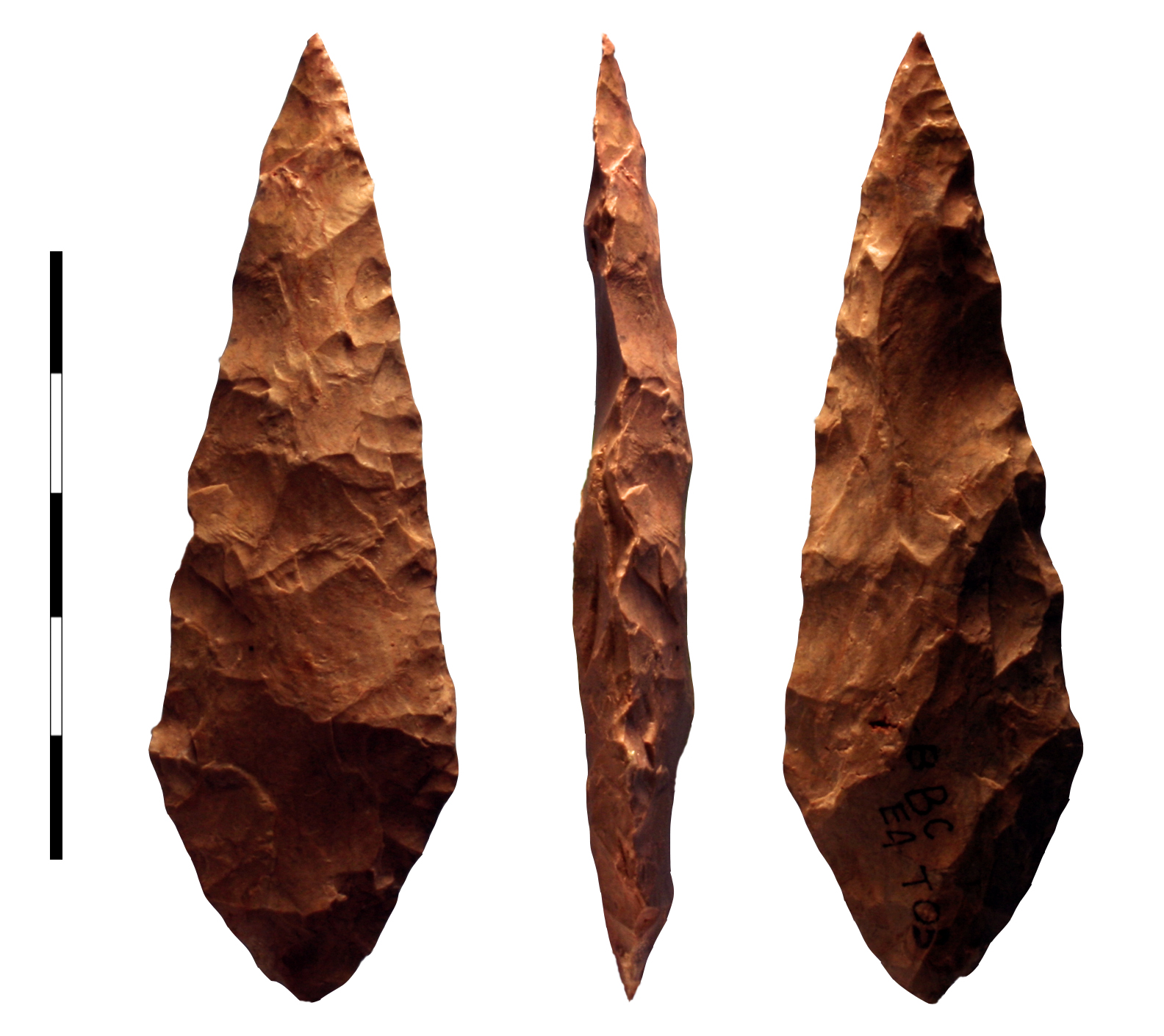
The progression of stone technology during the Paleolithic era
showing the evolution of stone tool processing.
(Left) Acheulian flint chopper, North Somerset, UK; ca. 750 kya.
(Middle) Lower Paleolithic flint stone tool, Egypt; ca.200 kya.
(Right) Bifacial silcrete point; Blombos Cave, South Africa; 71 kya.
In the late Paleolithic period, tools became even more sophisticated. As many as 80 different types of implements have been unearthed for what are called the Perigordian and Aurignacian industries in Europe. It is believed that these tools were used for hunting and butchering, clothes making, and a great variety of other tasks that moved early humankind closer to modern life. In all, hundreds of highly complex tools have been found, some of which are the prototypes for modern tools.
STONE TOOL INDUSTRY
https://www.britannica.com/topic/stone-tool-industry
While understanding an individual process was limited to particular materials and desired results, all processes involved a sense of time. Each step had to be done in a certain order, for example, and the eventual outcome was dependent on past steps that had been done correctly. Advanced processes often required precise conditions for specific durations of time -- such as the exacting heat treatment of silcrete (see below) to make it as workable as flint. The resulting stone was essentially an "artificial flint." 

AN EXAMPLE OF A LATER COMPLEX PROCESS WHICH CONTINUED TO DEVELOP

The Heat Treatment Of Silcrete For Stone Tools
Approx 130 - 60 kya

About 130 kya Paleolithic people learned to heat treat certain kinds of locally available stones. Instead of needing to use flint, for example, they, in a sense, made their own "artificial flint" by treating silcrete so that it had flint-like properties, which made it an excellent material for tools and arrows. The heat treatment made the stone harder, less prone to fracturing and easier to shape. Over perhaps 70,000 years into the Middle Paleolithic era (the time before the Upper Paleolithic cultural explosion), this technique became quite sophisticated. 

Beginning with an above-ground method of placing stones in a pile of embers, it evolved into a well crafted controlled method that used "underground heating in an earth-oven like fire-pit. (sciencedaily.com -- see reference next)" This is a good example of the evolution of a Paleolithic process and the increasing complexity, precision, and sophistication that was achieved.
The "silcrete heat treatment...may provide the first direct evidence of the intentional and extensive use of fire applied to a whole lithic chain of production."
"This heating process marks the emergence of fire engineering as a response to a variety of needs that largely transcend hominin basic subsistence requirements,"
"Early humans used innovative heating techniques to make stone blades." Science Daily. October 20, 2016.
https://www.sciencedaily.com/releases/2016/10/161020092107.htm
It was familiarity with a wide variety of processes, including stone-tool making, that eventually led to an understanding of linear time. This was crucial for the transition from animal behavior to behavioral modernity and for the development of language. 

Working with processes led to the development of a number of cognitive skills that were essential for behavioral modernity. Memory, a sense of time in terms of past, present and future along with a sense of time duration, goal-directed behavior, cognitive skills, and decision making came together as a result of managing a variety of complex and changing processes. In addition, there developed a way to teach and train each generation in these skills. Eventually, this culminated in modern human behavior including a full early language and a way to express linear time.

Example of heated silcrete stone that was then shaped 
(the same stone seen from different angles).


THE PREFRONTAL CORTEX

The Homo sapiens brain was more than twice as large as the brain of Homo habilis and 1.5 times bigger than the brain of Homo erectus. But in addition, Homo sapiens had a distinct part of the brain that was unlike that in any other animal. This part is called the prefrontal cortex. And it is only in the last decade that we have begun to understand that this recently discovered area was critical when it came to planning, cognition and understanding the linear progression of time.

I believe an ability to work with complex processes and then to innovate came about because both the larger brain and the prefrontal cortex given to Homo sapiens allowed them to do so.

A full description of the prefrontal cortex is best left to scientific sources, so what follows are descriptions from scientific websites.
"This part of the association cortex, which is implicated in higher cognition and affect, is thus disproportionately large in humans relative to other primates."
Stern, Peter. The human prefrontal cortex is special. Science. Science22 Jun 2018 : 1311-1312.
https://science.sciencemag.org/content/360/6395/1311.7
"This brain region has been implicated in planning complex cognitive behavior, ... [and] decision making...The basic activity of this brain region is considered to be orchestration of thoughts and actions in accordance with internal goals." [ED: i.e., the future]
Prefrontal Cortex. The Science Of Psychotherapy. 2017.
https://www.thescienceofpsychotherapy.com/prefrontal-cortex/
I was one of the first writers in 2014 to focus on the prefrontal cortex as a critical component in our ability to understand and conceptualize linear time. We are the only animal that has this capability. See my most popular article (more than 10,000 readers since 2014) about the prefrontal cortex: 

Animal Senses Compared to the Human Sense of Time

PROCESSES, TIME AND PROTO-LANGUAGE

After two million years, with their increased brain size and the added abilities of the prefrontal cortex, hominins began to develop a language and a set of conceptual tools that gave them greater control over their use of processes. 

In particular, language gave humans the tools to work with time. Language could express basic linear time concepts that allowed them to imagine processes, the order of the steps involved and the duration of each step. It also allowed them to imagine different outcomes and to share and discuss processes. And, of course, language was used to instruct the next generation.

Linguists and anthropologists assume that a fully developed language, even the most basic language, would have had words that expressed concepts of time. 

Anna Wierzbicka made a list of what are known as Semantic Primitives as listed by the Natural Semantic Metalanguage. The following are universal words for time that occur in all languages:  
when/time, now, before, after, a long time, a short time, for some time, moment

It is important to note that language and time concepts are closely linked. 

"Time reference is a universal property of language..."
Jacqueline Lecarme, Ph.D., Linguistics

And since processes proceed step-by-step, they became a model and metaphor for time, not unlike a clock which advances step-by-step as the hands of the clock move forward.

We can find examples of this today such as in this expression:
Your idea is half-baked. 
This comes from the process of cooking where the bread was not given enough time to bake.


CONCLUSION

Since hominins had been working with processes for millions of years, they were familiar and comfortable with them. So the eventual awareness of linear time that processes involved and the conscious understanding of the process steps evolved naturally. 

And this is why an understanding of processes is so important. Processes became the model and the metaphor for linear time along with duration. And once language and modern human behavior was achieved, humans had even greater control over their processes and their ability to control their environment. This eventually led to the Upper Paleolithic, the Neolithic and then to civilization.

________________________________________

AFTERWORD

ABOUT PROCESSES

I am quite familiar with processes. I processed my own black and white photographic negatives and then developed prints from those negatives for fifteen years. Negative processes involved time, temperature and proper handling, such as agitation. The initial spooling took place in the pitch dark.

I soon learned that what I did at the beginning greatly affected the end result. So as time went on, I became more precise. I learned to make accurate photographic exposures before developing so that the chemical process of developing produced a fine-grained thin negative with a full range of tones. And I added a couple of steps to standard developing that improved the results such as using distilled water as a pre-soak and diluting the developer for more control over the development time. 

Then I developed my own black and white slides which was even more exacting.
And finally, I developed color slides. This process was the most involved and the most precise. Color slides, for example, required that the developing solution had to be 100 degrees F +/- 1/2 degree for a very specific duration of time. 

I say all of this because I do understand how processes work and how they evolve. Whether I am talking about photographic processing or making stone-tools in the Paleolithic era or preparing esparto grass for basket weaving or for making rope, basic step-by-step procedures are common to all.

THINKING OUTSIDE THE BOX?

I realize that my ideas may seem a bit different and unusual to Paleoanthropologists, but consider:
"Tools are the products of our brains, and we have millions of stone tools," Wynn added. "What we need are more creative ideas on how to extract understanding from them, and what they tell us about our evolution." Quotation from paleoanthropologist Thomas Wynn of the University of Colorado at Colorado Springs.
Choi, Charles. "Human Evolution: The Origin of Tool Use." LiveScience, November 11, 2009. https://www.livescience.com/7968-human-evolution-origin-tool.html. Accessed 10/26/2019.
A Caveat: While I believe that Homo sapiens became aware of linear time and were able to use it to their advantage, their sense of time was quite different from our own. I discuss this in other articles I have written.


Thursday, January 19, 2017

Choosing Your Personal Time-Style

Choosing Your Own Personal Time-Style


INTRODUCTION


This blog, now in its fifth year, has been about the human experience of time. And there is nothing more personal or, I would suggest, more important than crafting you own individual relationship to time. 

This particular blog-post is about finding your own 'time-style'. It is also about making you more aware of time demands that the society and family put on you. Plus it is about making you more aware of your own feelings. If you can take  control of how you function in relation to time, you will feel better about your life.


This modern digital display of time (left) reinforces the notion of linear time, time always going forward, unlike this circular clock with hands (right) that emphasizes the repeating and cyclical nature of time.

Each society thinks its understanding of time is correct and absolute. But this is not true. Although each culture must live with time as a fact of life, there are many different ways of both thinking about and relating to time, i.e., time-styles. See the AFTERWORD part of this blog-post for descriptions of how other cultures deal with time.


HOW OUR CULTURE TEACHES US ABOUT TIME


From the time we are born, we are indoctrinated with and held accountable to an understanding of time. 

In the United States, for example, we are expected to 'be on time,' to 'save time' for important things, to not 'waste time', to manage our time wisely -- time, after all, is money. Time is considered something you own: if you have 'got time' you might go to a party, for example. Virtually everyone from parents to teachers to coaches to bosses to co-workers will express this same understanding of time. Everyone assumes this is simply the reality of time -- and like it or loath it, that is how time operates. 


A traditional time card system for employees to log in 
and log out of work by punching a time card.

However, this is not true. Different societies have quite different concepts of time and different ways of functioning. 

Nevertheless once you realize that your own society's concept of time is not written in stone, you will still need to meet people's expectations about scheduling. If you have a job, you should be on time and not be surprised if you are reprimanded for being late. But work is 40 hours a week, so 72 hours a week (after 8 hours sleep a night) is yours to do as you please. 
“Your time is limited, so don't waste it living someone else's life. Don't be trapped by dogma - which is living with the results of other people's thinking. Don't let the noise of other's opinions drown out your own inner voice. And most important, have the courage to follow your heart and intuition. They somehow already know what you truly want to become. Everything else is secondary.” Steve Jobs https://www.goodreads.com/author/quotes/5255891.Steve_Jobs 
Your relation to time has a lot to do with how you feel about your life. It will affect your marriage, your work, your sense of worth and your sense of who you are. If you feel rushed and over burdened, then you may have a negative view. If you can do things at a comfortable pace, you will feel more at ease. While there are many things you cannot control, there are many things you can. 

I believe there is a simple relationship between your sense of self and time: how you spend your time, which includes time spent in your thoughts, is who you are.


"I know for sure what we dwell on is who we become."
Oprah Winfrey
 In the United States and other industrialized countries, people are encouraged to go, go, go -- or "live life to the fullest by doing more." Energy drinks, such as the one pictured here, encourage people to keep going non-stop.


MY OWN PERSONAL 'TIME-STYLE' SOLUTION 


Perhaps the best way to illustrate what I mean about time-styles, is to give you specific examples from my life. 

I realized that if I could live inexpensively I would not have to earn as much money and I would have more time for my marriage and my art work -- the two things that were most important to me. The more I could do by myself such as car repair and heating with wood, the more money I could save and the more independent I could be. Also when I did my own work I avoided taxes -- because instead of earning money that I paid taxes on and then hiring someone or paying the oil company, I simply did the work myself. In a sense I was paying myself.

Knowing how to save money gave me more independence as well, because the time I spent buying used items or comparison shopping or doing repairs was time I did not need to spend at a job. Car repair is a good example. Not only did I save money, but also time as I did not have to wait at a repair shop or find a second car while my car was being fixed. And if my car broke down on the road, I could often figure out how to get it back running. Since I was living far out in the country at the time, this made a lot of sense. 

As for earning a living, I started a business as a freelance photographer and I also taught independent photography classes at night. I made a point of being prompt and prepared for all my work but freelancing gave me the flexibility to decide which classes I would teach and which jobs I would accept.

➜Short Overview Of My Own 'Time-style'
  • Live cheap -- e.g. buy things used, learn a number of diy skills, comparison shop 
  • Teach independent photography classes at night
  • Take freelance jobs and conform to the time demands of any job, which would be short term so it would not be too disruptive
  • Never promise to do a job that I could not fulfill as agreed -- be reliable, on budget and on time
  • Work on my art during the times I was not earning a living
  • Have time for activities with my wife
My method for saving money was so complete, I co-authored a book entitled Cheaper published by Random House about my methods:
Cheaper: Insiders' Tips for Saving on Everything 
https://www.amazon.com/Cheaper-Insiders-Tips-Saving-Everything/dp/0345512081 


LEARN THE DISCIPLINE OF TAKING TIME OFF


One of the successful people interviewed on the program RoadTrip Nation that airs on PBS made the following point: When you work hard to achieve a goal and you succeed, there can be a kind of let-down because what do you do now, what do you do next? His point was that when you achieve something, don't immediately rush into doing the next thing but instead relish the moment of success. He further added that learning to relax and enjoy that moment was a discipline in itself.

I found this quite interesting as I have always tried to take a day off when I got a job I wanted, won a prize, got a book published, got my degree in college, had an art exhibit etc. And I highly valued that moment of success in and of itself. It was like hitting a peak note in a song or a central chord in a symphony. "Aha," I would think, "I did it. Who knows what tomorrow will bring, but for now I can say I have reached a place I wanted to reach." 


Relaxing in a hammock by the sea.

Learning To Put Aside Your 'Checklist Clock'

Whether we realize it or not, each of us in the developed world carries around what might be called a 'checklist clock'. We are constantly referring to this checklist from minute to minute and as a result checking off what we just did, concentrating on what we planned to do at that moment or will do later -- often living a distracted life that seems a bit empty. 
While this is necessary for the time you are 'on duty', learn to turn that clock off when you are 'off duty' and learn to experience the now moment, that wonderful sense of time we all had when we were children. While planning and scheduling and doing your work are important, it is also important to regularly be 'in the moment' to lead a fulfilling life.

"Clocks slay time... time is dead as long as it is being clicked off by little wheels; only when the clock stops does time come to life." 
William Faulkner


THE DIFFERENT TIME-STYLES OF DIFFERENT PEOPLE


I have a friend who says he has two time-styles: fast and slow. When he is working, he is all business; when he takes time off, he relaxes completely and there is no schedule. He is comfortable with this and it seems to fit his personality.

I have another friend who likes to work hard and play hard -- which seems to fit her personality. 

However, I have other friends who always seemed rushed, out of time and with more things on their list than they can possibly do. They complain a lot and feel they are under too many demands.

It is up to you to find your own time-style -- and while there will always be things that you must do that you would prefer not to do, you can learn to gradually shape your life so that it roughly matches your particular time-style.

Understanding your time-style can become a guideline for your life. It is a goal you can aim for -- but often outside demands will take over. Nevertheless, you can learn to navigate the demands in your life so that they begin to be in-tune with your own personal time-style.


VARIOUS THOUGHTS ABOUT TIME-STYLES


➜The Myth Of 'Having It All' In The United States

In the United States we are often told the myth that we can 'have it all': a good marriage, a healthy family, an exciting career and enough money. But this is a myth. Barbara Walters once said that everyone wants a marriage, children and a career but you only get two out of the three. Not a simple choice -- but probably realistic. And even if you do achieve 'having it all' you will probably be too tired and stressed to enjoy it. 


Timers like this 5 second counter make us intensely, 
if not uncomfortably, aware of the passage of time.

➜Your Expectations

Be aware of your expectations. They are powerful and set the tone for how you view your life and your path in life. If you set them too high, you will always be disappointed. If you set them too low, you may not be able to achieve what is possible. Try to be realistic and flexible. As you gain more experience, reset your expectations accordingly.

➜Your Time-style May Change As You Age

I think that an individual's time-style can and will change during different periods in their life. When I was in college I loved being around lots of people both in class and late at night in coffee shops, along with working in a group on a class project -- and all the various time demands these required. Now that I am much older, I usually prefer to work alone and do not like being interrupted. 

➜Advertising

The tens of thousands of ads we see in the United States each year (and I assume in other countries) have one overall message: buy something better, do something better, never be satisfied. The Lowe's hardware and building supply store has the slogan: "Never Stop Improving." In other words the message is you should never be content but always striving toward the future and always be a bit dissatisfied with the present. So the 'now moment' is devalued, as is your enjoyment of it. This is a perfect example of linear time in a culture (see more about linear time in the Afterword).


A VERY PERSONAL EXAMPLE OF TAKING CONTROL


When I was at boarding school, I had no control over my schedule and I rarely got enough sleep. I had to be in chapel every morning at 8 o'clock. The first class was at 8:30 AM and I never did well in a class scheduled for that hour. When I went to college, I learned how to pick classes that met at later times. I never took a course before 10 AM and I made sure I got at least eight hours sleep at night. My grades improved and I was on the Dean's list the entire time. 

MY ADVICE
Listen to your body. It will tell you if you are stressed, anxious, comfortable, getting enough sleep, rested, on edge or out of tune with the things you really want in your life. Men in particular are taught to ignore these physical signals -- to 'be a man'. Forget that. Instead learn to listen to the pleasure and the pain of your body as it will guide you. 

New Research Shows High School Students Don't Get Enough Sleep


It turns out that probably none of us got enough sleep when we were in high school. This happened because our culture had fixed ideas about how teenagers should be conditioned. We were expected to go to bed at 10 PM and get up at 6 AM -- eight hours sleep. BUT studies now show that teens need to go to bed at 11 PM and get more than 8 hours of sleep. This means that they should not get up until 8 AM. This is not coddling, this is good sense as it brings the human biological needs in line with the needs of the culture. The culture will benefit because students will pay better attention and be more willing to do work. And it might reduce the well known teenage rebellion tendencies as well.


High school students taking a lunch break between classes.

Findings From Recent Research

These recent studies (cited next) have shown that teenagers operate on a different clock than adults. Teens who are allowed to go to bed later and get up later perform much better in school. So what I did with my college course load -- when I had control -- turned out to be intuitively correct. This is a good example of following your intuitions about your own personal time-style and sleep needs.

Biological sleep patterns shift toward later times for both sleeping and waking during adolescence -- meaning it is natural to not be able to fall asleep before 11:00 pm.
Teens need about 8 to 10 hours of sleep each night to function best. Most teens do not get enough sleep — one study found that only 15% reported sleeping 8 1/2 hours on school nights.
https://sleepfoundation.org/sleep-topics/teens-and-sleep 

Research shows that teens need eight to nine hours of sleep at night, as compared with eight hours needed for adults. However, they are not getting enough sleep. A recent study at Drexel University of students aged 12 to 18 found that "20 percent of those studied got the recommended eight or more hours of sleep during school nights with the rest getting less than eight hours. The average sleep for U.S. adolescents is seven hours..." A study of Rhode Island teenagers found that "85 percent were chronically sleep-deprived and accumulated a minimum 10-hour sleep deficit during the week. Forty percent went to bed after 11 p.m.; 26 percent said they usually got less than 6.5 hours on school nights." Thus, sleep deprivation in teens is causing a growing concern among researchers, educators and parents.
http://www.mathgoodies.com/articles/teens_sleep.html 

Personal Note

This new understanding about teens and their sleep needs is quite personal to me. One of my best friends at boarding school kept oversleeping in his senior year and was eventually kicked out for that reason. A brilliant and thoughtful student, being thrown out of school affected him for the rest of his life.


SOME THOUGHTS AND SAYINGS ABOUT TIME


"New York Minute"
It appears to have originated in Texas around 1967. It is a reference to the frenzied and hectic pace of New Yorkers' lives. A New Yorker does in an instant what a Texan would take a minute to do.
http://www.urbandictionary.com/define.php?term=New%20York%20Minute 


New Years Eve at Times Square NYC.

"It ain't over 'til it's over."
Yogi Berra
https://en.wikiquote.org/wiki/Yogi_Berra 

"Time You Enjoy Wasting is Not Wasted Time"
Don't beat yourself up over activities that are generally not what society considers to be worthwhile. If you're enjoying yourself and if it's making you happy, the time is well spent.
http://www.popsugar.com/smart-living/photo-gallery/34157152/image/34181854/Wasted-Time 


Steve Jobs holding the iPhone 4.

"And the only way to do great work is to love what you do. If you haven't found it yet, keep looking. Don't settle. As with all matters of the heart, you'll know when you find it."
Steve Jobs

"No one is busy in this world. It's all about priorities."
http://www.popsugar.com/smart-living/Life-Changing-Inspirational-Quotes-34157152#photo-34181328 

"Slow Parenting" (a phrase in the Urban Dictionary)
The movement to raise children with less pressure, more free time to play. Anti helicopter parenting.
http://www.urbandictionary.com/define.php?term=Slow+Parenting 

"We need to have two time skills:
one by the clock
the other off the clock"
Rick Doble


AFTERWORD


Susan Reynolds writes that today in the world 
there are three basic time-styles:
  • Linear: These cultures "view time as a precious commodity to be used, not wasted" -- as in the United States (also Anglo-Saxon, Germanic, and Scandinavian societies)
  • Flexible: These "cultures...view time as flexible [and] are reluctant to strictly measure or control it." (Italians, Spaniards, Portuguese, Greeks, Arabs, and Latinos)
  • Cyclical: "In cyclical time cultures, however, time manages life, and humans must adjust to time. In these cultures, time is neither viewed as linear nor as event/person related, but as cyclical, circular, repetitive. " (Asian, African, Native American)
The above is quoted from the following website
Linear, Flexible, and Cyclical Time: Analyzing Time in Cross-Cultural Communication
By Sana Reynolds, PhD
http://consultingsuccess.org/wp/?page_id=1204 


Relaxing on the beach.

The Sense Of Time In Different Cultures
quoted from The Exactly What Is Time Website
  • Future-orientated cultures: tend to run their lives by the clock, such as the United States
  • Past-orientated cultures: like that of India, for example, are much more laid back
  • Present-orientated: cultures like those in France that see the past as gone and the future unsure
  • No time orientation: The peaceful Hopi tribe of Arizona, USA, as well as some other Native American tribes and other aboriginal peoples around the world, have a language that lacks verb tenses and their language avoids all linear constructions about time. 
http://www.exactlywhatistime.com/other-aspects-of-time/time-in-different-cultures/ 


Another Definition Of Linear Time Vs. Cyclical Time
  • Time is non-linear, cyclical in nature. Time is measured in cyclical events. The seasons are central to this cyclical concept.
  • Time is usually linearly structured and future orientated. The framework of months, years, days etc. reinforces the linear structure.
The above was quoted from the following website:
http://www.ictinc.ca/blog/indigenous-peoples-worldviews-vs-western-worldviews