Saturday, October 31, 2020

Free eBook: Illustrated Theory of Paleo Basket-Weaving Technology

The Illustrated Theory 
of Paleo Basket-Weaving Technology 
by Rick Doble

Download Free 140-Page PDF eBook
-- no strings --


ABSTRACT: 
7 original articles concerning the Paleolithic development of woven-fiber technology, illustrated with approx. 200 photographs and pictures. More than 100 years ago Gustave Chauvet wrote that he believed basketry and simple weaving were present in the Upper Paleolithic sites he had studied. Yet it took almost that long to convince experts that this was the case. The discovery of irrefutable evidence in the form of impressions of weaving in clay provided the proof. Now it is also clear that basket-weaving and textile-weaving were not incompatible with the hunter-gatherer Paleolithic lifestyle and did not require the sedentary settled Neolithic way of life as had been assumed. This opens up the idea that basket-weaving or woven-fiber technology as I have called it, could have begun even in the Lower Paleolithic, millions of years ago. In these 7 articles, I outline how basketry could have begun perhaps two million years ago and then how it could have developed until the rise of the great civilizations of Sumer and Egypt which depended on this technology. I include ideas about how to find indirect evidence of basket-weaving in the Paleolithic era.

DOWNLOAD NOW
Figshare

Academia.edu


Wednesday, September 30, 2020

The History of a Rejected Idea: Basket-Weaving in the Paleolithic Era

The History and Final Acceptance
 of a Rejected Idea:
Basket-Weaving in the Paleolithic Era

ABSTRACT: 
More than 100 years ago Gustave Chauvet wrote that he believed basketry and simple weaving were present in the Upper Paleolithic sites he had studied. Yet it took almost that long to convince experts that this was the case. The discovery of irrefutable evidence in the form of impressions of weaving in clay provided the proof. Now it is clear that basket-weaving and textile-weaving were not incompatible with the hunter-gatherer Paleolithic lifestyle and did not require the sedentary settled Neolithic way of life as had been assumed. This opens up the idea that basket-weaving or woven-fiber technology as I have called it, could have begun even in the Lower Paleolithic, millions of years ago. What follows in the rest of this article is a summary of my seven articles over the past year in which I outline how basketry could have begun perhaps two million years ago and then how it could have developed until the rise of the great civilizations of Sumer and Egypt which depended on this technology. I conclude with ideas about how to find indirect evidence of basket-weaving in the Paleolithic era. 

See a listing of 14 blogs about basket weaving technology from its earliest stages in the Paleolithic era to its implementation in the world's first civilizations.

    Free Download    
A PDF of this blog-article at: 

https://unc.academia.edu/RickDoble/DRAFTS#drafts

   ALSO FREE:   
 The Illustrated Theory 
 of Paleo Basket-Weaving Technology 

 by Rick Doble 
 Download a 200-Page PDF eBook 
 -- no ads/no strings -- 
 DOWNLOAD NOW 
  Figshare  
  Academia.edu  


"Many...creation myths place basketry
among the first of the arts given to humans."
Basketry. Editors, Encyclopedia Britannica. (https://www.britannica.com/art/basketry)

INTRODUCTION

After reading an almost forgotten book by noted French archeologist Gustave Chauvet, Dr. Paul Bahn wrote in 2001 that, “It is a long overdue development that, 90 years after Chauvet’s publication, prehistory seems ready to at last accept the probably HUGE IMPORTANCE OF BASKETRY [ED: my emphasis] and simple weaving in the Upper Palaeolithic.” [1]

54: Bone Needle  55: Bone Awl  57: Rod of Reindeer Antler
A Paleolithic basket-weaving toolkit?

This picture, from a book by William Boyd Dawkins in 1880, shows bone tools found in the Church Hole cave in Britain.[2] These were dated to the Magdalenian era, i.e., to the end of the Upper Paleolithic about "12,500 and 12,200 years ago" according to the Durham University Website.[3] These implements were found 30 years before Chauvet suggested that baskets might have been made during this time period.

These Magdalenian, Upper Paleolithic tools shown above, are entirely consistent with tools used to make baskets. (A stone cutting tool needed for basketry was also found in the cave but not pictured here.) As the California Parks website stated when writing about American Indian Basketry and the Indian way of life -- which is considered to be very similar to European Upper Paleolithic,[4] -- "Whether coiled, twined, or plaited, baskets were woven...with little more than an awl and knife."[5] The book Basket Making of 1901 added that a single large knitting needle was also useful.[6]

The tools pictured here are similar to what Chauvet found and were from the same period, the Magdalenian, that he had studied in the Grotte du Placard in France and on which he based his ideas of the existence of basketry in the Upper Paleolithic.[7] But his ideas were ignored for 90 years until there was irrefutable proof.

This photo shows an almost complete contemporary basket-weaving toolkit.
The tools are a knife, awl, curved awl, and rapping iron.
It is from the basket making website of Willow Basketmaker (https://www.willowbasketmaker.com) reprinted by permission.
A small number of tools are all that is required to make baskets and woven objects. All of these tools or similar tools could have been made by Paleolithic people, as their basic design is not difficult. So it is possible that many of the unidentified tools that have been found in Paleolithic caves could have been basket-making tools. 


A NEW STORY OF THE DEVELOPMENT OF HUMAN TECHNOLOGY

The acceptance of evidence about basket-weaving in the Paleolithic era rewrites a considerable amount of history and changes basic assumptions that have been around for at least 150 years. Furthermore, it could alter the story of human evolution, human cognition, and the development of culture along with our understanding of who we are, what we believe, and how we got where we are today.

Recent discoveries have more than confirmed Chauvet's intuition. He was talking about weaving in the Magdalenian era which is 17,000 - 12,000 BP, the period just before the Neolithic farming era. But today recent discoveries have confirmed that weaving and basket making existed about 27,000 BP, a time period firmly in the Paleolithic era when humans were hunter-gatherers and long before they began the sedentary lifestyle of farming.[8] Moreover, the sophistication of the discovered weaving indicated that it had begun many thousands of years earlier.[9]

And this is one of the key points. Until this idea was accepted, the general assumption was that basket-weaving and textile weaving were too labor-intensive to be compatible with the mobile nomadic hunter-gatherer lifestyle. 

"The conventional wisdom has been that a time-consuming task like weaving would only be practiced by sedentary, agrarian cultures. [ED: i.e., Neolithic societies]" said Dr. Adovasio in an interview with Discovery Magazine.[10] However, this was only an assumption which evidence did not justify. And later it was discovered in a study of contemporary Philippine groups that hunter-gatherers actually had a lot more leisure time than farmers.[11]

So for almost 100 years, it was assumed that basket-weaving and such could only have begun when people settled down to farming in the Neolithic era. And while clear evidence of basketry and weaving was found in the Neolithic time period, nothing obvious was found in the Paleolithic era -- so this confirmed everyone's assumptions. 

The odd thing is that virtually everyone agreed that there had to be other technologies in the Paleolithic era that were based on wood and plants, but they were reluctant to venture a guess or to find ways to look for them.

Absence of evidence is not evidence of absence.
Carl Sagan
"In whichever way archaeological remains are interpreted, one must always be aware that the vast majority of the materials with which prehistoric people were surrounded and with which they worked is lost to us today. ...organic materials start to decay as soon as they are deposited in the ground." [12]
"This lack of archaeological visibility contrasts with the importance attributed to these perishable materials and techniques in some ethnoarchaeological studies, which highlight the extremely high proportion of objects made with them and the techniques compared to those made from stone and bone."[13]
Pre-conceptions and presumptions are sometimes more of a barrier to scientific inquiry than a lack of evidence. In a famous historical example, Darwin realized that his theory could only work if evolution occurred over millions of years and not the six thousand years that most experts assumed was the age of the Earth, which had hampered geological science for centuries.

The absence of evidence does not indicate evidence of absence as Carl Sagan used to say. While looking for evidence of plant material that has completely decayed is virtually impossible, there are other indirect ways that can give clear indications. In the case of Drs. Soffer and Adovasio, who proved that weaving occurred in the Paleolithic era, they found clay fragments that held distinct impressions of weaving.[14] In another case, wear patterns on bone tools pointed to the use of fiber ropes.[15]

So today researchers are open to the possibility that basket-weaving and textile technologies began many more years ago in the Upper Paleolithic or as long ago as 40 kya although evidence gets harder to find the further a researcher goes back into the past. 

But this discovery by Drs. Soffer and Adovasio has even greater implications. Accepting the fact that hunter-gatherers utilized basket-weaving and simple textile weaving opens the door to a much greater time span for the development of these technologies. Before the acceptance of this idea, the assumption was, as I said,  that a sedentary Neolithic lifestyle was required, but now that this barrier has been overcome, I believe the entire Paleolithic period of the hominid hunter-gatherer existence should be examined -- meaning Upper, Middle, and even Lower Paleolithic.

This is important because finding evidence in the distant past could change our view of human development. For example, if basket-weaving began one million years ago with Homo erectus, it might lead to major changes in our understanding of human cognition, evolution, and culture.

NEW QUESTIONS

SO NOW THERE ARE A NUMBER OF NEW QUESTIONS:
#1. When did basket-weaving, or weaving or textile weaving start and how long did each stage take to develop? 
#2. How did it begin and how did it develop?
#3. Where did it start and where did it spread to?

Over the last year, I have written seven articles about the possible early beginnings of basket-weaving and its importance to the human narrative. While I am certainly not the first person to suggest that basket-weaving began much earlier than previously thought and that it was perhaps a key technology that affected human development, I may be the first to attempt a general outline of how basket-weaving could have begun a million or so years ago, much earlier than previously thought. And then I outlined how the technology could have developed at different points on the timeline and in successive societies. Because it is one thing to show that this technology existed around 27,000 years ago but another thing to describe a possible scenario of its earliest beginnings and development.

THE ORIGINS OF BASKET-WEAVING
Please Note: The following footnotes 16-19, 21, 23 link to and refer to my detailed articles about different aspects of prehistoric basket-weaving.
In the scenario, I have proposed basket-weaving was the mother art form. All other fiber arts including textiles and cordage came from basket-weaving.

Basic basket-weaving could have begun in any of the Paleolithic periods, but the following scenario takes the technology back to the earliest days of humankind. 

I believe that basketry could have begun almost 2 million years ago using a basket model derived from the complicated woven nests of weaverbirds. I have been able to prove that Homo habilis (or Oldowan toolmakers) lived in Olduvai Gorge on the savanna in Africa at the same time as weaverbirds according to the fossil record.[16] And I have also shown that early hominids lived in close proximity to weaverbirds since they both congregated around baobab trees.[17] 

I believe that hominids with an upright stance and two free hands would have seen the advantage of carrying baskets and been inspired by the weaverbirds. The construction of the first baskets would have been based on a 'random weave'.[18] Such baskets could be quite strong and light. These baskets would have given early hominids a survival advantage since it meant that they could gather abundant food and different food far from their camp, for example, which would not have been worthwhile without these baskets. Without baskets, they would have spent more energy getting to the food than they got eating the food.

LEFT: A weaverbird nest.
RIGHT: A random weave basket made by a human being. It is both strong and light and capable of carrying up to four kilograms (about 9 pounds). Photo and basket by Nan Bowles.

As many anthropologists have suggested, a technological advantage such as this would have helped in the evolution of hominids leading to a bigger brain and a smaller gut size. In addition, the cognitive skills basketry required would also have had a significant impact on evolution and culture as well.[19]
As Kathy Schick and Nicholas Toth pointed out, "It is likely that this phenomenon of accelerated brain expansion in the human lineage was due to the ability of hominins to access higher quality food resources through the use of technology, which allowed for a decreased gut size and increased brain size."[20]
Then over perhaps the next million years, the powerful right-angle design of baskets (the spoke strands and the weaver strands at right angles to each other)[21] would have developed which then allowed an almost limitless number of items to be made in various sizes and configurations. Once mastered a wide variety of items could have been made from mats to sandals and hats to houses and boats. These products were both highly functional and durable.

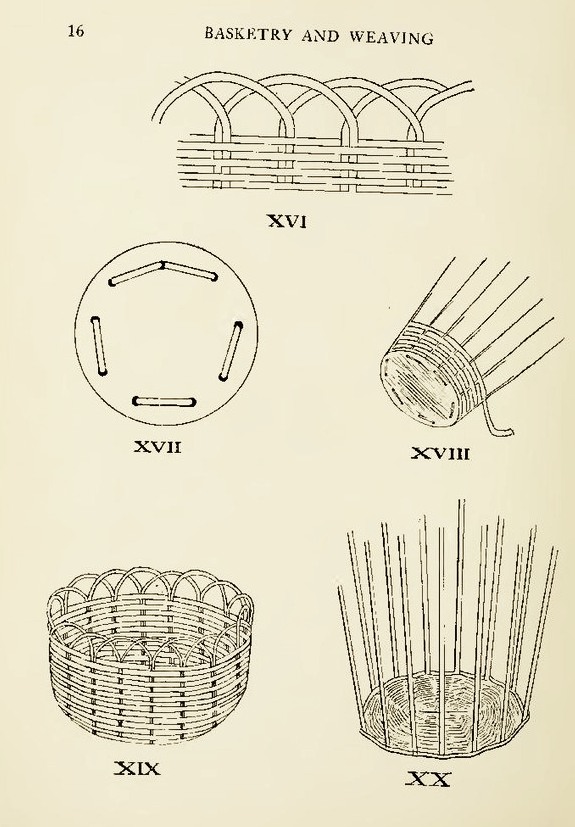
The right-angle design of baskets. An instruction page for school children
showing the right angle construction of basket-weaving.[22]

Cordage probably began about the same time as the first baskets, but textiles probably did not develop until basketry was quite advanced although it appears (according to the clay impressions found) it had begun by the Upper Paleolithic era.

Textiles seem to have developed rapidly in the Neolithic era along with a full range of related basket-weaving techniques designed for farming, food processing, thatching roofs, building houses, walls and fences, and for numerous other necessities.[23]

This is a model of the Tigris, a large reed boat. Built by Thor Heyerdahl of Kon-Tiki fame, the Tigris was 18 meters (about 60 feet) with a crew of eleven. It was a recreation of a 5000-year-old design used by Sumerian sailors and traders in the earliest days of civilization. Constructed with weaving technology, it was capable of carrying 50 tons of cargo according to Heyerdahl. It sailed from southern Mesopotamia to Pakistan and after six months was still in excellent condition.[24]

Basket-weaving and related skills then became fully developed with the rise of the great civilizations of Sumer and Egypt. These civilizations could not have functioned without basket technology as they were used throughout agriculture, fishing, and also in the storage of grain. 

Egyptian agriculture used woven-fiber sacks and baskets for planting, harvesting, transporting, storing, and processing. Without woven-fiber technology, Egyptian civilization could not have functioned.
(Left) Ancient Egyptian model of a granary with scribes. This model was found in a tomb and shows men delivering grain in woven sacks, which is being recorded by scribes.
(Right) Ancient Egyptian painting of men carrying and delivering sacks, from the Tomb of Oumsou.

I realize that I am suggesting a scenario that goes way beyond what most researchers have considered. Yet it is a start -- which I am sure will need to be modified or discarded.

I invite others to come up with alternate scenarios that describe the earliest beginnings of what I have called woven-fiber technology and its development and then describe how the other related technologies developed later.

FINDING EVIDENCE

Having said all of this, I realize that a major problem, the problem that has always dogged this subject, still remains. And that problem is how do you find clear evidence of basket-weaving or woven-fiber technology? Weaving impressions in clay -- since clay and baskets were often used in combination [25] -- and wear patterns on tools seem to be the most promising indicators.[26] 

Impressions of weaving in clay.
From Prehistoric Textile Fabrics Of The United States, Derived From Impressions On Pottery 
by William Henry Holmes, published in 1884.[27]

Writing about the very early Oldowan tools of a million or so years ago and their use on the African savanna, Dr. Toth of the Stoneage Institute said, "As plant processing in Oldowan times is a nearly invisible activity due to the general lack of preservation of macroscopic plant remains, this microwear evidence provides an invaluable window into this aspect of early hominin adaptation. The plant-cutting knives show classic ‘sickle gloss,’ indicating the gathering or processing of soft plants, whether for food, bedding, or other purposes." And African savanna grasses were also ideal for basket-weaving. [26]

Experimental Archaeology

In addition techniques from experimental archaeology might yield some insights. A contemporary basket maker could try to make random or regular baskets with stone and bone tools copied from Lower, Middle, and Upper Paleolithic tools. They could construct the basket with plant materials that were available during these periods. And trying to recreate possible Paleolithic baskets might spark some new ideas about finding evidence. 

This Acheulean handaxe is about 15 cm long (about 6 inches)
and 6 cm (about 2.5 inches) wide at the top.
"Acheulean handaxes were multi-purpose tools used in a variety of tasks. Studies of surface-wear patterns reveal the uses of the handaxe included the butchering and skinning of game, digging in soil, and cutting wood or other plant materials."[28][29] 

For example, I would like to see what a modern-day basket maker could do with an Acheulean handaxe made by Homo erectus (or another hominid) about 300 kya, such as the one pictured above. Handaxes with a characteristic teardrop shape might have functioned as basket making tools.  The teardrop shape is similar to that of an awl which is one of the few essential tools needed for making baskets. But in addition, the handaxe could have been used to cut plants and also to process the plant material for basket making.

Ethnoarchaeology

Since virtually all societies make baskets, contemporary members of various societies from hunter-gatherers to traditional farming cultures should be consulted. Traditional basket-weavers might be able to identify which Paleolithic tools were probably used to weave baskets along with an understanding of how they were used.

Computer Simulations

Another approach could be computer simulations and "what if?" scenarios. For example, what if Homo habilis made random weave baskets that could carry up to 4 kilos. How would that affect their survival and evolution?
This is similar to other such ideas that have been developed recently. [30]

This is not going to be easy. But perhaps paleoanthropologists have taken the first step. And that step is to acknowledge that such evidence might exist. I believe you cannot find something if you aren't aware that it could be possible. 

Now people are aware. And that is half of the battle, so to speak.


MORE INFORMATION/BACKGROUND ABOUT 
POSSIBLE BASKET-WEAVING TOOLS IN THE PALEOLITHIC ERA

Please Note: Due to copyright restrictions I am limited to the pages I have posted in this article. However, thousands of bone, stone, and other tools have been documented but are under copyright.

Both of these Venus figures are from the Upper Paleolithic and are at least 25 kya. 
LEFT: The Venus of Brassempouy, discovered in 1892, is carved in ivory. 
RIGHT: The Venus of Dolní Vestonice is a ceramic figurine discovered in 1925. 

The sophistication of both of these female figures indicates that by 25 kya (or at least 8,000 years older than the Magdalenian culture that Gustave Chauvet was writing about) Upper Paleolithic peoples were capable of complex, sophisticated, detailed, precise objects. Therefore it stands to reason that they would have been able to make baskets and other related woven-fiber objects.

The following page shows tools and instruments that were discovered in the Raymonden cave in France. The cave was found by Michel Hardy in 1876 and these pictures are from his book about the cave. The finds in the cave have been dated to the Magdalenian, the same time period that was studied by Gustave Chauvet who believed that people of this era were capable of basket-weaving.


These implements pictured above are entirely consistent with the types of tools needed to make baskets. While this does not prove that they were, in fact, used this way, it does suggest that researchers need to study these tools carefully to see if there are any indications about how they might have been used to make baskets and/or weave other objects.[31]

From the 1903 book by M. l'abbe A. Parat, entitled Les Grottes de la Cure (cote d'Arcy).[32]

Many awls from different periods are often found in Upper Paleolithic caves. This page of awls (above) is from the Trilobite Cave in the Arcy-sur-Cure cave site in France. Two of the awls in this picture (#1 and #5) are from the very old Aurignacian period (43,000 to 26,000 years ago) and the others from the Magdalenian and other Upper Paleolithic strata in the cave, This page illustrates how common the awl was to Upper Paleolithic peoples. And, as I have pointed out, the awl is one of the few essential tools needed for basket-weaving. 


The above photo could be of a multi-purpose tool for making baskets. It is made out of mammoth bone and is dated to about 25,000 BP.[33]  It is from the Kostenki (or Kostjonki) Upper Paleolithic culture in Russia. This is the same culture that made a newly discovered huge building out of mammoth bones as early as 25 kya. If they could make such an elaborate and sophisticated building, isn't it possible they could make baskets as well? Anthropologists can only guess how the roof was put together over the building's framework of mammoth bones. “I cannot possibly imagine how they would have roofed over this structure,” said  Alexander Pryor, the lead author of a study of this new discovery.[34] I would suggest that the roof could have been a thatched kind of roof, utilizing woven-fiber technology.

While it is good that basketry technology in the Paleolithic era is now accepted, I have to wonder why it took so long, about 100 years. I believe it is clear from the facts presented in this article that:
#1. Paleolithic people were skilled and intelligent.
#2. They had the tools that were needed for basket-weaving and other woven objects and these tools were found by anthropologists.
#3. They had the plant materials -- as all locations in the world have plants that can be used for woven objects.
#4. They had the need -- to gather more food or to carry tools.
#5. Anthropologists agreed that Paleolithic peoples must have utilized plant materials for tools -- although evidence had disappeared due to decay
#6. It was generally known among experts that virtually all 'primitive' cultures had a basket-weaving technology. For example, baskets, wickerwork, and the like were mentioned more than 75 times in Sir James George Frazer's monumental work about 'primitive societies', The Golden Bough, which was first published in 1890. [35]
#7. It was clear that direct evidence of basketry was going to be almost impossible to find due to the decay of plant materials.
#8. It was/is well established that from the time of early hominids there were sophisticated stone-tool technologies such as the Oldowan and Acheulean. It stands to reason that if there was a technology that we do know about, there could also have been other technologies we do not have clear evidence of.
#9. Other sciences have ways of dealing with unknown factors in their concepts. For example, in astronomy, dark matter and dark energy are largely unknown but considered essential for an understanding of the structure and dynamics of the universe.

Therefore, logically, basket-weaving as a technology should have been on the list of likely technologies that Paleolithic peoples employed. So instead of denying that such a possibility could have existed, I believe that basket-weaving should have been accepted as one possible theory -- subject to change. Accepting it as a possibility meant that archeologists might have been more aware and more tuned-in to indirect evidence, such as wear patterns on tools. Now, as a result, we are, perhaps, 100 years behind in our understanding of the development of early hominid technology.
Speaking about the lack of archaeological interest in basketry, mats and textiles, Grace M. Crowfoot wrote the following in A History of Technology, Volume 1. "In considering gaps in the knowledge of textiles, it must be remembered that there are vast areas where little archaeological study has been undertaken...Surviving pieces of rag were often rejected as without interest...Determination of the exact botanical origin of the fibres used in basketry and weaving has only quite recently been recognized as of archaeological importance."[36]

_________________________

AFTERWORD

COGNITIVE, SOCIAL, CULTURAL, AND RELIGIOUS IMPLICATIONS

If basket-weaving began a long time ago, this has huge implications for cognitive, social, cultural, and religious development.

It is important to understand that in the past basket-weaving was a general term that was applied to woven-fiber items, not just baskets as we think of them today. It is also important to note that basket-weaving was not just a convenience, it was crucial. As you will read next, baskets were used to gather food, process food, and to cook food (Native Americans cooked with baskets, e.g.). They were also used to store food plus special baskets and woven nets were used to trap small game and catch fish.
NOTE: 
I use Native American culture and basketry as an example because many tribes were particularly skilled in basket making and many anthropologists believe that their hunter-gatherer lifestyle was similar to that of the Upper Paleolithic in Europe.[37]
Basket-weaving skills were central to many if not most Native American cultures. "Tribal women provided almost all household tools and utensils, storage containers, cups, and cradles by using one art: basket weaving."[38]

Morse, T. Vernette, Mrs., Basket Making (How To Do It Series).
Art Craft Institute, Chicago, 1902, p.6.

As can be seen above in this image of Native American baskets, quite a few configurations were possible. This has cognitive implications because a basket-weaver would need to have a clear idea of the final product before gathering the materials and starting on the construction.

While stone tool making might have been confined to hunters, basketry could have been tribal wide, and also children may have been instructed in basketry from an early age such as finding plants, preparing plants, and making simple baskets. Basket-making in the past has not been confined to one gender, so it is likely that both males and females and girls and boys made baskets.

To this day both males and females, young and old make baskets. There does not seem to be a gender distinction. However, textiles in ancient times and the goddesses of textiles were almost entirely women.

The fact that basket-weaving was probably tribal-wide meant that it was a common experience that all could relate to. So there could have been metaphors about baskets which became part of the language.

We also know that in many early cultures, baskets had a ritual and religious quality, so it may have been part of their belief system.

LEFT: A Mesopotamian king depicted with a basket on his head performing the basket-bearer ritual which was always enacted before the building of a temple, a ziggurat.[39] 
RIGHT: A computer reconstruction of the Ziggurat of Ur. A ziggurat was a Mesopotamian temple that was at the center of each city.

And -- since this is a blog about the human experience of time -- baskets and the process of making baskets might have been models for time itself. The process of making a basket involved a conception of time and an understanding of the step-by-step procedures. Baskets were divided into grids, each of which took a certain amount of time to make. The steps in making a basket could have eventually become time metaphors, for example.

American Indian Basketry
California Department of Parks and Recreation
Baskets were used for utilitarian and ceremonial purposes. They were well suited to a seasonal subsistence lifestyle once practiced by many Indian tribes because they were light and durable. Various basketry forms were used in the gathering, processing, and cooking of food resources. Important events such as rituals, weddings, and other rites of passage were celebrated with gifts of beautiful baskets decorated with feathers, beads, wool and shell pendants. In all of their forms, these baskets demonstrated the great artistic skill and attention to detail that went beyond their actual usefulness.

Whether coiled, twined, or plaited, baskets were woven from a variety of native plant materials, with little more than an awl and knife. Weavers and their families tended and harvested numerous plants on a yearly basis throughout basket-making communities. 

The preparation of weaving materials often took as long as the actual weaving process itself.

__________________________________________________________________

FOOTNOTES

NOTE:
Many of my sources and ideas were inspired by the following excellent work:
Wigforss, Eva. "Perished Material - Vanished People Understanding variation in Upper Palaeolithic/Mesolithic Textile Technologies." Master Essay, Lund University, 2014.

[1] Bahn, Dr. Paul. (2001). "Palaeolithic weaving – a contribution from Chauvet." Antiquity, 75:271-272.

[2] Dawkins, William Boyd. Early Man In Britain And His Place In The Tertiary Period. Macmillan, London, 1880, p. 185.
https://archive.org/details/earlymaninbritai00dawkrich/page/n7

[3] Department of Archaeology, Durham University. "Palaeolithic art and archaeology of Creswell Crags, UK." 2020.
https://www.dur.ac.uk/archaeology/research/projects/all/?mode=project&id=639    Accessed 09/23/2020.

[4] Hyland, David C.; Zhushchikhovskaya, I. S.; Medvedev, V. E.: Derevianko, A. P.; Tabarev, A. V. "Pleistocene Textiles in the Russian Far East: Impressions From Some of the World's Oldest Pottery." Antropologie: Xl/1 • Pp. 1–10 • 2002, p. 1.

[5] California Department of Parks and Recreation. "American Indian Basketry." 2020.
https://www.parks.ca.gov/?page_id=24166  Accessed 09/23/2020.

[6] Morse, T. Vernette, Mrs., Basket Making (How To Do It Series). Art Craft Institute, Chicago, 1902, p. 2.

[7] Chauvet, Gustave. 1910. Os, ivoires et bois de renne ouvrés de la Charente. Hypothèses palethnographiques. (Bones, ivories and worked reindeer antlers from the Charente.) Bulletins et Mémoires de la Société archéologique et historique de la Charente (8° série) I: 1–184.

[8] Soffer, Dr. Olga; Adovasio, Dr. James. "Perishable Industries from Dolní Vestonice I: New Insights into the Nature and Origin of the Gravettian." Archaeology Ethnology and Anthropology of Eurasia, January 2001. (Available online: DolniVestonice.pdf)

[9] Soffer, Adovasio, 2001.

[10] Menon, Shanti. "The Basket Age." Discovery Magazine, January 1996 Issue. http://discovermagazine.com/1996/jan/thebasketage619

[11] The University of Cambridge. "Farmers have less leisure time than hunter-gatherers." ScienceDaily, 21 May 2019. <www.sciencedaily.com/releases/2019/05/190520115646.htm>. Accessed 09/23/2020.

[12] Grömer, Dr. Karina. "An Introduction to Prehistoric Textiles." Brewminate.com, Natural History Museum, Vienna, March 01, 2016,
https://brewminate.com/an-introduction-to-prehistoric-textiles  Accessed 09/23/2020.

[13] Aura Tortosa, J., Pérez-Jordà, G., Carrión Marco, Y. et al. "Cordage, basketry and containers at the Pleistocene–Holocene boundary in southwest Europe. Evidence from Coves de Santa Maira (Valencian region, Spain)." Veget Hist Archaeobot 29, 581–594 (2020). https://doi.org/10.1007/s00334-019-00758-x  Accessed 09/23/2020.

[14] Soffer, Adovasio, 2001.

[15] Lucas, C., Galway-Witham, J., Stringer, C.B. et al. "Investigating the use of Paleolithic perforated batons: new evidence from Gough’s Cave (Somerset, UK)." Archaeol Anthropol Sci 11, 5231–5255 (2019). https://doi.org/10.1007/s12520-019-00847-y Accessed 09/23/2020.

[16] Doble, Rick. "Paleolithic Evidence Shows That Homo Habilis Could Have Learned Weaving From Weaverbirds (Ploceidae)." Blogger.com, 2019. 
https://deconstructingtime.blogspot.com/2019/10/paleolithic-evidence-for-early-weaving_27.html

[17] Doble, Rick. "Evidence That Paleolithic Hominins Lived in Close Association With Weaverbirds and Their Basket Making Skills." Blogger.com, 2020. 
https://deconstructingtime.blogspot.com/2020/04/oldowan-weaverbirds-homo-habilis-basket-making.html 

[18] Doble, Rick. "The Invention of Right-Angle Construction in the Paleolithic Era." Blogger.com, 2020. 
https://deconstructingtime.blogspot.com/2020/08/invention-of-right-angle-in-paleolithic-era.html

[19] Doble, Rick. "The Importance of Processes in the Paleolithic Era." Blogger.com, 2019. 
https://deconstructingtime.blogspot.com/2019/11/the-importance-of-processes-in.html

[19A] Doble, Rick. "The Tribal-Wide Use of Processes in the Paleolithic Era." Blogger.com, 2019. 
https://deconstructingtime.blogspot.com/2019/12/the-tribal-wide-use-of-processes.html

[20] Schick, Kathy, and Toth, Nicholas. "THE OLDOWAN: Case Studies into the Earliest Stone Age."  Stoneage Institute Publication Series, Schick, Kathy and Toth, Nicholas (Eds.). Stone Age Institute and Indiana University, Stone Age Institute Press, 2006, p. 35.

[21] Doble, Rick. "The Invention of Right-Angle Construction in the Paleolithic Era." Blogger.com, 2020. 
https://deconstructingtime.blogspot.com/2020/08/invention-of-right-angle-in-paleolithic-era.html  

[22] Pasch, Katherine. Basketry and Weaving in the School. A. Flanagan, Chicago, 1904, p. 16.

[23] Doble, Rick. "Evidence for a Basket Weaving and Woven-Fiber Technology in the Paleolithic Era." Blogger.com, 2019. 
https://deconstructingtime.blogspot.com/2019/09/evidence-for-basket-weaving-technology.html 

[24] The Tigris expedition: A National Geographic Special (documentary about Thor Heyerdahl's expedition). National Geographic Society, broadcast on PBS 04/01/1979.

[25] Lakeside Pottery. "Clay and Pottery - Brief History." 2020. 
http://www.lakesidepottery.com/HTML%20Text/brief%20history%20of%20clay_pottery.htm  Accessed 09/23/2020.

[26] Schick, Toth, 2006:35. 

[27] Holmes, William Henry. "Prehistoric Textile Fabrics Of The United States, Derived From Impressions On Pottery." Third Annual Report of the Bureau of Ethnology to the Secretary of the Smithsonian Institution, 1881-82, Government Printing Office, Washington, 1884, pages 393-425, p. 396.

[28] "Oldowan and Acheulean Stone Tools." Museum of Anthropology, University of Missouri. 
https://anthromuseum.missouri.edu/exhibit/oldowan-and-acheulean-stone-tools  Accessed 09/23/2020.

[29] Handaxe. Flint. Acheulean industry, Lower Palaeolithic, 800,000 - 300 000 BP. Abbeville, St. Acheul, Somme, France. 
https://commons.wikimedia.org/wiki/File:Acheulean_implements._Flint._Abbeville,_St_Acheul._Neues_Museum.jpg  Accessed 09/23/2020.

[30] Benguigui, Macarena, and Miguel Arenas. “Spatial and temporal simulation of human evolution. Methods, frameworks and applications.” Current genomics vol. 15,4 (2014): 245-55. doi:10.2174/1389202915666140506223639 
https://www.ncbi.nlm.nih.gov/pmc/articles/PMC4133948/  Accessed 09/23/2020.

[31] Hardy, M. 1891. "The quaternary station of Raymonden in Chancelade (Dordogne) and the burial place of a hunter from Rennes." Bulletin of the Historical and Archaeological Society of Périgord 18, p. 24. 
https://commons.wikimedia.org/wiki/File:La_station_quaternaire_de_Raymonden_(...)Hardy_Michel_bpt6k5567846s_(3).jpg 

[32] Picture information: Grotte du Trilobite, Arcy-sur-Cure, Yonne, Burgundy, France. Taken from Abbé Alexandre Parat, Les Grottes de la Cure (côte d'Arcy): La Grotte du Trilobite, plate 3 (between pp. 32-33). Bone tools. 
https://commons.wikimedia.org/wiki/File:Grotte_du_Trilobite_-_Arcy_-_os_ouvr%C3%A9s,_planche_3.jpg

Pictures from the book:
Parat, M. l'abbe A. Les Grottes de la Cure (cote d'Arcy). Auxerre, 1903.
https://gallica.bnf.fr/ark:/12148/bpt6k141509c/f38.item.zoom 

[33] Lochstab_Kostenki.jpg "Perforated rod made of Kostjonki, mammoth ivory, approx. 25,000 BP." 
https://commons.wikimedia.org/wiki/File:Lochstab_Kostenki.jpg

[34] Handwerk, Brian. "A Mysterious 25,000-Year-Old Structure Built of the Bones of 60 Mammoths." Smithsonianmag.com, March 16, 2020. https://www.smithsonianmag.com/science-nature/60-mammoths-house-russia-180974426/

[35] Frazer, Sir James George. The Golden Bough: A study of magic and religion. Macmillan and Co., London, 1890. 
http://www.gutenberg.org/cache/epub/3623/pg3623.txt  

[36] Charles Singer, E.J. Holmyard, A.R. Hall. A History of Technology, Volume I: From Early Times to Fall of Ancient Empires. Oxford University Press, 1954. (Kindle location = 8905)

[37] Hyland et al, 2002:1.

[38] Boule, Mary Null. "Hupa Tribe." Kahle/Austin Foundation, 1992.

[39] Porter, Barbara Nevling. Trees, Kings, and Politics Studies in Assyrian Iconography. Academic Press Fribourg Vandenhoeck & Ruprecht Göttingen, 2003, pp. 50-51. Porter_2003_Trees_Kings_and_Politics.pdf


Friday, August 14, 2020

The Invention of Right-Angle Construction in the Paleolithic Era

The Invention
of Right-Angle Construction
in the Paleolithic Era

Including a picture essay that illustrates
the capabilities of right-angle woven-fiber technology and basketry.
Click on any picture to see the images in slideshow fashion.

ABSTRACT:
We live in a world of right-angle structures. Cloth is made this way, as is furniture, homes, and even skyscrapers. In fact, they are just about everywhere in the modern world. Yet right-angle construction is a human invention and not natural. Nevertheless, there has been virtually nothing written about this important discovery. When early humans began to understand the power of this concept, it was a major advance in their technology. When applied to basket weaving and related crafts, it led to the development of hundreds of products. It gave human-kind a powerful tool that helped them survive and prevail and eventually build civilizations.

    Free Download    
A PDF of this blog-article at: 

https://unc.academia.edu/RickDoble/DRAFTS#drafts

   ALSO FREE:   
 The Illustrated Theory 
 of Paleo Basket-Weaving Technology 

 by Rick Doble 
 Download a 200-Page PDF eBook 
 -- no ads/no strings -- 
 DOWNLOAD NOW 
  Figshare  
  Academia.edu  


INTRODUCTION
Ironworkers (as these skyscraper workers are called) having lunch on a horizontal crossbeam supported by vertical steel columns 840 feet up. Modern steel-framed construction uses horizontal beams and vertical columns at right angles to build today's highrise and skyscraper buildings. This picture is from the construction of Rockefeller Plaza in 1932 in New York City. Below the ironworkers is the entire city built with right-angle construction.
Clyde, Charles."Lunch atop a Skyscraper." New York Herald-Tribune, published Oct. 2, 1932.


In the distant past, early humans made a major technological breakthrough that has been overlooked. It is something that we use every day and that in many ways has built the modern world. Because it is everywhere, it seems natural; however, it is anything but. I am talking about right-angle construction -- the structure that is at the heart of weaving and textiles and the clothes you wear, the furniture you sit in and at the center of a skyscraper's construction and even your own home. 

I tried to research this idea and could find almost nothing that dealt with this technology as an invention and discovery that humans had made.

(Left) Painting of Archimedes in deep thought. 
(Right) Detail of painting showing right-angle square tool.
Archimedes of Syracuse contemplates the properties of the right angle. Archimedes is considered one of the greatest scientific thinkers; he was an ancient Greek mathematician, engineer, and inventor.
Painting by Domenico Fetti. "Archimedes Thoughtful." 1620.

“There are no...right angles in nature,” 
Antoni Gaudi, the famous Spanish architect declared.

Square (Tool). A square is a basic and essential right-angle tool used in construction. Carpenters and builders use it to ensure the accuracy of construction right angles and it is also used for marking lines on materials before making a cut. It is so fundamental it is often used in heraldry and on construction logos.

While Gaudi's declaration is an overstatement, as some trees grow straight up, perpendicular to the ground, and we as humans generally walk at right angles to the earth, natural right-angle complex structures are almost non-existent. In particular, I am talking about interlocking, interwoven perpendicular structures that do not occur in nature but which humans construct.

(Left) Steel-framed construction showing the basic right-angle skeleton structure.
(Right) A modern complex built using right-angle steel-framed construction.
Most modern highrise and skyscrapers are built using steel-framed construction. A horizontal and vertical steel skeleton is built which is strong enough to support the windows, floors, and walls. 


ABOUT RIGHT-ANGLE CONSTRUCTIONS

At some point in the past, humans realized that fiber items made with a right-angle design were strong, durable, and flexible. Moreover, they could be easily made with local plant materials. 
NOTE: Of course, with a dome-like structure and non-rectangular shapes, all the elements of a frame or the structure are not always at a strict right angle in relation to each other, nevertheless a consistent perpendicular opposition is a key part of these structures. 
This was a major advance in human technology. When and how this happened is open to debate. But that it did happen is undeniable and most important.

While a number of developing skills may have contributed to this technology, my guess is that basket weaving was one of the major areas where this insight was both discovered and implemented.
"From basket weaving to loom-weaving, the process of weaving was already known in the Paleolithic era, as early as 27,000 years ago. Weaving, the process of joining individual threads together at RIGHT ANGLES [ED: my emphasis] to one another, has been around for millennia."
BSAMPLY. "WHAT ARE WOVEN FABRICS?" 

HOW WAS RIGHT-ANGLE CONSTRUCTION DISCOVERED?

The discovery or invention of right-angle construction must have been preceded by an earlier woven-fiber technology. I have again searched the Internet and could only find vague references to the origins of basket weaving or woven-fiber technology, as I have called it, such as the following quote.
"The idea of interlacing materials together to create a weave was probably inspired by nature; by observing birds’ nests, spider webs and various animal constructions..."
Wild Tussah. "The History of Weaving." September 2014. https://wildtussah.com/history-weaving-2/ Accessed August 7, 2020.
If weaving was inspired by nature, the origins of weaving may have begun as follows:

It has been well established [1] that early hominids spent a good deal of time around baobab trees on the savannas of Africa. This tree was also used by weaverbirds who built elaborate nests. So, as I have written, it seems quite likely that at some time in the past, hominids learned how to weave by watching weaverbirds build their nests and by observing the completed nests and handling abandoned nests when they fell down.

Just how much could early hominids have learned from the weaverbirds and their skills at nest building? Quite a lot.

Weaverbirds building nests. 
(Left) A male bird working to complete a nest.
(Right) A completed nest with a male and female weaverbird ready to move in.

ABOUT THE WEAVERBIRD
"The nest is made from long strips torn from the leaves of grasses, which are intertwined in a regular lattice formed by passing successive strips over and under, and in a direction orthogonal to, strips already laid. It is held together, and attached to the substrate, by a variety of stitches and fastenings... The bird uses its beak rather like a needle in sewing or darning."
Ingold, Tim. "Chapter Nineteen Of string bags and birds’ nests Skill and the construction of artifacts." The Perception of the Environment, Essays on Livelihood, Dwelling and Skill. Taylor & Francis Group.

A weaverbird starting to build a nest. He is creating the basic skeleton
that the nest will be built around.

Weaverbirds gave hominids good initial instructions which included most of the basics of basket weaving such as creating a regular lattice, tearing then placing long strips at an opposing angle to already existing strips, passing the strips over and under and tying this all together with a variety of knots. Eventually, hominids would have been able to expand on this craft.

THE FIRST HOMINID BASKETS WERE PROBABLY 'RANDOM WEAVE' CONSTRUCTIONS

Assuming that the model for early basket-like containers and carriers was bird nests and such, the most likely human-made designs were probably made with a 'random weave.' This is due to the fact that a random weave in many ways imitated the process that birds used to build nests such as the construction process of weaverbirds who were common in Africa then and now [2].

Two random weave baskets. Photos and baskets by Nan Bowles.

A random weave basket generally starts with a circular or oval bare-bones open skeleton made of strong thick branches or vines which are intertwined. The branches might be green so that they are pliable. The sides are then laced with smaller more flexible (often green) branches and vines that are woven over and under the skeleton frame and over and under each other and at opposing angles to existing strands. When allowed to dry out, a simple basket like this is remarkably strong and can hold two to six kilograms, in my experience. It is also quite light, so carrying it for a long-distance would not have been a problem. 

Such technology would have given early hominids a distinct survival advantage. For example, it would have allowed hominins to forage much further from their base because they could bring back a large amount of food from distant locations.

(Left) A fallen abandoned weaverbird nest.
(Right) A simple basket using opposing strands.

Over time this basic construction could have evolved into a more regular and standard right-angle structure, the kind that we are familiar with. And once mastered this design could have been expanded and developed to create a wide range of items.

Master craftsmen, at different stages, weaving baskets and other items. 

The principle of regular basket weaving is quite simple. A set of strands is placed at right angles to another set of strands. In basket weaving the vertical stands, known as spokes, are fairly hard. Then the opposing strands, called weaver strands, are more flexible and wrap over and under around the spokes to make the walls of the basket. While the term 'basket' and 'basket weaving' is used, the ancient craft applies to mats, flexible bags and sacks, wide gauge and fine gauge baskets, different styles of weaving, and a large variety of fiber articles from sandals to boats and houses. In short, the 'basket weaver' was/is a fiber craftsman.

This photo shows the huge variations possible with even a simple basket design.

However, the historic timetable is unclear. When humans first began to make random weave baskets and how long this went on is unclear. Yet, logically, this would have been the craft that preceded sophisticated right-angle woven structures.

It was no accident that the two earliest civilizations Sumer and Egypt employed weaving as a key technology throughout their empires. Both had plants that could be used for a variety of woven-fiber structures. In Sumer, the primary materials were the reeds that grew abundantly in the mashes as well as esparto for rugged baskets and the best rope. In Egypt, it was papyrus and flax which could be used to make sacks, cloth, baskets, sandals, and even boats. Egypt's granaries, for example, were managed with sacks of grain. Quite simply, neither civilization would have been able to function without woven-fiber technology.

In the Elementary Sumerian Glossary the highly respected 'basket weaver' is defined as: "a reed craftsman, basket and mat weaver"
Foxvog, Daniel A. Elementary Sumerian Glossary. University of California at Berkeley, revised 2008. SumerianGlossaryFoxvog.pdf


 PICTURE ESSAY

It is my educated guess that humans probably discovered the power of right-angle construction with basket weaving and then expanded that technology to make larger, stronger, and/or more complex woven structures.

Yet in a sense, it does not matter if this insight came from basket weaving. What does matter is that at some point it became part of and central to basket weaving and when it did it allowed a huge variety of objects to be constructed. Then this technology gave humans a distinct advantage in the struggle for survival.

Moreover, we can say with certainty that eventually new woven designs were invented for a wide variety of uses such as making fish traps with an open type of weaving, and hats, and sandals, and mats, i.e., myriads of items small to large. This was possible because right-angle technology was scalable. As you will see in the following picture gallery, small one-person boats could be made with this technology as well as huge boats for commercial purposes. I believe it started small and evolved into many small things and then later evolved into bigger things.

The following images illustrate just how versatile this technology became, a technology that we do know was in place at least by the Neolithic era -- but probably much earlier.

ABOUT THESE IMAGES

PLEASE NOTE: The following photographs and images were found at commons.wikimedia.org with a few exceptions. All images are used with permission.

At the end of this article, I have listed the web link for each image. To get more information about each one, please go to the Internet page for that image.

In the following descriptions, phrases in quotes are quoted from the original image description.

SCALABLE: Many right-angle woven-fiber designs can be made 
in a wide range of sizes
(Left) Small Neolithic baskets, about 5000 years old. They were found in a dry cave, Cueva de los Murciélagos (Albuñol, Granada), which is why they are so well preserved.
(Middle) Working medium-sized traditional panniers baskets on a donkey (the second basket is not visible on the other side of the donkey).
(Right) Large baskets in a boat, ready to be filled with grain.

VERSATILE: Right-angle woven-fiber technology can create a large number 
of shapes and configurations
(Left) A wicker sewing basket.
(Middle) A rattan chair.
(Right) Walls in Swaziland, Africa.

VOLUME: Items can be produced in large quantities.
(Top) Sandal Maker, Tomb of Rekhmire, Egypt, about 3500 years ago, This is a facsimile from a wall painting.
(Bottom) A pair of ancient sandals made from the papyrus reed and from about the same time period as the painting above. These were made in quantity.

A VARIETY OF DESIGNS TO ACCOMPLISH A TASK: FISH TRAPS
(Top Left) A traditional basket for gathering snails in Southern Spain.
(Top Right) Fish Trap, Aitutaki (Cook Islands)
(Bottom Left) Braided fish trap.
(Bottom Right) "Bamboo fish pot or trap in general use in Porto Rico."


WATERCRAFT

---- Basket Boats (Coracles) ----
These boats are based on a basket-like structure that is then covered with animal hides and sealed with waterproofing materials such as bitumen which occurred naturally in Mesopotamia. These boats are quite seaworthy and have been used throughout the world for thousands of years. They are light and strong and can be made in a wide range of sizes from small boats for an individual sailor to ones capable of carrying five tons.
Coracles have been used in England, Wales, Scotland, and Ireland for centuries and are still in use today. One person can easily carry a light coracle on his back and take the boat to a lake or river.

(Left) The basket structure of this boat is visible.
(Right) Large basket boats can carry twenty people.

---- Rafts ----
The right-angled horizontal crossbeams hold a raft together and are the basis for its integrity. As these pictures show, it does not matter if the raft is small or large.
(Top) Children on a raft -- the crossbeams are clearly visible and keep the raft together.
(Bottom) A common working bamboo raft in Taiwan. The horizontal right-angled slats are visible.


This model of a balsa raft is a model of a traditional Peruvian raft, sailed by pre-Columbian people, as drawn by the Spanish around 1600. The raft is made of large balsa logs and is a "double-decker" in that there are two levels that are held together by horizontal bamboo crossbeams that are lashed to the vertical balsa logs and the deck above. This design was the inspiration for the famous South American raft, Kon-Tiki.

---- Reed Boats & Ships ----
Reed boats are made by bundling and tying reeds together in columns and then securing them with right-angle horizontal binding. Common in Egypt and Sumer/Babylon, they were made of marsh reeds in Babylon and papyrus in Egypt. As with other boats in this section, they can be quite small for an individual sailor or sixty feet long with a crew of eleven as was the case with the reproduction of an ancient Mesopotamian boat seen below.

(Top) A small reed boat. 
(Bottom) Named the Tigris, this is a model of the Mesopotamian reed boat built by Thor Heyerdahl of Kon-Tiki fame. He believed that a boat similar to this had been used in the early days of the Sumerian/Babylonian civilizations. The Tigris was almost 60 feet long, had a crew of eleven, and sailed more than 4,000 miles without any serious problems.

In these ancient depictions, the right-angle cross-weaving is evident for these reed boats. 
(Top) This image clearly shows that the Mesopotamian boats used a right-angle cross-weaving in their boats. The drawing is after an ancient bas-relief from Nineveh Babylon dated to about 600 BCE. This was one of the pictures that inspired Thor Heyerdahl to build the Tigris.
(Bottom) The cross-weaving is also evident in this image of an Egyptian boat more than 2500 years ago.


HOUSING

---- African Huts ----

These traditional huts are based on a basket-type right-angle design. They are essentially large upside-down baskets which are then covered with a robust woven outer layer that keeps out the wind and the rain.

"Swazi type hut under construction."
This shows the skeleton structure over which a covering is placed. 


Traditional African Huts
(Top Left) "Frame slats of a Swazi hut, at a cultural village at Jeppes Reef border post."
(Top Right) A rural hut inside the Zululand Museum, showing the basic structure, over which a covering is placed.
(Bottom Left) "The replica Zulu Hut at the Voortrekker Monument is typical of the dwellings found in Zululand, which were traditionally constructed by men."
(Bottom Right) A traditional African hut.


Detail of thatching of the replica Zulu hut (full view of Zulu hut is above bottom left).


Large mudhif buildings made entirely of reeds.
Weaving technology once mastered can be scaled up to make quite large structures such as these traditional mudhif reed houses that have been made for centuries by the Mudan people in the marshes of southern Iraq. These are used for community gatherings.
(Left) Interior of mudhif. "A mudhif, a traditional Marsh Arab guesthouse made entirely out of reeds. The Marsh Arabs live a lifestyle that dates back 5,000 years."
(Right) Very large mudhif building in Nasiriyah Iraq.

(Left) Local contractors begin the job of building a mudhif. "The reeds are gathered from marshlands near the Euphrates River." 
(Middle) "Local contractors construct the main reed arches of a marsh Arab mudhif."
(Right) Almost completed, the mudhif exterior.


---- Neolithic Reconstructions ----

Early Neolithic houses in Europe.
(Top) Archeon Museum Park, Netherlands "showing a replica of a house 8000 years BC."
(Bottom) "Stone Age village of Kussow, Damshagen municipality, Germany."


LATER NEOLITHIC BUILDINGS 
WITH FULL RIGHT-ANGLE ENGINEERING

(Top) "Neolithic model dwelling, from an excavation in Hungary of the 5th millenium . Musée des tumulus de Bougon"
(Bottom) Model: "Wels ( Upper Austria ). City Museum - Minoritenkloster: Model of a neolithic village."


(Left) Building detail, interior. "Neolithical village Heldenberg."
(Right) From the Pfahlbaumuseum Unteruhldingen in Germany. The open-air museum comprises several reconstructions such as this.


(Left) Reconstruction of Lakeside Neolithic settlement in Dispilio, Greece.
(Right) Archeoparc, Germany (Schnals valley/South Tyrol). Reconstruction of a neolithic hut.

---- Neolithic Looms ----

(Left) Reconstruction. "Neolithic loom, Vinca, Serbia."
(Right) "Cucuteni Vertical Loom Reconstruction Piatra nNamt."

Textiles were invented using the same structure. The famous Anni Albers of the Bauhaus School had this to say.

"During the 4,500 years or, in some estimates, even 8,000  years [ED: there is now concrete evidence that it is at least 27,000 years old] that we believe mankind has been weaving, the process itself has been unaffected by the various devices that contributed to greater speed of execution. We still deal in weaving, as at the time of its beginning, with a rigid set of parallel threads in tension and a mobile one that transverses it at RIGHT ANGLES. [ED: My emphasis]"

This basic insight about right angles has never been overshadowed. Anni Albers went on to say, "And weaving, even the most elaborate, can be done, given time, with a minimum of equipment....Fabrics of great accuracy have been executed without much mechanical aid."


WHEN DID THE DISCOVERY OF RIGHT-ANGLE CONSTRUCTION TAKE PLACE?

Right-angle design was probably discovered by basket-weaving craftsmen or was discovered in other technologies as well and then applied to basket weaving. In any case, basket weaving made full use of it.

Nevertheless, it may have taken thousands of years to derive a general principle that could be applied to a number of different weaves, different materials, strands of different gauges, different sizes, different uses, etc. Inventing something original from scratch would not have been easy. For example, with a basket, the forces are intertwined together, but in a building, the additional force of gravity is a key element even though the basic structure is similar. 

It is also important to note that working with baskets and weaving patterns and styles would have allowed people to 'play' with these structures. Playing with inventions is important just as it is with children. Overtime a general understanding might have emerged. I assume that it was not mathematical as we would know it, but perhaps proto-mathematical in which strands of different strengths and thicknesses were put in 'opposition' to each other, for example. 

Yet making baskets was one thing, and building larger items was something quite different, i.e., designing such things as walls or roofs and boats. This again would probably have taken thousands of years. 


A BASKET-WEAVING TIMELINE?

I think it is very unlikely that sophisticated right-angle basket weaving began by itself and did not evolve from something earlier. But because woven-fiber constructions decay, they have left little evidence; as one paleoanthropologist wrote, their past existence is invisible [3] -- for the most part (more about trace evidence in a future article.)

Nevertheless, another anthropologist has asserted that what we have found so far -- i.e., artifacts that have survived such as stone tools -- are only about 10% of the tools and items that were made and used in Paleolithic cultures.[4]

While microscopic trace evidence on stone tools has shown wear patterns that were caused by cutting plants and wood, this is about the only direct evidence we have. We might be forced to use other means such as computer simulations or simple logic.

SUMMARY OF A POSSIBLE TIMELINE
For example, using logic as our tool, the following timeline makes sense. 

Early on -- it could be tens of thousands of years ago or a million years ago -- hominids began making the first baskets with a random weave based on models from nature such as birds' nests. Then, after thousands of years, they gradually discovered the power of right-angle design which again, after thousands of years, allowed them to make a wide variety of well-crafted items from sandals to large boats and houses and played a major role in the emergence of civilizations such as Egypt and Sumer.

But the exact timing is not the most important thing, the progression is the most important thing.


CONCLUSION

It is quite clear that the first civilizations of Sumer, Babylon, and Egypt could not have functioned without a sophisticated woven-fiber technology which included an understanding of right-angle construction. This crucial technology included baskets and sacks for a wide variety of agricultural tasks, along with mats, shoes, containers, cordage, houses, boats, clothing, and much more. This means that woven-fiber constructions were critical to the emergence of civilization. Therefore it is important to understand the origins and development of this technology as it played a major role in the ascendence of humanity.

Egyptian agriculture used woven-fiber sacks and baskets for planting, harvesting, transporting, storing, and processing. Without woven-fiber technology, Egyptian civilization could not have functioned.
(Left) Ancient Egyptian model of a granary with scribes. This model was found in a tomb and shows men delivering grain in woven sacks which is being recorded by scribes.
(Right) Ancient Egyptian painting of men carrying and delivering sacks, from the Tomb of Oumsou.

Right now there is almost no information about the origins of basket-weaving and the discovery of right-angle construction. If we are to understand the development of human culture and the accompanying technologies, woven-fiber technology needs to be at the top of the list. Clearly, it warrants more consideration than it has been given in the past.


(Left) Typical Egyptian work basket.
(Right) The Egyptian God Heh kneeling on a basket. He is often shown with a basket emphasizing its importance. Medium: "Egyptian faience with pale green glaze" dated "between 1070 and 332 BC (Third Intermediate-Late Period)."

SPECIAL NOTE: An important new article has just been published about similar subject matter. Entitled "Mobile containers in human cognitive evolution studies: Understudied and underrepresented" by Michelle C. Langley and Thomas Suddendorf, it was published in Evolutionary Anthropology, 2020.
____________________________________________

FOOTNOTES
#1. Please see my blog:
Homo Habilis Learned Basket Making from Weaverbirds

#2. See the above blog-article for information about weaverbirds.

#3. “Thus far, the use-wear on the quartz and quartzite subsample of Kanjera artifacts confirms that animal butchery was conducted on-site, but also demonstrates the processing of a variety of plant tissues, including wood (for making wooden tools?) and tubers. This is significant, because the processing of plant materials appears to have been quite important, but would otherwise have been archaeologically invisible”. 
Popular Archaeology, June 12, 2012, quoting Dr. Thomas Plummer of Queens College, City University of New York.

#4. Dr. Adovasio has made the point that there is "ample ethnographic evidence that perishable technologies form the bulk of hunter-gatherer material culture even in arctic and sub-arctic environments (e.g. Damas 1984; Helm 1981). Archaeologists working with materials recovered from environmental contexts with ideal preservation clearly confirm that this is also true for the past as well. Taylor (1966:73), for example, notes that in dry caves he recovered 20 times more fiber artifacts than those made of stone, Croes (1997:536) reports that wet sites yield inventories where >95% of prehistoric material culture is made of wood and fiber, and Collins (1937) confirms the same for sites in Alaskan permafrost."
Soffer O, Adovasio JM, Hyland DC, Klíma B, Svoboda J. "Perishable Industries from Dolní Vestonice I: New Insights into the Nature and Origin of the Gravettian." Paper Prepared for the 63rd Annual Meeting of the Society for American Archaeology Seattle, Washington, 25–29 March 1998. DolniVestonice.pdf. 

PICTURE ESSAY LINKS
Please copy and paste these links into your browser.
Links are in the same order as the pictures in the essay.

SCALABLE
https://commons.wikimedia.org/wiki/File:Cestillos_de_esparto_(29319999262).jpg
https://commons.wikimedia.org/wiki/File:Donkey_panniers.jpg
https://commons.wikimedia.org/wiki/File:Ballast_Baskets_(1402074671).jpg

VERSATILE
https://commons.wikimedia.org/wiki/File:1950s_Wicker_Woven_Musical_Sewing_Basket_-_ivorybird_(12398155865).jpg
https://commons.wikimedia.org/wiki/File:Sillón_-_Madrid_(España).jpg
https://commons.wikimedia.org/wiki/File:Swaziland_-_Traditional_homes.jpg

VOLUME
https://commons.wikimedia.org/wiki/File:Sandal_Maker,_Tomb_of_Rekhmire_MET_DP346330.jpg
https://commons.wikimedia.org/wiki/File:Pair_of_Sandals_MET_eg28.jpg

FISHING TRAPS
https://commons.wikimedia.org/wiki/File:Snail_basket.jpg
https://commons.wikimedia.org/wiki/File:FMIB_33815_Fish_Trap,_Aitutaki.jpeg
https://commons.wikimedia.org/wiki/File:COLLECTIE_TROPENMUSEUM_Gevlochten_visfuik_TMnr_15-454.jpg
https://commons.wikimedia.org/wiki/File:FMIB_33300_Bamboo_Fish_Pot_or_Trap_in_General_Use_in_Porto_Rico.jpeg

RAFTS
https://commons.wikimedia.org/wiki/File:Children_on_a_raft_on_Lake_Washington_near_Bryn_Mawr,_Washington,_May_30,_1904_(KIEHL_23).jpeg
https://commons.wikimedia.org/wiki/File:Mid-south_western_Taiwan_bamboo_raft.jpg
https://commons.wikimedia.org/wiki/File:Balsa_Raft.jpg

CORACLES
https://commons.wikimedia.org/wiki/File:Britons_with_coracles_-_from_Cassell's_History_of_England,_Vol._I_-_anonymous_author_and_artists.jpg
https://commons.wikimedia.org/wiki/File:Hogenakkal_Coracle.jpg
https://commons.wikimedia.org/wiki/File:Kuphar.jpg

REED BOATS
https://commons.wikimedia.org/wiki/File:Bolivia-130_-_Reed_Boat_(2218109064).jpg
https://commons.wikimedia.org/wiki/File:Tigris_Model_Pyramids_of_Guimar.jpg
-- for the Babylonian drawing see the note at the end of this section
https://commons.wikimedia.org/wiki/File:Boating,_Luxor,_tomb_of_Mentuemhet,_Third_Intermediate_Period_to_Late_Period,_Dynasties_25-26,_c._690-664_BC,_limestone,_pigment_-_Oriental_Institute_Museum,_University_of_Chicago_-_DSC07798.jpg

HOUSING
https://commons.wikimedia.org/wiki/File:The_National_Archives_UK_-_CO_1069-202-35.jpg
https://commons.wikimedia.org/wiki/File:ZA-MP-matsamo-huette.jpg
https://commons.wikimedia.org/wiki/File:Fort_Nonquai_-_Eshowe_-_Zululand_Museum.jpg
https://commons.wikimedia.org/wiki/File:Replica_Zulu_Hut,_Voortrekker_Monument.jpg
https://commons.wikimedia.org/wiki/File:Une_hutte_traditionnelle.jpg

DETAIL: Replica_Zulu_Hut_thatch
https://commons.wikimedia.org/wiki/File:Replica_Zulu_Hut_thatch.jpg

MUDHIF
https://commons.wikimedia.org/wiki/File:Iraqi_mudhif_interior.jpg
"A mudhif, a traditional Marsh Arab guesthouse made entirely out of reeds. The Marsh Arab live a lifestyle that dates back 5,000 years."
https://commons.wikimedia.org/wiki/File:Modhif_neserya_1.jpg

CONSTRUCTION OF MUDHIF 
https://www.dvidshub.net/news/48053/mudhif-houses-capture-spirit-iraqi-culture
https://www.dvidshub.net/news/42276/marsh-arab-mudhif-rises-cob-adder

NEOLITHIC - EUROPEAN
https://commons.wikimedia.org/wiki/File:Archeon_8000_years_BC.jpg
https://commons.wikimedia.org/wiki/File:Kussow,_Steinzeitdorf.jpg
https://commons.wikimedia.org/wiki/File:Neolithic_model_dwelling.Musée_des_tumulus_de_Bougon.jpg
https://commons.wikimedia.org/wiki/File:SMWM_-_Jungsteinzeitliches_Dorf_4.jpg
https://commons.wikimedia.org/wiki/File:Heldenberg-IMG_7865-Neolithisches_Dorf.JPG
https://commons.wikimedia.org/wiki/File:Bodensee,_Unteruhldingen-Pfahlbauten_D-017.jpg
https://commons.wikimedia.org/wiki/File:Dispilio1.jpg
https://commons.wikimedia.org/wiki/File:Archeoparc_-_Hütte_3.jpg

LOOMS 
https://commons.wikimedia.org/wiki/File:Neolitic_loom,_Vin%C4%8Da,_Serbia.jpg
https://commons.wikimedia.org/wiki/File:VerticalLoom.JPG

EGYPT AND BABYLON BASKET IMAGERY
https://commons.wikimedia.org/wiki/File:Model_of_a_Granary_with_Scribes_MET_DP351557.jpg
https://commons.wikimedia.org/wiki/File:Tombe_d%27Oumsou_1.jpg
https://commons.wikimedia.org/wiki/File:Egyptian_-_Kneeling_Heh_on_a_Basket_-_Walters_48425.jpg
https://commons.wikimedia.org/wiki/File:Basket_with_handles_MET_31-3-149.jpg

The drawing of boats from Babylon came from:
King, Leonard. A History of Babylon, From the Foundation of the Monarchy to the Persian Conquest, Vol. 2. London,  Chatto and Windus, 1915.
https://www.gutenberg.org/ebooks/56667 -- page 322 in the ebook.