Showing posts with label stone age. Show all posts

Sunday, October 9, 2022

HUT THEORY: Human Understanding of Time

Rick Doble's Theory About 
The Human Understanding of Time (HUT)

AN OVERVIEW
A complete theory
From about 3 million years ago to the present day
From 10 years of this blog about the human experience of time

Lucy (Australopithecus) 3.2 mya, related to and possibly one of our early ancestors. Image compiled by Peter Schmid courtesy of Lee R. Berger, University of the Witwatersrand.
The Human Understanding of Time (HUT)

HUT is a comprehensive theory about how the human understanding of time came about and how it developed.

The reason we are the dominant species on this planet is due, in large part, to our ability to plan, organize, manage, and predict -- which all require a sophisticated understanding of time.

Homo sapiens is the only animal on the planet that conceives and works with time in a linear fashion, time with a past, present, and future plus duration. This did not happen quickly but, I believe, took millions of years, beginning with early hominins.

In past articles over the last ten years, I have gone into detail about different aspects ranging from millions of years ago, to the emerging civilizations of Mesopotamia and Egypt, and the consumer culture and photography of today. In this article I want to put the pieces together, to look at a grand view, to look at the forest, and not concentrate on the trees. In brief, I want to paint a BIG PICTURE.

The HUT theory involves many aspects: 
* the addition of the pre-frontal cortex to the hominin brain, a part of the brain that allowed hominins to consider possible future actions and eventually to conceive of linear time with a past, present, and future 
* the development of the brain with the increased ability to remember and to imagine
* the early and continuing development of plant and fiber technology, a technology that all agree must have existed but until now has been ignored due to a lack of direct evidence; new indirect and some direct evidence points to woven-fiber technology (basket making) as an important early technology
* the survival benefits of woven-fiber technology (basket making) which allowed hominins to gather and carry much more food and materials 
* the possible influence of woven-fiber technology on evolution itself due to increased food supplies and better access to important materials 
* concepts of time related to basket making which took planning and then time-consuming work to make
* the development of culture based on concepts of time
* the development of languages all of which include time references
* the development of time concepts such as: coordination, management, planning, design, imagination, memory, prediction, and the use and development of processes

ABOUT DOCUMENTATION
Since this article is an overview I will not provide a list of sources for my statements, but if you look at my timeline article (next link) and the specific articles referenced, you will find extensive documentation.

Please see my previous article,
 A Historic Timeline About Human Concepts of Time,
 for documentation about statements made in this article.

EARLIER INCORRECT ASSUMPTIONS

A major reason that this type of theory did not exist until now is because many assumptions were incorrect. In particular, the old assumed timeline of human development that existed for about 150 years had many flaws, flaws in part due to an inability to properly date archaeological finds. Now, however, this has been largely solved due to advanced dating techniques. So, for example, modern dating was able to confirm that the ceiling cave paintings at the Cave of Altamira in Spain were about 14,000 years old and not fraudulent as originally claimed by experts.

But the timeline was also incorrect because of many unfounded assumptions.

To perhaps over-generalize, in the past, it was assumed that early hominins were not very intelligent or sophisticated. It was only with the much later rise of civilization that humans finally emerged from primitive and brutish conditions. The entire prehistoric past (meaning before written records) and stone age technology, including advanced Neolithic technology, was seen as crude and unrefined at best.

The thinking now is almost the opposite. It is my opinion, and that of many others, that even the earliest hominins with small brains such as Homo habilis or Homo erectus accomplished remarkable things and that they were very smart with the brain power they did have. For example, they invented technologies that had never existed before, such as the making of stone tools, which they continued to develop and refine.

But even when considering more recent time periods such as the Neolithic era, the bias of modern thinking is evident. For example, using written history as a key dividing point in human history is and was a mistake. Before written history, i.e., in prehistoric times, extremely sophisticated cultures and societies were established. They were so sophisticated that some of the Neolithic processes, for example, are still used today or until recently.

The Neolithic time period is a good example of how modern thinking stood as a barrier to a clear understanding of Neolithic accomplishments. It was assumed that since it used stone age technology, it was primitive. Not so. In fact, well-designed stone age tools, which were extremely efficient, were used for thousands of years even after the rise of the great civilizations and the invention of bronze, because bronze was rare and expensive. 

This axe looks crude but it was state of the art for thousands of years. It not only could quickly clear a forested site, it and similar stone tools could cut and shape wood better than any tools before it. It led to a new 'wood' technology that had not been possible before in Europe.
"A Neolithic stone axe with a wooden handle. Found at Ehenside Tarn, now in the British Museum."

Incorrect assumptions are a barrier to new discoveries. They prevent research into ideas that disagree with these assumptions, prevent students from exploring new areas, and choke off funding.

I say all of this because many incorrect assumptions need to be put to rest so that the new insights of a comprehensive theory such as HUT can be considered.

I will summarize past incorrect assumptions as follows:
ASSUMPTION: It was assumed that basketry was developed during the Neolithic era and not before. It was also assumed that the hunter-gatherers of the Upper Paleolithic did not have the time to make baskets or woven-fiber items nor the sophisticated intelligence and skills to make them.
FACT: Recent studies showed that hunter-gatherers had more time than horticultural farmers. And Native American Indian mobile hunter-gathers (a lifestyle viewed as similar to those in the European Upper Paleolithic) were expert basket makers who preferred light durable fiber containers over heavy and breakable pottery.
ASSUMPTION: If a culture does not use an advanced technology that is available to it, it is primitive.
FACT: Humans use a technology because they need it. For example, the assumption that Native American Indians who did not use pottery but preferred basketry were less sophisticated was incorrect. Mobile hunter-gatherers needed light strong items as they moved. While not well known, they had developed large and small baskets for carrying water and baskets for cooking with hot rocks. Plus they could make just about any additional woven-fiber item from local vegetation as they moved around.
ASSUMPTION: Technological advances happen in a fairly predictable progression.
FACT: Many things that were assumed to be part of the Neolithic have been found in the Paleolithic such as a highly sophisticated ceramic figurine. It can no longer be assumed that technology progressed in an orderly fashion.

It was always assumed that ceramics began in the Neolithic era along with pottery as it required a hot and controlled fire. But this figurine was made about 20,000 years earlier in the Upper Paleolithic era.
Venus of Dolní Vestonice
"Venus figurine, a ceramic statuette of a nude female figure dated to 29,000–25,000 BCE [or early Upper Paleolithic]. This figurine...is among the oldest known ceramic articles in the world."

ASSUMPTION: Basket making was women's work and therefore not important.
FACT: Yes, in many cases baskets were made by women, which should have nothing to do with the value of their work. The Native American Indians revered the highly sophisticated processes and creations of their women.
ASSUMPTION: It was assumed that basketry was, in any case, not important and certainly not as important as stone tools.
FACT: Basket making and woven-fiber technology (which includes rope) were critical. The tools made with these technologies could be made anywhere in the world with local materials and used for a wide variety of items from boats to large burden baskets for gathering food or firewood. This technology was also used to make hats, shoes, and even suspension rope bridges. These were versatile tools even though they have not been thought of as tools by researchers until recently.
ASSUMPTION: The birth of civilization, meaning Mesopotamia and Egypt, marks the start of man's highest achievements.
FACT: Most of the processes and technologies that made the great civilizations possible had been highly developed in the Neolithic time period. For example, The Bronze Age, seen as a clear break from the 'primitive' stone age, depended on Neolithic inventions. Neolithic pottery kilns were able to achieve high temperatures which had not been possible before. And this ability led directly to the even higher temperatures necessary for metallurgy. They also built a variety of small and large reed boats which became important for trade. Furthermore, the Neolithic radical change in lifestyle from the previous hunter-gatherer existence depended on agriculture, a selection of basic crops (founder crops), a method for storing and preserving the crops over months or years, sedentary villages, textiles, and pottery. All of the above formed the foundation for the civilizations of Mesopotamia and Egypt. 
ASSUMPTION: Writing is the dividing technology that separates advanced societies from earlier crude cultures.
FACT: Neolithic societies did not require writing as the Neolithic cities were not big enough to need it. However, the much larger later civilizations did need it.
ASSUMPTION: The scientific achievements of civilizations show a clear superiority over Neolithic and earlier cultures.
FACT: Some Neolithic science was as advanced or even more advanced than those of later civilizations. For example, the passageway at Newgrange, which was aligned with the winter solstice sun and used to determine the day of the solstice, was more precise than methods used by the Romans or the Greeks.

Newgrange
LEFT: Close-up of the gate to the passageway (bottom) and the roof-box (top).
RIGHT: Close-up of the roof-box and the funnel stones. The solstice light comes through this specially designed roof-box and then into the passageway. The light does not come through the passageway doorway.
"For 17 minutes, therefore, at sunrise on the shortest day of the year, direct sunlight can enter Newgrange, not through the doorway, but through the specially contrived slit that lies under the roof-box at the outer end of the passage roof."
(O'Kelly et al., Newgrange: Archaeology, Art and Legend.)

While this looks crude to our modern eyes, the alignment and placement of the stones were exact and could determine the day of the solstice in real time, which was (and still is) very hard to determine through direct observation.
Coffey, George. Drawings of Newgrange from the late 1800s. Published in: The Dolmens of Ireland,, by William Copeland Borlase. Published by the University of Michigan Library (January 1, 1897).

While we have no written records, the many Neolithic monuments that are astronomically aligned indicate the ability of Neolithic science to mark and measure time and also the importance of time.

Writing about Neolithic monuments and megaliths, Michael Gantley of National Geographic wrote,
"The incorporation of astronomical alignments suggests that Neolithic ceremonies were closely bound with the changing seasons. These cycles were critical to agrarian communities..."
(Gantley, Europe’s Mighty Megaliths "Rock" the Winter Solstice)
_______________________________

A NEW STORY OF 
HUMAN, CULTURAL, & TECHNOLOGICAL EVOLUTION

Once these incorrect assumptions are pushed aside, a new story of human, technological, and cultural evolution becomes possible.

In particular, the human understanding of time is critical. It took a long time to develop and once developed it went through many versions. Yet this idea has not taken center stage until now. Without an understanding of time, none of the great achievements of humankind would have been possible. 

Why a study of the human understanding of time has not been explored is a mystery. I believe it was again due to another incorrect assumption: many believe that time is what it is and our perception of it has always been the same. Before I started writing my blog, I could only find a few discussions of different possible conceptions of time as humankind developed.


THE PREFRONTAL CORTEX (PFC)

Millions of years ago (no one is sure when) some primates acquired a unique part of the brain, the prefrontal cortex which, among many other things, allowed some creatures to consider different future outcomes and then choose which action to take. It is very likely that over time, and with increased memory and imagination due to a much larger brain, hominins were able to conceive of time in a linear fashion, with a past, present, and future, but this did not happen quickly. It took millions of years. 

Early developing technologies such as basket making and the demands of woven-fiber technology may have affected how this part of the brain evolved. While other primate brains have the prefrontal cortex, the one that Homo sapiens have is much larger and unique to our species. Studies of the PFC are ongoing as modern science is still learning about this part of the brain.


THE DEVELOPMENT OF A SENSE OF TIME 
IN THE PALEOLITHIC ERA

"It must have required enormous effort for man to overcome his natural tendency to live like the animals in a continual present."
"Man must have been conscious of memories and purposes long before he made any explicit distinction between past, present, and future."
Whitrow, Gerald. Time in History: Views of Time from Prehistory to the Present Day. Oxford, UK, Oxford University Press. 1988, pages 21-22.

As members of the animal kingdom, I believe hominins emerged from a sense of time that was immediate to a very different sense of time that could be imagined and worked with.

To begin my search for evidence, I focused on basketry because I felt that basket making and woven-fiber items were closely related to concepts of time and would have been familiar to everyone in a tribe. I also knew that containers and weaving were found in all cultures around the world, so there was a good chance that basketry was an ancient technology.

A basket must be imagined first and then created in a grid pattern which takes time and also represents time. So a basket becomes, in a way, a symbol for time itself.

In my work, I pushed back the beginning of woven-fiber technology and basket making to about 2 million years ago when it can be proved with fossil evidence that early hominins lived in close association with weaverbirds who made sophisticated basket-like nests. Oldowan tools from early hominins were found in the same layers as skeletons of weaverbirds at Olduvai Gorge in Africa. So it is likely that early humans learned a type of basket making from these birds. For example, random weave baskets made from flexible green vines are easy to make and can be quite strong once the vines have dried out. 

LEFT: Weaverbird nests are well-designed and strong. Abandoned ones fell down from Baobab tree limbs (trees where hominins often camped) which early hominins could have collected. "Weaverbird (Southern Masked Weaver) nest of dry grass, near Pretoria, South Africa"
RIGHT: A random weave basket made from vines by Nan Bowles. It was constructed with green flexible vines that later dried to make a light, stiff, strong basket. (Basket/Photo by Nan Bowles)

I was then able to show indirectly that baskets and woven-fiber items probably continued to be developed by Homo erectus about 300,000 years ago with a much more advanced right-angle design. 

I believe that after more than a million years, random weave technology began to develop into a technology that used a regular design and right angle or opposing strand construction. This was a crucial breakthrough. This technology allowed the creation of an endless number of woven-fiber items plus it was scalable, meaning that large products were possible such as reed boats. It was with this basic model that shoes, hats, containers, huts, and boats in a wide variety of configurations could be constructed.

At some point, probably hundreds of thousands of years ago, a system of vertical spokes and horizontal weaver strands (or a system of opposing strands) developed. Eventually, this system was capable of creating a wide variety of durable items from sandals to large houses using local materials. Some such baskets lasted generations and were passed down in a family.

RIGHT: The stiff vertical spokes and the right-angled horizontal flexible weaver strands are clearly visible in this basket that has almost been completed. 

This idea was based on the discovery of an A-frame-like building at Terra Amata in France constructed by Homo erectus, which included many of the elements required for right-angle basketry and woven-fiber technology, such as the use of even regular opposing poles. 

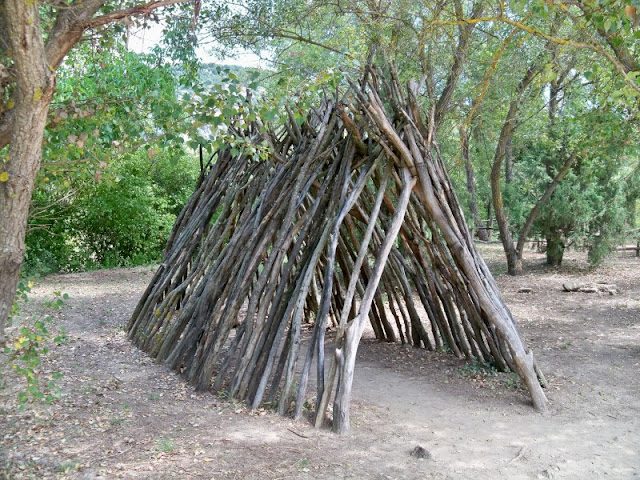
A museum recreation of a building (Terra Amata, Nice, France) probably made by Homo erectus and is considered the oldest known human building.

Then I was able to find new direct evidence. Microscopic evidence of basic cordage (rope) made by Neanderthals was discovered dating to the Middle Paleolithic. And impressions in clay of sophisticated basket and textile weaving were dated to the Upper Paleolithic. Plus Native American Indian hunter-gathers (a lifestyle viewed as similar to those in the European Upper Paleolithic) were shown to be expert basket makers.

These last discoveries of direct evidence revealed technologies that were already highly developed. Therefore experts believe that the early stages of these must have begun much sooner. 

TOP: This realistic painting of a bison is about 14,000 years old and was painted by a Paleolithic 'caveman' in the Cave of Altamira in Spain. This work was done from memory with a multi-colored spray-paint technique in the darkness of the cave. This demonstrates the remarkable skills, powers of observation, and memory humans had in Paleolithic times.(NOTE: This photo was taken of an accurate reproduction of this bison painted on the ceiling at Altamira as visitors are no longer allowed in the cave.)
BOTTOM: A photograph of a European bison today (a somewhat different bison species), shows the accuracy of the cave painting on the top.


PROCESSES

It seems clear that early on a sense of time began to develop since it can be shown that processes were invented to make stone tools and that these processes continued to be developed and refined over millions of years.

Definition: Process (Oxford Language):
A series of actions or steps taken in order to achieve a particular end.

Technology involves processes that require steps that must be done in a certain chronological order and require a duration of time to achieve a specific future result. Processes involve the past, present, and future plus duration -- the essential elements of linear time. 

Moreover, processes almost inevitably become more complicated. For example, with "the major [stone tool] industries [that] include (in chronological order) the Oldowan, Acheulean, Mousterian, Aurignacian, Solutrean, and Magdalenian industries" (Britannica) each stone age industry was more complex than the one before it. For example, 18 different types of stone implements have been discovered from the Acheulean industry (starting with Homo erectus 1.75 mya) such as chisels, awls and anvils but by the late Upper Paleolithic (ending about 10 kya) the tool kit was up to 80 different implements. (Britannica)

As the complexity increased, so did an understanding of time because more planning and preparation were involved, more stone shaping was required, teaching the young these skills took time, and imagining the final result from the initial raw stone required a linear sense of progression. In addition processes such as making baskets required a sense of math, geometry, and a concept of the basket to be made. Teaching this did not initially require language as it could be learned by imitation. In one study I referenced, a woman was shown how to make baskets by imitation without a word being spoken. A native girl in a contemporary tribe sat next to her and led her through the steps involved.

LEFT: Paleolithic 'flake tools'.
RICHT: Neolithic polished tools.
Page 280, Volume 15 of the German illustrated encyclopedia Meyers Konversationslexikon, 4th edition (1885-1890).

So I believe a complex unspoken sense of time did develop before language began.


SURVIVAL AND EVOLUTION

Basketry and other woven-fiber items would have allowed hominins to gather more food and materials. For example, big "backpack" type baskets known as "burden baskets" would have allowed hominins to gather large quantities of goods from distant locations. This would have increased their chances of survival. And this ability to provide more food would have affected their evolution. 
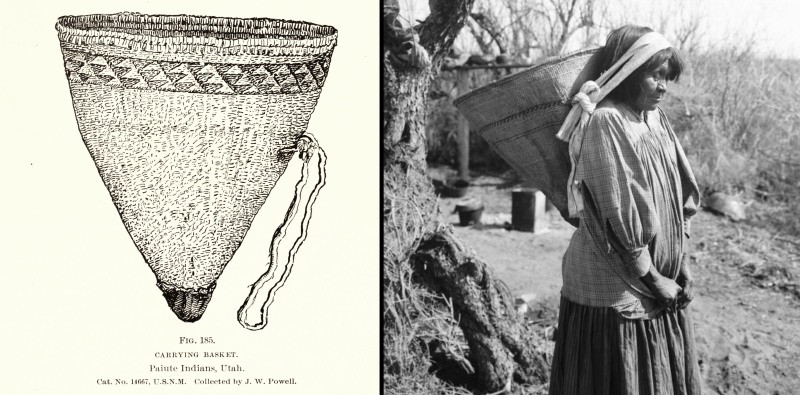
Known as burden baskets, these baskets were used worldwide in just about every society even today, and were widely used by hunter-gatherer Native American Indians on a daily basis, and probably during the Neolithic time period for harvesting crops.
LEFT: Carrying Basket, Paiute Indians, Utah.
(Aboriginal American Basketry, 1904, Fig. 185, p. 494)
RIGHT: "Apache Indian woman carrying a "Kathak" on her back, Arizona, ca.1880."
(University of Southern California, ca.1880, Apache Indian woman carrying a "Kathak")


LANGUAGE

For words are to thought
what tools are to work;
the product depends largely on the growth of the tools.
 
Will Durant, History of Civilization: Volume 1, Chapter 5, The Mental Elements of Civilization.

Time reference is a universal property of language...
Jacqueline Lecarme, Ph.D., Linguistics

No one knows exactly when, but possibly at some point in the Middle Paleolithic or early Upper Paleolithic era, an initial full language began to emerge although there may have been a rudimentary proto-language long before that. I believe that language then became the main tool for working with time. 

With early languages, it is my contention that the sense of time was immediate. Time was understood in terms of a couple of days, no more. There is evidence for this with the hunter-gatherer Piraha tribe in the Amazon who think this way but also have an extremely complex language that expresses their time concepts. 

A Piraha community. The Pirahas are hunter-gatherers who live in the Amazon.


NEOLITHIC LINEAR TIME WITHIN CYCLICAL TIME

Eventually in the Neolithic era there began to be an understanding of long-term linear time. This sense of time made it possible to plan, harvest and store crops over a year's time. But again it is my contention, that the Neolithic people conceived of time as primarily cyclical year to year, season to season, and day to day but within that cycle linear time could exist. 

When the great civilizations of Mesopotamia and Egypt emerged they used a range of woven-fiber items that employed technology passed down from Neolithic societies who had continued to develop and expand the woven-fiber technology. 

This woven bowl is an example of the fine workmanship
that had been achieved in the Neolithic era.
LEFT: Bowl  
RIGHT: Detail of bowl
Baskets, basket bowls, sandals, textiles, and mats from
the Neolithic Era (5200-4600 BCE or 7200-6600 BP)
were found in Los Murcielagos Cave, Albunol, Province Of Granada, Andalusia, Spain.

Sophisticated reed housing began in the Neolithic as well.
"A mudhif, a traditional Marsh Arab guesthouse made entirely out of reeds. The Marsh Arabs live a lifestyle that dates back 5,000 years." Quoted from: https://commons.wikimedia.org/wiki/File:Iraqi_mudhif_interior.jpg
Mudhif Reception Hall

Known as mudhifs, these buildings were (and still are) made entirely from reeds. Buildings can be quite large and are used for ceremonial purposes. Small ones, called rabas, are used as family homes. Weaving technology once mastered can be scaled up to make quite large structures such as these traditional mudhif reed buildings that have been made for thousands of years by the Mudan people in the marshes of southern Iraq.

LEFT: Local contractors begin the job of building a mudhif. "The reeds are gathered from marshlands near the Euphrates River." 
MIDDLE: "Local contractors construct the main reed arches of a marsh Arab mudhif."
RIGHT: Almost completed, the mudhif exterior.

It is very likely that many if not most houses in Mesopotamian cities, at least in the beginning, were these mudhif/raba-type grass huts since high-quality reeds grew wild in the marshes. These were quite nice comfortable homes. Homes made out of bricks came later and were expensive, so their use may have been limited.


ANCIENT CULTURES

Basketry was a key element of Mesopotamian societies and a central part of their mythology, so much so that in one myth an important god declared, "The pickax and the basket build cities." Baskets sealed with bitumen were used to hold water to irrigate the fields and other baskets were used to manage and dredge the canals. There were over 100 words altogether in Mesopotamia that dealt with basket weaving, baskets, woven mats, reed craftsmanship, reed constructions, and weaving with palm leaves.

Cuneiform shipping receipts in Mesopotamia show that there was a key reed industry since high-quality reeds grew naturally in the marshes. Writing had also begun. Scribes wrote with reed styluses to record sales on clay tablets which were then filed in reed baskets. Reeds were used to build large and small boats and a variety of containers. So woven-fiber technology which had been developing for perhaps several million years was a critical part of early civilizations.

This reed ship in Mesopotamia illustrates the sophistication of the reed industry. This painting depicts a large ship made of reeds in early Mesopotamia. The existence of similar large reed boats has been well documented. <LINK>

Both Egypt and the Mesopotamian cities adopted the Neolithic sense of linear time within cyclical time. And it was this sense of time, which was so different from hunter-gathers just ten or twenty thousand years earlier, that gave them the power to manage their societies based on extensive agriculture. 

While often overlooked, both the Mesopotamians and the Egyptians depended on huge numbers of woven-fiber sacks for holding and transporting grain
along with baskets carried by pack animals. 
LEFT: Picture from the Sumerian Standard of Ur.
of a person carrying a sack, circa 2600 BCE.
RIGHT: Picture of an Egyptian carrying a sack
from Tombe d'Oumsou, circa 1450 BCE.

The oldest Egyptian mathematical document, known as "The Moscow Mathematical Papyrus" which is dated to the 13th dynasty (approx. 1800 BCE), contains a geometry problem (Problem 10) relating to basketry, which shows the importance of basket making to this early civilization. 
This picture is of Problem 14 in the Moscow Papyrus

Egyptian paintings show a wide range of baskets that were used in agriculture along with sacks to carry and store grain. In addition, woven papyrus boats and sandals were common.

Baskets were critical tools for Egyptian agriculture.
BOTTOM:

While astronomy is the study of the sun, moon, stars, and planets, it is also a study of time. At night, for example, the sky moves every second and starts at a different point from night to night. Over a year the star patterns repeat and indicate a precise way of determining the time of year.

"Map of the night sky: star positions
from the Bright Stars Catalog, 5th Edition. Rasterized." 2006.
This modern map of the stars visible in the Northern Hemisphere
is based on the Babylonian model. The white curved line is the zodiac. 
Notice the faint horizontal and vertical grid lines and the 360-degree indicators.

The later Babylonian culture (Neo-Babylonian) conceived of the sky as a circle and then divided the sky into 12 sections, 30 degrees apart making a yearly total of 360 degrees (still used today for degrees in a circle) that repeated yearly. Each 30-degree section was a constellation in the Zodiac which was a concept they invented. They also mapped out the ecliptic, the path that the sun, moon, and planets all followed. Each degree was subdivided into 60 arcminutes and each minute into 60 arcseconds (the same numbers we use today). Finally, the sky in a circle was divided into a grid pattern of declination and right-ascension which can be thought of today as latitude and longitude on Earth projected into the sky. And with these two coordinates, any star or planet could be pinpointed. The Babylonian map of the sky with this grid right-angle pattern looked very much like an upside-down basket.  While I cannot yet confirm that this grid pattern was derived from basketry, it is an intriguing idea that should be researched.


CLASSICAL, MEDIEVAL, & MODERN TIME

It was assumed until about 400 years ago that the sun went around the Earth. Around 150 CE, Claudius Ptolemy devised an accurate system that was only off by one day every hundred years based on this assumption. His system required epicycles or circles within circles. For about 1500 years his science was the accepted astronomy. His system also included a grid and coordinates for star and planet positions, which he adopted from the Babylonians.

"A simple illustration showing the basic elements of Ptolemaic astronomy.
It shows a planet rotating on an epicycle which is itself rotating around
a deferent inside a crystalline sphere." Quoted from:

While the geocentric system of Ptolemy is no longer believed and has been replaced with the heliocentric system (the Earth revolves around the sun), his accurate system of wheels within wheels (epicycles) created a sophisticated way of gearing which led directly to the Industrial Revolution and machines.

Gears based on Ptolemy's epicycles in a pocket watch.


"The Prague astronomical clock [above] was installed in 1410...and is the oldest functioning Astronomical clock in the world." Photo and quote from:
Medieval clocks were built using the epicycle gearing of Ptolemy's geocentric astronomy. Ptolemy's astronomy and geography also used a vertical and horizontal 'grid' system probably inherited from the Babylonians. Ptolemy's gearing geometry would lead directly to the construction of machines and the Industrial Revolution. 


CONTEMPORARY TIME

Clocks were the "key machine of the modern industrial age."
Strandh, Sigvard, A History of the Machine.

In a sense, all machines are clocks. A geared clock is simply a machine whose product is the movement of clock hands on a clock face. A car motor is a machine that produces speed. Both have to proceed in a specific orderly manner to function properly. A misfiring car engine is a good example of a timing problem because the engine is firing when the pistons are not in the right position.

Today virtually all computers have a clock at their center that handles data according to its clock speed. For example, a CPU with 3700 megahertz clock speed (MHz) handles three billion seven hundred million cycles per second. So the clock continues to be at the heart of our technology.

For thousands of years time continued to be thought of as cyclical but eventually with the Scientific Revolution around 1700 and the work of Isaac Newton, cosmological time was seen as linear.

In the modern world, we think of time as primarily linear although our days and weeks, and seasons are cyclical. Time is seen as a commodity so we spend and save time. We are constantly aware of time because clocks and schedules are ever-present. We are to some extent imprisoned by time as we can rarely step outside the grid. 

It is clear from my research that much of what we think of as time has been molded by the culture. Time is not something that can be seen or felt in the physical world. Much of it exists in our collective imagination that we have been conditioned to accept. This is as true today as it was for Homo sapiens in the Paleolithic. Today, for example, Aboriginal Australians have a very different concept of time and have expressed great difficulty when dealing with Western linear time.

See my article about time being the most important subject
in schools in industrialized societies.
School's Most Important Subject: Time


FUTURE TIME

But thinking about time does not stop with a study of history. Understanding time today is just as important. 

Global warming will require a response that takes into account the speed of sea level rise, for example, and how quickly to respond to it. But the effects of the Industrial Revolution (which came about partly due to the Scientific Revolution) are not just limited to global warming. These effects will require an understanding of their possible damage and also may require a timely response. For example, 380 million tons of plastic are entering the oceans every year.

CATHEDRAL THINKING

Perhaps the most important contribution of the Middle Ages to our current age is the concept of Cathedral Thinking. This concept has now become relevant as we face the consequences of industrial development which may lead to climate change and yet may not be felt for a hundred years. 

Cathedral thinking is about the work and the time required to build a great cathedral. In the past, many of the workers never saw their work completed and did not expect to. Nevertheless, they were committed to the grand vision of building a magnificent cathedral which became a source of pride to the local community and provided an experience of reverence for the faithful. The work of the builders was seen as an expression of devotion to their spiritual beliefs. 

An example is the York Minster Cathedral in England which was built from 1220 to 1472 or over more than 250 years. While other cathedrals did not take this long to build, a hundred years or so for their construction was not unusual. 


CONCLUSION 

So my Theory About The Human Understanding of Time (HUT) attempts to explain how humans developed a sense and concept of linear time from its earliest beginnings right up to today. Since time is so important, a deeper understanding should help us as a species.

Today, in our digital age, even clocks depict time as linear, 
with numbers always going forward rather than the implied repeating cycle 
of earlier round circular clocks. 


Saturday, December 11, 2021

Terra Amata and Modern Basket Weaving Technology

Terra Amata:
Does the Oldest Paleolithic Building Site
Indicate the Use of
Advanced Basket Weaving Technology?
By Rick Doble

This is a reconstruction of one of the 300,000-year-old Terra Amata huts in the Prehistoric Village of the Gorges du Verdon Museum in Quinson, France. The museum states, "The habitats [in their prehistoric village] have all been reconstructed based on research and observations by archaeologists. They are maintained by the museum's scientific team."


ABSTRACT
I have been writing about Paleolithic basket weaving technology for 2 years now. In this article, I attempt to show that there was an intermediate period in the development of the technology when an understanding of structure and constructions based on right angle or opposing fibers occurred. This was the crucial breakthrough that eventually would give humans the power to make an almost unlimited number of items both large and small, such as large boats and large houses made out of reeds. It is my contention that it was this key technology that led to the rise of civilization. In previous articles, I have shown that basket weaving technology could have begun in a rudimentary form 2 million years ago with the creation of random weave basketry. About 6 thousand years ago this culminated in the rise of the Sumerian and the Egyptian civilizations. But somewhere in-between the power of right angle and opposing fiber structure was discovered which then opened the door to this versatile technology. The Lower Paleolithic site at Terra Amata in Nice France provides ample evidence that suggests this transition from random weave basket technology to modern regular basket weaving had occurred by 300 ka with hominins such as Homo erectus. In this article, I list that evidence and argue that it suggests an advanced form of basket weaving had already taken place.


INTRODUCTION

For the last two years in this blog, I have argued that basket weaving technology (or woven-fiber technology as I have suggested it be called) was a crucial technology that developed over millions of years. I believe it began 2 million years ago or earlier. I have suggested that these first baskets could have been made with a random weave and probably used weaverbird nests as models since early humans often lived in close proximity to weaverbirds in Baobab trees (most scientists believe that early humans spent a good deal of time around Baobab trees). (Doble 2020-04)  Next, I have argued that a fully advanced basket weaving technology culminated in the first civilizations of Mesopotamia and Egypt and was crucial for the emergence of these civilizations. Engineers and craftsmen built boats, houses, irrigated fields, dredged canals, and constructed levees with an advanced woven-fiber technology, for example. (Doble 2021-04)


LEFT: "Weaverbird (Southern Masked Weaver) nest of dry grass,
near Pretoria, South Africa" <LINK>
RIGHT: Random weave basket (Basket/Photo by Nan Bowles)


I have also argued that after more than a million years or so, random weave technology began to develop into a technology that used a regular design and right-angle or opposing strand construction. This was the crucial breakthrough. Because once this had been achieved modern basket weaving technology as we know it was invented. And it was with this basic model that shoes, hats, containers, houses, boats in a wide variety of configurations, flexibility, size, and strength could be created.

The purpose of this blog-article is to suggest when this innovation could have occurred. And my current research is pointing to a time roughly around 300 ka with our direct ancestor, Homo erectus.
FROM RANDOM TO REGULAR
For the purposes of this article, I am going to speak of 'Random Basket Weaving Technology'. And then I will speak of 'Modern Regular Basket Weaving Technology' meaning, for example, that the strong vertical spokes and the flexible horizontal strands that are used to make a plaited basket are placed at regular intervals in an orderly fashion and are not random.


From a weaverbird nest (left) to a random weave basket (middle) to an advanced basket (right) made with opposing strands and regular even spacing.
LEFT: Weaverbird: "Fallen nest of Ploceus cucullatus" <LINK>
MIDDLE: Random weave basket (Basket/Photo by Nan Bowles)
RIGHT: "Basket, palm leaf, Huaorani" "Exhibit in the South American collection of the American Museum of Natural History, Manhattan, New York City" <LINK>

The change from random weave basketry to modern regular weave basketry ushered in the modern construction of baskets and woven-fiber structures. This was a technical revolution that greatly affected the ability of hominins to survive and to prevail. And it affected their cognitive abilities as well. I believe it may have taken hundreds of thousands of years to fully develop this technology. But by the Neolithic era, there is evidence that large boats and large buildings were being made with reeds, for example, around the area of Mesopotamia. (Doble 2021-04)


Baskets are made in virtually all cultures and made worldwide from local materials. A basket made from the palm-like karagumoy tree in the Philippines is one example of making a  basic basket from local materials.
LEFT:  Karagumoy (Pandanus simplex): "The leaves are used as materials for weaving native hats, bags and mats in the Philippines" <LINK>
RIGHT: A basic basket made from the wide leaves of the palm-like karagumoy tree woven in a hexagonal pattern <LINK>

Once the basic principles of modern regular basket weaving technology were understood, it was like a blueprint that could be expanded, elaborated, enlarged, and reconfigured. It was like a Paleolithic "Principia," i.e., the famous work by Isaac Newton that is the foundation of classical mechanics and led to the scientific and technological revolutions. The plants of the natural world could now be processed and woven to create whatever the human mind could imagine within the constraints of the technology. It was the plastic of its age.

When the power of regular weave structure was understood, it was a major technological leap. Combined with an understanding of right-angle or opposing strand construction, it opened up limitless numbers of possible basket and woven-fiber objects. For example, baskets could now be small or large, flexible or rigid, designed for heavy-duty or light-duty use, made with an open or closed weave, open or closed as containers, and worn on the back or carried by hand. And this new technology could do all of this using local plants found anywhere around the world. These baskets were usually light, strong, and durable. For example, many baskets made by Native American Indians lasted several generations and were revered as important family objects. (Doble 2020-12) But baskets were only the beginning and only part of the story. This technology was scalable so the basic model led to a technology that could be applied to building grass houses, thatched roofs, fences, walls, fish traps, grass boats, shoes, hats, cooking baskets, levee foundations, and waterproof canteens and buckets, etc. And it could be combined with other materials such as bitumen, wood, rope, and clay.


The advanced development of basketry led to a wide variety of products such as this basic boat. Notice the essential right-angle cordage that ties and holds the bundles together.
LEFT: "Building a Papyrus Boat. Nigeria, Africa." <LINK>
MIDDLE: "Reed boat at Ekehagen Prehistoric village...Sweden" <LINK>
RIGHT: "Reed Boat, Lake Hawassa, Ethiopia" <LINK>

See a Slide Show of Woven Items (Doble, 2019-09)
Evidence for a Basket Weaving
and Woven-Fiber Technology
in the Paleolithic Era

Nevertheless, this does not mean that once a tribe or tribal group discovered this technology that it spread quickly to other groups. It may have been found but then lost; it may have been discovered by different groups but then not accepted by other groups. But eventually, I believe, it was widely known among hominins.


CAN THIS BE PROVEN?

However, there are major problems in an effort to prove that this kind of basket weaving technology began hundreds of thousands of years ago. First and most important is the fact that basket plant material decays quickly and rarely leaves trace evidence (see the Afterword). (Soffer et al.) (Grömer) And secondly the further we go back in time, the less likely we are to find direct evidence. Some indirect evidence is possible such as microwear patterns on tools or impressions in clay fragments. But even these are hard to find.


DIRECT EVIDENCE FROM A SITE 
WHERE EVIDENCE OF THE OLDEST BUILDINGS HAS BEEN FOUND

In this blog-article I will focus on one Lower Paleolithic site, Terra Amata, in Nice, France, where there is direct evidence of the construction of the oldest buildings found so far. Then, using clear evidence from this site, I will suggest a hypothesis about the beginnings of 'modern regular basket weaving' technology.

However, much of what I will say about basketry is based on inference because direct evidence, as I have said, rarely exists,

So, for the time being, we are stuck with the following. We need to determine what was possible and then what was probable.

I can make a case based on the possible, i.e., how possible was it that basic random basket weaving technology was used in Terra Amata, for example. Did they have the necessary materials, did they have the necessary skills, and did they have a compelling need?

Once the above questions are answered, the next is even harder. How probable is it that these hominins actually worked with and used this basket weaving technology? If the answer is yes, then the question becomes, if they used basic basketry, could they or did they take it to the next step, i.e., make baskets with a modern regular structure. What evidence do we have that points to that conclusion? So how likely was it that they had discovered basic modern regular basket weaving technology as described above?

WAS BASKET WEAVING POSSIBLE FOR THESE HOMININS?

Did they have the materials?
-- As you will read next, the following plants were plentiful in the area where Terra Amata was located. Heather and several pines (sea pine, Aleppo pine, and Norway pine) along with genista were all well known in the ancient world for their usefulness when it came to making baskets. (Dear)  (Farm)

Genista, in particular, was highly valued in the ancient world for its fiber weaving qualities.
"The well-known Genista Spanish Broom is a native of the south of Europe and is found wild in ...the south of France. The plant is known to yield a fibre. It has long been regarded as the material of cordage, nets, bags, and even sails, which were in use by the Greeks, Romans and Carthaginians."
Royal Gardens. "The Spanish Broom as a Fibre Plant." Kew. Bulletin of Miscellaneous Information, No. 63, March 1892. 

Did they have the skills, e.g., hand coordination, ability to visualize and plan?
-- It is clear from their architectural skills, described next, that they did have these skills and therefore would have been able to make basic baskets.

Did they have the need?
-- Dr. de Lumley chief archaeologist and the man who discovered the site made the point that this group of hominins was highly mobile and only stayed at this location for a short time period. So it seems likely they needed some way to help them carry and transport essential tools, food, and other items when they were on the move.

SO BASIC RANDOM BASKET WEAVING TECHNOLOGY WAS POSSIBLE
BUT WAS IT PROBABLE?

Based on the evidence described next, it seems unlikely that an advanced hunter-gatherer society that could plan and build buildings, make a fire in those buildings, and craft biface Acheulean stone tools, would not have discovered how to make simple random weave baskets. Furthermore, there were many plants available in the area that could have been used to make basket-type woven-fiber items as shown above in the listing of materials.

Basketry in particular would have been extremely useful for a mobile tribe in their travels and also to help them gather materials when they camped. 

So Did The Terra Amata People Probably 
Have A Basic Random Basket Weaving Technology
In A Word "Yes"

HOWEVER, WAS IT PROBABLE
THAT THEY HAD BEGUN TO MAKE BASKETS
WITH A MODERN REGULAR BASKET WEAVING TECHNIQUE?

To answer that question, we have to look in detail at the direct evidence that was found at the site at Terra Amata.

The Huts At Terra Amata

The best direct evidence of hominins working with vegetable/plant matter to make structures hundreds of thousands of years ago can be found in the ruins of the huts at Terra Amata. It is dated about 300 ka (see the footnote about dating). Since virtually all evidence from baskets and woven-fiber items has been lost, the construction of these well-documented large structures might give us major clues about hominins working with plants and vegetation. 

FACTS ABOUT THE TERRA AMATA HUTS 
AND THE SITE IN NICE, FRANCE
Quotations From Dr. de Lumley's
Scientific American Article In 1966 And More
de Lumley, H. (1969). A Paleolithic camp at Nice. Scientific American, 220, 42-50. https://www.scientificamerican.com/article/a-paleolithic-camp-at-nice/


Genista   <LINK>

MATERIALS
"Pollen studies...indicate that fir and Norway pine on the alpine heights grew farther down the slopes than is now the case, and that heather, sea pine, Aleppo pine, and holm oak covered Mont Boron and its coastal neighbors. (42)
"A few seashore plants-grasses, horsetails, short-stemmed plantain and various shrubs grew in the cove. (43)
"Our other indirect source of information consists of fossilized human feces found in the vicinity of the huts. De Beaulieu's analysis of their pollen content shows that...it comes from plants, such as genista." (45)

THE STRUCTURES
PLEASE NOTE: Dr. de Lumley, who is French, referred to the poles that made up the walls as 'stakes' which in English is a bit confusing as stakes are not usually as long as the poles that made the Terra Amata huts. I have decided to call these wall stakes 'stake-poles' as they were 3 inches in diameter and probably from 10 to 13 feet long.
"The superimposed living floors at Terra Amata are located in three separate areas. Four are on the section of beach that had formed the sandbar until the sea level dropped; six are on the beach seaward of the bar, and 11 are on the dune inland. The huts that were built on the living floors all had the same shape: an elongated oval. They ranged from 26 to 49 feet in length and from 13 to nearly 20 feet in width. Their outline can be traced ...[wit] the imprint of a series of stake-poles, averaging some three inches in diameter, that were driven into the sand to form the walls of the hut. 
"The palisade of stake-poles that formed the walls was not the huts' only structural element. There are also visible the imprints left by a number of stout posts, each about a foot in diameter. These supports were set in place down the long axis of the hut. Evidence of how the palisade and the center posts were integrated to form the roof of the hut has not survived."
In a caption to a hypothetical drawing de Lumley wrote:
"Some larger posts were set up along the huts' long axes, but how these and the walls were joined to make roofs is unknown."  (43)

FIRE AND WIND PROTECTION
"A basic feature of each hut is a hearth placed at the center. These fireplaces are either pebble-paved surface areas or shallow pits, a foot or two in diameter, scooped out of the sand. A little wall, made by piling up cobbles or pebbles, stands at the northwest side of each hearth. These walls were evidently windscreens to protect the fire against drafts, particularly from the northwest wind that is the prevailing one at Nice to this day.
"It is worth noting that the hearths at Terra Amata, together with those at one other site in Europe, are the oldest yet discovered anywhere in the world." (43) 

THE PEOPLE
There was found "the imprint of a right foot, 9 1/2 inches long, preserved in the sand of the dune."
"If...one uses the formula applied to Neanderthal footprints found in the grotto of Toirano in Italy, the individual whose footprint was found at Terra Amata may have been five feet one inch tall." (45)
NOTE: While there has been some doubt in the past about which early hominins camped at Terra Amata, the museum in Nice, The Museum Of Prehistory Of Terra Amata, which is continually updating its information now clearly states, "A footprint and a tooth from a seven-year-old child are direct testimonies of Homo erectus at Terra Amata." (Museum Of Prehistory Of Terra Amata) So Dr. de Lumley's original assessment that it was Homo erectus who camped here appears to be correct.
TOOLS
Picture Caption: "Representative Tools unearthed at Terra Amata include...a bone fragment pointed to make an awl." (45)
ALSO:
"A bone...fragment has one end smoothed by wear; still another [bone tool] may have served as an awl..." (49)
There were also a number of biface Acheulean stone tools ("so named because many of the tools are made out of stone 'cores' that are shaped by chipping flakes from both faces rather than from one face only"). The biface stone age technology is considered to be an indicator of increased intelligence and a major advance in technology.
A CONTAINER
"On the dune a spherical imprint in the sand, filled with a whitish substance, may be the impression left by a wooden bowl." (49)

THE SOCIETY
"The 11 living floors on the dune at Terra Amata are so precisely superimposed that they almost certainly represent 11 consecutive yearly visits, probably involving many of the same individuals." (49)
"At least one of the projectile points unearthed at Terra Amata could not have been produced locally. The stone from which it is made is a volcanic rock of a kind found only in the area of Esterel, southwest of Cannes and some 30 miles from Nice. This discovery allows us to conclude that these summer visitors' travels covered at least that much territory in the south of France, although we cannot be sure how much more widely they may have roamed." (47)

THE AGE
"These huts [were] put up by hunters [hunter-gatherers] who visited the shore of the Mediterranean some 300,000.years ago." (42)
"There is no older evidence of man-made structures than that at Terra Amata." (49)

SUMMARY:
The site contained 21 different huts of different sizes but all shaped the same which was an elongated oval. While it would have been easier to build the two opposing walls in a straight line rather than with the curve of an oval, this gave the hut more space and also showed engineering and design sophistication.

There was a substantial difference in overall size, the smallest being about one-third the square footage of the largest. "They ranged from 26 to 49 feet in length and from 13 to nearly 20 feet in width." 
 (43)

The main numerous stake-poles were about three inches in diameter but there were some stout posts one foot in diameter "set in place down the long axis of the hut" but how is not clear.
 (43)

The three-inch diameter stake-poles "were driven into the sand to form the walls of the hut" and, according to the recreation by the museum and de Lumley's depictions, were placed at regular intervals. "Evidence of how the palisade and the center posts were integrated to form the roof of the hut has not survived." 
 (43)


ABOUT THE BUILDINGS


Based on my research this recreation by the Gorges du Verdon Museum seems like the most accurate model of one of the huts, which is very similar to the model of a hut in the Terra Amata Museum in Nice where the original archeological site is located.

ABOUT THE RECREATION OF THE TERRA AMATA HUT
Based on the current recreation by the Gorges du Verdon Museum, the hut that is pictured required at least 40 stake-poles to make both walls, all about 3-inches in diameter and about the same length. In addition, there were several posts that were one foot in diameter. The 3-inch stake-poles were pushed into the sand which left a lasting impression and which allowed these structures to be discovered.


Using the Pythagorean formula (and assuming a building height of 6 feet since the people were estimated to be 5 feet tall), each of the 40 stake-poles would have been about 12 feet long up to the apex for the largest structure and about 9 feet up to the apex for the smallest. I would also assume that the stake-poles had to be at least a foot longer to go above the apex and then be joined with the ends of other stake-poles. According to the recreation by the Gorges du Verdon Museum these stake-poles were fairly straight and they may have been trimmed to remove small protruding limbs which is also depicted in the Smithsonian picture of a Terra Amata hut. (Smithsonian Institution) It should also be noted that the oval shape meant that some stake-poles needed to be longer than others and this had to be factored into building the huts.


The two sides or walls of the building had to be at a proper angle to allow hominins who were perhaps five feet tall to enter. In addition, the structure had to provide enough space inside the building for human activity and also to create a solid structure -- one that could withstand the famous strong mistral wind in that area. The basic idea behind a structure such as this is that when the wind hits a wall the opposing wall resists and keeps the first wall from collapsing -- which is the key to stability and resilience and the strength of a triangular structure.

However, I do think that these walls might have been covered by animal skins or a basic grass or leaf thatching to reduce the effect of wind and rain -- see the note in the Afterword.

There are more than five drawings or models of a Terra Amata hut which are all a bit different. But in all cases the depictions show:
  • -- multiple stake-poles making up one leaning wall
  • -- a wall that is opposed by a leaning wall of the same size on the opposite side that is made up with about the same number of stake-poles.
  • -- an overall shape that is a long triangle.
  • -- stake-poles in parallel in a line, pressed into the sand and laid out in an oval.
  • -- the front of the building open for hominins to enter and exit
To the modern eye, the recreation of this simple structure does not seem like much of a breakthrough, but it is. It indicates a unified sense of design that could be configured to be large or small, for example, since some buildings were about a third the size of the largest ones. It indicates planning and a sense of math and geometry such as shape and volume. A certain number of straight stake-poles of the right length and width had to be pushed into the sand at regular intervals and the same done on the opposing wall. Then the walls were laced or attached together at the top to secure them. All of this defined and enclosed a useful artificial space that had been created by and for hominins.

Furthermore building these huts required communication and coordination among members of the tribe. And since each hut needed a large number of stake-poles that had to be gathered and trimmed, there must have been a number of hominins involved. See the Smithsonian picture of the construction of the Terra Amata Shelter 
(Smithsonian Institution) which shows six men working on the construction of these buildings.

And if this is true, these huts would also have required a shared idea of what the hut would look like once constructed. And since the huts could be made large or small with an oval design, this added another layer, another level, to the sophistication of the construction and the communication. Also, the building of these huts meant that the people involved were adept at planning, coordinating, and doing this work in a proper sequence. Stake-poles had to be located, cut down, and trimmed, meaning that the processing of materials was involved before the building was erected. Moreover, the actual construction of these buildings was probably a bit complicated and required teamwork because each pole had to be supported probably by an opposite pole when it was being put together since an unsupported leaning pole would collapse. All of the above is something we take for granted in the modern world, but for early hominins, this was a major step toward an advanced culture and technology.

The cooperation and teamwork strongly suggest that there was a proto-language that was being used to communicate as Dr. Daniel Everett has suggested. 
(Everett) While this may be true, ideas and construction such as this can be also done without words or with just a few words It could be accomplished with a kind of 'show and tell' approach with drawings in the sand, for example. (Doble 2021-02) (Blackmore pp. 225-255) (Boyette)

While this ability to work together was not necessarily important for an individual making a basket, it clearly indicated a high level of intelligence and the ability to conceptualize and to plan -- all of which were important for making baskets or woven-fiber structures.

Taken together, the above paragraphs describe the same abilities that were also required for a modern regular basket weaving technology (or woven-fiber technology as I have suggested it be called). These were the same skills needed to make a basket or container or a hat or a small straw boat.

EVIDENCE OF EARLY BASKETRY?

Could The Terra Amata People Have Begun
To Make Advanced Basket Weaving Constructions
Using Right-Angle And Opposing Strand Structure?

Let's Examine The Evidence
MAKING INFERENCES (FROM EXPII.COM)
An inference is a conclusion or educated guess drawn from observations as well as previous knowledge.
Similar to a hypothesis, an inference is an informed guess about science or scientific relationships. Inferences are based on real, observed evidence but are still just guesses about the true relationship that exists.

Scientific Inference — Definition & Examples
https://www.expii.com/t/scientific-inference-definition-examples-10307

ABOUT INFERRING THESE QUALITIES FROM TERRA AMATA
A recent study about Acheulean stone age tools showed that their manufacture also provided hints about the hominins who made them.
"Lead author of the study, James Green, a Ph.D. student in the Department of Archaeology at the University of York, added: 'By deciphering the mental and physical processes involved in the production of prehistoric artefacts, we can gain valuable insights into the abilities of the individuals who made them.'
"These [Acheulean] axes demonstrate social learning and effortful activity...They also provide some of the earliest evidence of something being deliberately made in a sequence from a picture in someone's mind."
University of York. "Researchers Trace Evolution Of Self-Control." Phys.Org, May 12, 2020. https://phys.org/news/2020-05-evolution-self-control.html
In the same fashion, simple huts such as those found at Terra Amata can reveal a good deal about the processes that led to their construction which, in turn, can uncover a significant amount of information about the cognitive abilities of the hominins who made them.

About The Triangular Shape
One of the shapes that can bear weight very well is the triangle...When a force (the load) is applied to one of the corners of a triangle, it is distributed down each side. The two sides of the triangle are squeezed. Another word for this squeezing is compression. 
Let's Talk Science. "Why is a Triangle a Strong Shape?." August 17,2020. https://letstalkscience.ca/educational-resources/backgrounders/why-a-triangle-a-strong-shape

It was quite remarkable that early hominins understood the strength of the triangle which was the basic shape later used for the construction of Egyptian pyramids and for Native American Indian teepees.
SPECIFIC HUT MAKING SKILLS IN COMMON
WITH MODERN REGULAR BASKET WEAVING TECHNOLOGY
* = information from Dr. de Lumley's article
-- = similar modern regular basket weaving skills
The builders:
* were able to plan.
-- Construction of a basket requires planning.
* had to find material and then construct the building in a specific sequence.
-- Basket making requires the gathering of material and then construction in a sequence.
* had a basic general mental concept, i.e., a triangle.
-- A basket craftsman must have an understanding of basic basket shapes.
* had a specific concept of a particular finished building.
-- To make a specific basket, a craftsman must have a clear image of the finished basket before starting.
* created an oval-shape design and a mental image of one.
-- Same as above.
* designed a structure that was symmetrical.
-- Baskets in general are symmetrical.
* had the cognitive, mathematical and geometric skills to scale the huts large or small with the same basic shape and construction.
-- Baskets require the same skills since baskets can be made large or small and can be scaled.
* had the concept of creating an artificial environment within the building.
-- A basket is an artificial space that is created for a specific human purpose and is a portable environment (i.e., can carry multiple things together).
* designed for human needs, i.e., for five foot people to enter/exit and designed for the use of fire in the building.
-- A basket is designed for a specific human need.
* found multiple stake-poles the same width and length.
-- Simple baskets are often built with rigid vertical poles (called spokes) the same width and length around which flexible weaver strands are woven.
* processed (i.e., trimmed etc) multiple stake-poles prior to construction.
-- Plants used for modern regular basketry are usually processed.
* placed the stake-poles so they were supported by stake-poles on the opposite wall thus creating a stable structure which could handle the force of the strong mistral winds.
-- Opposing structure is the basis of 'modern regular basket weaving'.
* placed stake-poles vertically in parallel while placing them securely in the sand.
-- The spokes for many basket configurations are placed securely vertically in parallel with regular spacing.
LEFT: The vertical spokes can be plainly seen as this young girl begins to make a basket. <LINK>
RIGHT: The stiff vertical spokes and the right-angled horizontal flexible weaver strands are clearly visible in this basket that has almost been completed. <LINK>
This idea quoted earlier applies to both the building of these huts and also to the construction of baskets which "provide... evidence of something being deliberately made in a sequence from a picture in someone's mind." (University of York)

TO SUMMARIZE

TERRA AMATA HUT STRUCTURE SIMILARITIES
WITH MODERN REGULAR BASKET WEAVING TECHNOLOGY
--- They were structures built with opposing forces, i.e., two opposing walls at Terra Amata, vertical spokes, and horizontal strands with basic basket technology.
--- Both used regular repeating construction vs. random or non-standard non-regular construction.
--- Both processed materials before construction.
--- Both required a mental image of the finished structure.
--- Both used regular spacing and a regular size for the stake-poles along with a standardized model.
--- Both designs were scalable. Huts were different sizes as are baskets.
--- Both created an artificial space designed for human needs.
--- Both were symmetrical.
--- The triangle design gave each hut strength that spread pressure (compression) which is similar to modern regular basket weaving construction.

In these three examples the power, simplicity and variety
of right-angle or opposing design can be seen.
<LINK>  <LINK>  <LINK>

SO WAS MODERN REGULAR BASKET WEAVING TECHNOLOGY
PROBABLE FOR THESE HOMININS?

The above lists indicate that these hominins at Terra Amata had more than enough intelligence and skills to weave baskets and that the skills they did have were similar to those required for basketry.

It's a lot like a puzzle where many of the pieces are missing. Nevertheless, the pieces we do have need to be placed in the proper position to begin to grasp the whole picture. Then when we have enough clues, not unlike the TV game Wheel of Fortune, we can make an educated guess about the big picture, but at that point, it is only a hypothesis and not a proof.

However, a well-crafted hypothesis can guide us to look for the other missing pieces and to look for direct or indirect evidence, And this is what happened, for example, with the discovery of cordage that was 40 ka and made by Neanderthals in the south of France (see the Afterword). 
(Ledsom) Researchers realized that there was a micro-environment when cordage was attached to a stone tool and when they looked at this with a microscope, they made a major discovery.


CONCLUSION

We can say with confidence that the hominins at Terra Amata had the intelligence, the imagination, the skills, the knowledge plus the math, geometry, and the cognitive abilities to conceptualize and to plan -- all of which modern regular basket weaving required. Plus this highly mobile group of hunter-gatherers clearly needed baskets to help them carry numerous items when they were often on the move. We can also say that adequate basket-making materials were available to them.

So it seems likely that these hominins made or had made the most basic random weave baskets. But then it also seems probable that they could have taken it to the next level.

Therefore it is my hypothesis that around 300 ka (give or take) modern regular basket weaving, that we would recognize, probably was being used by these hominins at Terra Amata.

What we cannot know is how advanced their basket weaving technology had become. There are three basic ways to weave a basket, each one more difficult than the previous one. Plaiting is the simplest; it is just basic vertical spokes and horizontal weaver strands with the strands woven over and under the spokes. Simple basic basket making often uses wide materials and does not take long to make. Twining is the next way and can take much longer. Finally, there is coiling which can take a very long time, often months. And there are endless variations. (Beckman)

Therefore, as Lower Paleolithic sites are discovered, archaeologists need to be aware that there could be evidence that supports an early development of modern regular basket weaving by Homo erectus or other hominins.

"Indian in canoe made of rushes, Calif., 1924."
Notice the basket in the bow of her 'tule'. <LINK>
_________________________________
AFTERWORD


PLANT MATERIALS FORMED THE BULK
OF HUNTER-GATHERER CULTURAL ITEMS
BUT DUE TO DECAY, EVIDENCE HAS BEEN LOST

Dr. Adovasio has made the point that there is "ample ethnographic evidence that perishable technologies form the bulk of hunter-gatherer material culture even in arctic and sub-arctic environments (e.g. Damas 1984; Helm 1981). Archaeologists working with materials recovered from environmental contexts with ideal preservation clearly confirm that this is also true for the past as well. Taylor (1966:73), for example, notes that in dry caves he recovered 20 times more fiber artifacts than those made of stone, Croes (1997:536) reports that wet sites yield inventories where >95% of prehistoric material culture is made of wood and fiber, and Collins (1937) confirms the same for sites in Alaskan permafrost." (Soffer et al.)

"The vast majority of the materials with which prehistoric people were surrounded and with which they worked is lost to us today. ...organic materials start to decay as soon as they are deposited in the ground." (Grömer)


ABOUT THE AGE OF TERRA AMATA

The site of Terra Amata is 230 +/- 40 ka old, based on two thermoluminescence (TL) dates on burnt flints from the littoral marine deposits (Beach and Lower Cycle) published by the Oxford Laboratory (Wintle and Aitken 1977... However, an electron spin resonance (ESR) date on quartz grains from the same deposits indicates an age of 380 +/- 80 ka B.P. (Falgueres, Yokohama, and Quaegebeur 1988). Neither the fauna (cf. comments on the fauna in Mourer-Chauvird and Renault-Miskovsky 1980) nor the lithic assemblage, nor, indeed, the strati-graphic sequence, allow us to choose between the ESR date and the TL results. (Villa 196)

So the exact age of the Terra Amata site is still being determined. But what we can say with a good deal of certainty, is that the site is at least 190 ka (derived from the lowest dating listed above: 230 - 40 = 190) which is still quite old. When the figures from the quote above are averaged, the date for the site is close to 300 ka which is the figure I used in this article and the date that Dr. de Lumley used.. 


ABOUT THE BONE TOOL POINTED TO MAKE AN AWL

In the Scientific American article de Lumley wrote that he found a "bone fragment pointed to make an awl." (45) Among Native American Indians, the women who made baskets used a bone awl to make those baskets and this was the one indispensable tool that they used. (Doble, 2020-12)

In an exhaustive study of prehistoric bone awls, Douglas Campana determined that they were used primarily to puncture animal skins and to make baskets. In the study of bone tool use, Campana concluded "These [bone awl] tools were used both as perforators in the working of skins and leather or as manipulators in the making of basketry."
(Campana 54) 
(Buc,Loponte pp. 143-157)


A MAJOR FIBER DISCOVERY IN THE SOUTH OF FRANCE

For about 100 years it was an accepted assumption among archaeologists and anthropologists that basket weaving technology could not have started earlier than the Neolithic era. This was not based on facts or science but prevented research into woven-fiber technology during the Paleolithic era. Now there is direct evidence that sophisticated rope was being made in the Middle Paleolithic era by early hominins and not Homo sapiens. This new discovery supports my hypothesis that basket weaving technology was developed all through the Paleolithic era. 

At the prehistoric site of Abri du Maras in the south of France direct evidence of cordage made by Neanderthals about 40 ka (B.P.) was discovered using microscopic examinations of fiber attached to a stone tool. This site is about 200 km (as the crow flies) from Terra Amata. The cord was made from a conifer, so the pines at Terra Amata were similar. This discovery of complex cordage indicated that hominins such as Neanderthals were much more sophisticated than previously thought and that their invention of cordage must have begun many thousands of years earlier since it required advanced thought and processing. (Doble 2021-09) (Hardy et al.)


ABOUT THE ROOF AT TERRA AMATA

It is important to note that de Lumley wrote several times in his Scientific American article that he could not state the exact form of the buildings, that the way "the walls were joined to make roofs is unknown; the form shown [in his article drawing] is conjectural." (43) So the complete configuration of the huts is not clear. However, based on temporary shelters made by contemporary African nomadic tribes, animal skins or grass thatching could have been part of the design. They could have been attached to the stake-poles to cover the walls (walls which were also the roofs in all of the hut recreations). These would have reduced the effect of the wind which nevertheless would still have been an important factor when the famous mistral winds were at their maximum. These winds can blow at 40 knots for several days with much stronger gusts and are part of the environment around Nice. (Ledsom) This would explain why the huts' hearths needed to be "protected from drafts by a small pebble windscreen" even though the covered walls could have provided a basic shield. (de Lumley 43)

Writing about another prehistoric campsite, Mary Leaky pointed out that contemporary nomadic tribes constructed temporary buildings by bending branches to make a structure and then covering these with grasses or animal hides to make a wall. (Leaky 24)


<LINK>   <LINK>

The development of advanced basketry would have led to  "burden baskets" or large baskets carried on the back such as these pictured here that were used by Native American Indians. These baskets were used worldwide and in their early stages would have helped hominins to be able to gather food and materials which would have increased their chances for survival.


<LINK>   <LINK>

_________________________________
ENDNOTES

Beckman, Tad. "Indian Basketry: Form and Use." Harvey Mudd College. http://pages.hmc.edu/beckman/indian/basketry/forms.html Accessed 2021-12-09.

Blackmore, Susan. "Evolution and Memes: The Human Brain as a Selective Imitation Device." Cybernetics and Systems, Vol 32:1, 225-255, 2001.

Boyette, Adam; Hewlett, Barry. "Teaching in Hunter-Gatherers." Washington State University. # Springer Science+Business Media, Dordrecht, 2017. DOI 10.1007/s13164-017-0347-2. BoyetteHewlett_teaching_in_HG_tYq6NC7.pdf. Accessed 2021-12-09.

Buc, Natacha; Loponte, Daniel (2007). "Bone tool types and microwear patterns: Some examples from the Pampa region, South America." Methods and Interpretations in Worked Bone. INAPL. pp. 143–157.

Campana, D. "Natufian and Protoneolithic Bone Tools. The Manufacture and Use of Bone Implements in the Zagros and the Levant." BAR International Series No 494. Oxford: British Archaeological Reports, 1989, page 54. <https://www.academia.edu/8195058/Natufian_and_Protoneolithic_Bone_Tools_The_Manufacture_and_Use_of_Bone_Implements_in_the_Zagros_and_the_Levant>. Accessed 2021-12-09.

Dear,Caroline. "Notes On Heather Use In Basket Making." The University of St Andrews and Scottish Basketmakers' Circle. https://wovencommunities.org/collection/caroline-dear-notes-on-heather-use-in-basket-making/ Accessed 2021-12-09.

de Lumley, H. "A Paleolithic camp at Nice." Scientific American, 220, pp. 42-50, 1969. https://www.scientificamerican.com/article/a-paleolithic-camp-at-nice/ Accessed 2021-12-09.

DOBLE'S ARTICLES ARE LISTED IN CHRONOLOGICAL ORDER

Doble, Rick. "Evidence for a Basket Weaving and Woven-Fiber Technology in the Paleolithic Era." DeconstructingTime, 2019-09.

Doble, Rick. "Evidence That Paleolithic Hominins Lived in Close Association With Weaverbirds and Their Basket Making Skills." DeconstructingTime, 2020-04.

Doble, Rick. "Overcoming Gender Bias in Paleolithic Research:
Gender Bias May Have Prevented Paleolithic Basket-Weaving Technology from Being Recognized and Accepted." DeconstructingTime, 2020-12. https://deconstructingtime.blogspot.com/2020/12/overcoming-gender-bias-in-paleolithic.html Accessed 2021-12-09.

Doble, Rick. "Basket-Weaving Education and Its Cognitive Aspects." DeconstructingTime, 2021-02. https://deconstructingtime.blogspot.com/2021/02/basket-weaving-education-and-cognitive-aspects.html Accessed 2021-12-09.

Doble, Rick. "The Importance of Basket Weaving Technology for the World's First Civilizations." DeconstructingTime, 2021-04.

Doble, Rick. "A Nature Journal Article Validates DeconstructingTime's Blogs." DeconstructingTime, 2021-09. https://deconstructingtime.blogspot.com/2021/09/nature-article-validates.html Accessed 2021-12-09.

Everett, Dr. Daniel. How Language Began: The Story of Humanity's Greatest Invention. Liveright/W. W. Norton & Company, 2017.

Farm, Joybilee. "Making Pine Needle Baskets From Local Materials." https://joybileefarm.com/making-pine-needle-baskets-from-local-materials/ Accessed 2021-12-09.

Grömer, Dr. Karina. "An Introduction to Prehistoric Textiles" Brewminate.com, Natural History Museum, Vienna, March 01, 2016, https://brewminate.com/an-introduction-to-prehistoric-textiles  Accessed 2021-12-09.

Hardy, B.L., Moncel, MH., Kerfant, C., et al. "Direct evidence of Neanderthal fibre technology and its cognitive and behavioral implications." Sci Rep 10, 4889 (2020). https://www.nature.com/articles/s41598-020-61839-w Accessed 2021-12-09.

Leakey, M. D. Olduvai Gorge: Volume 3, Excavations in Beds I and II, 1960-1963. Cambridge University Press, p. 24. ISBN 9780521077231.

Ledsom, Alex. "France's Crazy Wind is the Main Reason Behind Provence's Sunny Climate." The Culture Trip, 22 June 2017. https://theculturetrip.com/europe/france/articles/frances-crazy-wind-is-the-main-reason-behind-provences-sunny-climate/ Accessed 2021-12-09.

Let's Talk Science. "Why is a Triangle a Strong Shape?." August 17, 2020. https://letstalkscience.ca/educational-resources/backgrounders/why-a-triangle-a-strong-shape Accessed 2021-12-09.

Museum Of Prehistory Of Terra Amata. https://www.nice.fr/fr/culture/musees-et-galeries/presentation-du-musee-terra-amata Accessed 2021-12-09.

Museum of Prehistory of the Gorges du Verdon. (Musée de Préhistoire des Gorges du Verdon.) http://www.museeprehistoire.com/en/home.html Accessed 2021-12-09.

Prehistoric village (Quinson). "Prehistoric habitats from 4 different periods." Museum of Prehistory of the Gorges du Verdon. (Musée de Préhistoire des Gorges du Verdon.) http://www.museeprehistoire.com/en/one-thousand-millennia/the-village-to-live-prehistory/4-prehistoric-habitats-from-4-different-periods.html Accessed 2021-12-09.

Royal Gardens. "The Spanish Broom as a Fibre Plant." Kew. Bulletin of Miscellaneous Information, No. 63, March 1892. 

Smithsonian Institution. "Terra Amata Shelter." Page Last Updated: June 17, 2020. https://humanorigins.si.edu/evidence/behavior/hearths-shelters/terra-amata-shelter Accessed 2021-12-09.

Soffer O, Adovasio JM, Hyland DC, Klíma B, Svoboda J. "Perishable Industries from Dolní Vestonice I: New Insights into the Nature and Origin of the Gravettian." Paper Prepared for the 63rd Annual Meeting of the Society for American Archaeology Seattle, Washington, 25–29 March 1998. DolniVestonice.pdf. 

The University of York. "Researchers Trace Evolution Of Self-Control." Phys.Org, May 12, 2020. https://phys.org/news/2020-05-evolution-self-control.html Accessed 2021-12-09.

Villa, Paola. "Middle Pleistocene Prehistory in Southwestern Europe: The State of Our Knowledge and Ignorance." The University of Chicago Press. Journal of Anthropological Research, 1991, Vol. 47, No. 2, pp. 193-217.