Showing posts with label woven-fiber. Show all posts

Wednesday, February 16, 2022

Pre-Pottery Neolithic Basket Weaving

Basket Weaving
and Woven-Fiber Technology
in the Pre-Pottery Neolithic (PPN)
By Rick Doble
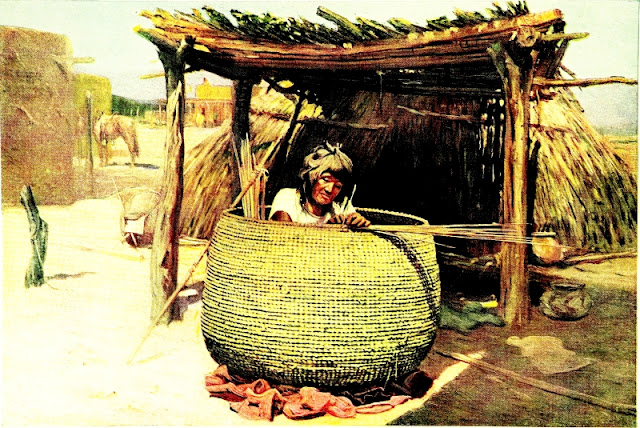
"The [basket that this] grandmother is weaving about herself
is to be used as a store for grains and vegetables."
This storage basket is very similar to an early Neolithic basket that was just found.
This is a colorized b&w photo from 
American Indians: first families of the Southwest by Huckel.
"Relatively few tribes of American Indians understood pottery, except in the crudest form. As for basketry, it may be said that every Indian from the land of the Esquimaux down through Mexico was a basket weaver."


ABSTRACT
It is clear from the fact that pottery had not been invented until late in the Neolithic era, that other tools and implements must have been fabricated during the Pre-Pottery Neolithic (PPN). Serge Svizzero points out in his quoted article that agriculture would have required a necessary set of support tools and containers to be successful; it is not enough to say that the Neolithic way of life occurred because of agriculture and the domestication of animals. In this article, I present direct and indirect evidence of Neolithic basketry to show that many of these implements could have been made using woven-fiber technology or basket weaving skills, a technology that may have been passed down from Upper Paleolithic societies. And I suggest these skills continued to be employed all during the Neolithic time period. Furthermore, I suggest these skills were passed on to the emerging civilizations in Mesopotamia and Egypt who made full use of this technology when needed.

INTRODUCTION

There is a large gap in the commonly accepted timeline of Neolithic technological development. Agriculture, domestication of animals, polished stone tools, pottery, and textiles are the accepted hallmarks of the Neolithic time period. But pottery did not occur until about 6,500 BCE and the domestication of pack animals did not occur until 3,500 BCE. This means that during the early part of the Neolithic, or for at least 3500 years, a large number of containers, implements, and tools were made with pre-pottery, pre-pack animal technology. And the technology that probably provided many of these things was basket weaving technology or woven-fiber technology as I have suggested this technology be called. Yet when I researched this topic, I could find almost no mention of basket weaving technology in the early Neolithic even though there is now direct evidence of basket use. However, I was able to find a substantial amount of information about Neolithic pottery. Clearly, baskets played a major role in the establishment of Neolithic settlements and were widely used before and after pottery took hold. 
THE NEOLITHIC TIME PERIOD: It is generally agreed that the time period of the Neolithic in the Levant went from ca. 10,000 BCE to ca. 4000 BCE when the first cities began to emerge in Mesopotamia. The first part of the Neolithic era, known as Pre-Pottery Neolithic A & B (PPN), ran from ca. 10,000 to ca. 6,500 BCE. This was followed by the Pottery Neolithic time period which ran from ca. 6,500 - ca, 4,000 BCE. In other words the PPN eras lasted about 3500 years and its technology proceeded the later Pottery Neolithic which lasted about 2500 years.
NOTE: These dates can only be roughly assigned and will change as discoveries are made. At the moment the above applies to the areas around the Tigris and Euphrates Rivers and the Persian Gulf.
This is another example of basket technology being taken for granted or simply not considered, even though it was crucial for Neolithic development and furthermore it had become highly developed and useful in the time period before the Neolithic. Later it would be just as important to the first civilizations. 
ABOUT THE NEOLITHIC TIME PERIOD
The Neolithic is not a fixed time period. It is a time after the Upper Paleolithic (the late Old Stone Age) and before the emergence of civilization when hunter-gatherers settled into a permanent sedentary life of villages and agriculture. For example, in Europe the Neolithic ended much later than in Mesopotamia and Egypt. The first civilizations in Mesopotamia emerged about 6000 years ago while the first European civilizations began less than 4000 years ago.
NOTE ABOUT THE MESOLITHIC: There is a time period between the Upper Paleolithic and the Neolithic called the Mesolithic which was a transitory period when many hunter-gatherers became semi-nomadic, for example. In this blog-article I mainly am concerned with the Neolithic time before the emergence of civilization. 


WOVEN-FIBER TECHNOLOGY AND NEOLITHIC CULTURES

It is my contention that advanced woven-fiber technology by nomadic hunter-gatherers of the Upper Paleolithic (see my earlier blog-article) was passed on to Neolithic cultures. Then during the Neolithic sedentary way of life people were able to expand and develop these technologies to create a kind of "infrastructure" that would allow them to farm and settle in villages. As Svizzero points out (see next), the Neolithic was not just about farming and domesticating goats and sheep, it required a wealth of support items many of which were woven-fiber based, such as large grain storage baskets used to store seeds for next year's harvest, waterproof woven fiber containers (often coated with bitumen) for irrigation and carrying water, grass houses, small boats, sandals, hats, fences, and much more.

WOVEN-FIBER TECHNOLOGY IN THE NEOLITHIC ERA

When the Neolithic revolution -- or more likely a slow transition -- occurred, there must have been a large number of support implements and methods that developed but are not often mentioned. The following quote makes this clear.
 Persistent Controversies About The Neolithic Revolution
"The domestication of plants and animals is a necessary but not a sufficient condition for the transition from foraging to an economy fully-based on agriculture to occur. Indeed, domestication can be seen as an innovation but many other innovations are required for the whole human population to be fed from agropastoralism activities. 
"These additional innovations are respectively related to the production of food resources, their processing, storage and consumption. Even if we consider agriculture in its first stage, specific tools and techniques are required, for instance, a digging stick to sow grains, an irrigation system, even if it is very basic or a sickle to harvest cereals. Once they have been harvested, domestic cereals require human activity, in the form of threshing and winnowing, to separate and disperse seeds. Once the seeds were obtained, they had to be stored in order to reduce the seasonal food risks. This requires some storage systems.
"Even though the innovations listed above seem us to be very basic they were all necessary for a complete transition to agriculture."
(Svizzero, "Persistent Controversies About The Neolithic Revolution")
PACK ANIMAL, any domesticated animal that is used to carry freight, goods, or supplies. The ass or donkey is the oldest-known pack animal, having been in use possibly as early as 3500 BCE


WHAT WAS USED BEFORE PACK ANIMALS? BURDEN BASKETS?

Although the following is only an educated guess, I believe it is worth considering as it provides a logical way that harvesting and processing grain, for example, would have been done before pack animals. 

I suggest that early Neolithic people employed 'burden baskets'. These are often huge baskets, carried on the back, that are capable of carrying a substantial amount of harvested plants. These baskets are still in use by hunter-gatherers today and were widely used by nomadic Native American Indians and other tribes. They were so important many Indian tribes had a unique design and also a unique name for these baskets as they had a special status. And they are still in use today in virtually every region of the world. Of course, like all baskets, we do not have direct evidence as these baskets from long ago would have decayed and left no indication of their existence. But their wide cross-cultural use, use by contemporary hunter-gatherers, and continued recent use on farms suggest that they could have been made in the Neolithic time period and would have helped accomplish the work these societies needed to bring in the harvest.

Contemporary pygmy hunter-gatherers use burden baskets for a variety of purposes.
<https://commons.wikimedia.org/wiki/File:Pygm%C3%A9es_(RDC).jpg>


Back baskets in Slovenia ca. 1963.


LEFT: "Haymaking - man collects grass in a pannier"
RIGHT: Harvest in Argenteuil (France) at the beginning of the 20th century.
<https://commons.wikimedia.org/wiki/File:046_Fienagione_-_uomo_raccoglie_l%27erba_in_una_gerla.jpg>
<https://commons.wikimedia.org/wiki/File:Vendange_argenteuil_95.png>


LEFT: Pima Carrying Frame
(Aboriginal American Basketry, 1904, Fig. 100, p. 294)
RIGHT: "Pima Indian woman...carrying firewood in her Kathak"
(University of Southern California, 1904, Pima Indian woman)


LEFT: Carrying Basket, Paiute Indians, Utah.
(Aboriginal American Basketry, 1904, Fig. 185, p. 494)
RIGHT: "Apache Indian woman carrying a "Kathak" on her back, Arizona, ca.1880."
(University of Southern California, ca.1880, Apache Indian woman carrying a "Kathak")


"Silva, 3 years old, goes to the field with her mother in 1954," Slovenia.
<https://commons.wikimedia.org/wiki/File:Silva,_3_leta,_Planina,_gre_s_koškom_z_materjo_na_njivo_1954.jpg>

Burden baskets are just one example of woven-fiber technology that could have been used in the Neolithic era. And even when pack animals were common, they carried baskets, such as these esparto donkey panniers pictured here.


BASKET IMPLEMENTS IN THE PRE-POTTERY NEOLITHIC 

As I pointed out earlier, for more than half of the Neolithic era, there was no pottery,  yet these agricultural societies clearly needed a wide variety of containers and related items for harvesting, winnowing, milling, sifting, and storing plus household items for cooking. 

I argue that many woven-fiber items were invented, created, and used for agriculture. But as I wrote in the article before this one, much of this technology had been handed down from Paleolithic societies. Here are some examples of grain processing baskets that Native American Indians used around 1900 when these photos were taken. As I have pointed out in my previous article, many Native American Indians lived a way of life that was roughly equivalent to the Upper Paleolithic in Europe so studying their technology may be helpful.

Examples of milling baskets; Pomo milling baskets. 
(Aboriginal American Basketry, 1904, Plate 97, explanation p. 350)


From this photo, it appears that the 'paddle' this Pomo Indian woman used was carefully constructed. It has a wrapped handle and a strong paddle surface for hitting plants so that she could collect their seeds in a burden basket.

BASKETS ARE TOOLS
For some reason, baskets are not often included as tools, but they are. Thinking of baskets as tools changes the way that they are evaluated and also elevates their importance.


BOTTOM:


ESPARTO WOVEN-FIBER ARTIFACTS

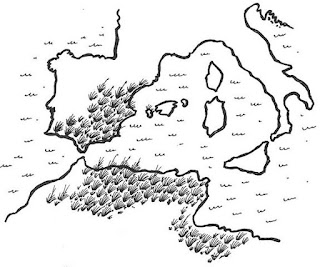
Just how versatile was this technology? What kind of products could it provide? Woven-fiber technology was dependent on the plants that grew wild locally. So reeds were plentiful and versatile around Mesopotamia, papyrus was widely used in Lower Egypt, and in Spain and in North Africa the esparto plant was valued for its many uses.

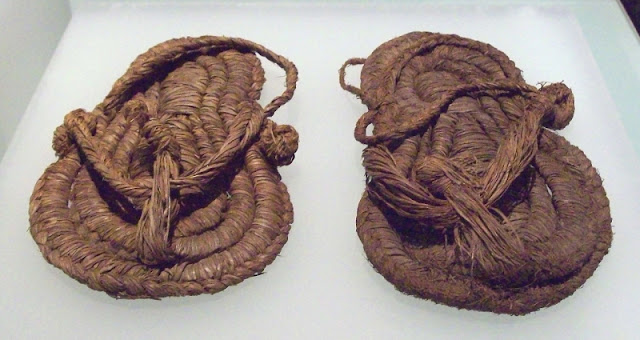
Fortunately, in the case of esparto, we have direct evidence since many baskets, shoes, and mats from the Neolithic era  (5200-4600 BCE OR 7200-6600 BP. Los Murcielagos Cave, Albunol, province of Granada, Andalusia) have survived intact. They were found in a dry cave near Granada Spain. The existence of these items also shows that basketry and weaving technologies were being widely used in the Neolithic. 
 
The following is quoted from:
Traditional Craft Techniques of Esparto Grass (Stipa tenacissima L.) in Spain
"Numerous archaeological artifacts and remains of esparto basketry have been discovered that date from the Neolithic period in southeast Spain. THESE PIECES DEMONSTRATE HIGH STANDARDS OF QUALITY COMPARED WITH MORE MODERN PIECES. [ED. My emphasis] In addition, there are many imprints of esparto basketry in clay or pottery (Ayala and Jiménez 2007). Among the abundant archaeological remains, some of the most outstanding are the artifacts dating back to 7,200– 6,600 BP, which were found with several mummies in Cueva de los Murciélagos (Granada). These pieces represented clothes, hats, tunics, sandals, baskets, and ropes—ALL MADE WITH THE FINEST TECHNIQUES. [ED. My emphasis]  In some cases, the artifacts included colored espartos." (Fajardo et al. "Traditional Craft Techniques of Esparto Grass...")
The authors list all the things that can be made with esparto:
Baskets (wide variety), Beehive, Belt for mules and donkeys, Bottle and container covers, Bowls, Canteen, Chair, Cheese mold, Clothing, Covered basket, Donkey pannier, Dough basket, Espadrilles Esparteñas, Fan, Ferret basket, Fishing net, Fish trap, Fodder basket to feed animals, specially mules and horses, Hat Sombrero, Long rug, Net for fishing or to carry straw in the cart, Oil mill basket for pressing olive pulp, Pitcher, Rope, Round rug, Saddle, Saffron basket to collect saffron flowers, Sandals, Shepherd spoon, Provisional spoon to eat curd, Shutters to keep the home fresh, Shepherd’s slings, Snail basket to catch snails, Sowing basket, Stool, Swarm catcher to catch bee swarms, Table mat, Toys and ornaments, Tunics.


Baskets, Shoes, And Mats From The Neolithic Era  (5200 - 4600 BCE or 7200 - 6600 BP)
Found In Los Murcielagos Cave, Albunol, Province Of Granada, Andalusia, Spain.

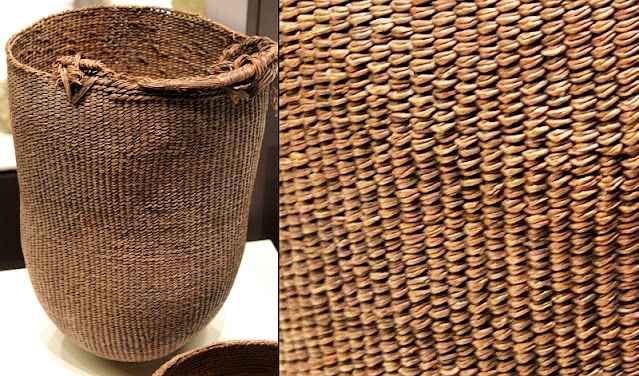


LEFT: Recreation of a Neolithic snail basket,
a traditional basket for collecting and gathering snails 
RIGHT: Detail snail basket

There are also many ways of processing the esparto plant and many ways of weaving the plant for various purposes which show the depth of knowledge people had.


DIRECT EVIDENCE OF NEOLITHIC BASKETRY IN AGRICULTURE

In 2021 in Israel the world's oldest complete basket, including lids, was discovered and dated to 10,500 years ago (BP), or near the beginning of the Neolithic era.
This large basket could hold about 92 liters or about 24 gallons, about as big as a human torso. According to Dr. Haim Cohen of the Israel Antiquities Authority project, "the ancient people who manufactured it probably...used it for storage."
This find was a major discovery. It was direct evidence of basketry in the early part of the Neolithic.(Palace "Oldest Basket Ever Found") 

This basket looks remarkably like this Native American Indian basket pictured next. The size, the shape, and even the lids are similar.

Coiled Granary, Pima Indians
The newly discovered basket in Israel looks remarkably like this
large Native American Indian one which was also used for storage and had similar lids.
(Aboriginal American Basketry, 1904, Fig. 203, p. 524)

OTHER NEOLITHIC BASKET FINDS
"The oldest basketry found in Egypt dates to the Neolithic period (ca. 5900–4000 BCE). In the Fayum Oasis, about 100 km (60 miles) southwest of Cairo, grain storage pits were excavated in the desert floor, lined with coarse straw basketry." "Near the Neolithic grain storage pits part of an extremely finely coiled basket was found, dated to about 4200 BCE, made of separate bundle and winder materials..." (Wendrich "Basketry in Ancient Egypt")

"Basketry is known from the earliest sites in Egypt [ED: Neolithic]. Remains of baskets have been found in the Fayum dating to the Neolithic period, about 5000 BCE. Basketry found in a predynastic context [ED: i.e., Neolithic] is often of very high quality, not surpassed later." (Bizzari "Weaving And Basketry In Ancient And Modern Egypt")
This direct evidence indicates that basket weaving was an essential technology in the Neolithic. But baskets are not the only example of woven-fiber technology. Weaving cloth, building large grass houses, and thatching roofs, were also highly developed. This has been well established. So weaving skills were widespread and very much a part of Neolithic life.


ABOUT WEAVING AND NEOLITHIC LOOMS

The establishment of weaving and making cloth throughout Neolithic societies, both in the Levant and later in Europe, indicates that in the early Neolithic these societies were well acquainted with the art of weaving in general and also skilled in the making of thread.

Impressions of plain-weave have been found in clay and dated to 23,000 BCE. However, it is an educated guess that these early impressions came from small handlooms for making belts and narrow strips.

"Guatemalan woman, handloom, 1970s."

The large looms necessary to make fabric and clothing, which are characteristic of the Neolithic era, probably looked like this.

This is a recreation of a Neolithic warp-weighted loom about 5300 years ago. The recreation is by The ArcheoParc Schnals Museum of South Tyrol, Italy. The clothing pictured here is also a recreation by the museum and part of their loom display.
<https://commons.wikimedia.org/wiki/Category:Archeoparc_Schnals_-_Museum#/media/File:Archeoparc_-_%C3%96tzi_Webstuhl.jpg>

"The first proof of true weaving [ED: weaving wide cloth] occurs circa 7000 B.C.E. at the start of the Neolithic, with impressions of plain-weave and basket-weave on clay at Jarmo (north-east Iraq) and a pseudomorph (minerals having outward characteristics of organic materials) of a plain-weave textile on a bone at Çayönü Tepesi (southern Turkey). These fabrics are too well done to be the start of weaving." (Barber "Prehistoric Textiles")


NEOLITHIC BUILDINGS

Weaving was also an important part of building. In the early Neolithic, homes were often made with weaving skills. 

Recreation of Neolithic huts 
in the Steinzeitdorf Kussow open-air museum, Damshagen, Germany.
<https://commons.wikimedia.org/wiki/File:Kussow,_Steinzeitdorf.jpg>

Some Native American Indian buildings, such as this one below, showed sophisticated weaving skills. As I have argued, I believe that Upper Paleolithic and Mesolithic technology was highly developed and was passed on to Neolithic societies. And again, as I have argued, the skills of Native American Indians around 1900 can be seen as similar to those of the Upper Paleolithic and Mesolithic in Europe.
“While it is now certain, that perishable fibre industries were part of the first Americans, [ED: Native American Indians] they also seem to have been part of Upper Palaeolithic techno-economic suite for much longer than we have imaged.” (Soffer "Recovering Perishable Technologies")

Later homes looked more like modern houses but still had thatched roofs. And thatching has continued to this day.

RIGHT: Roofer covering a modern thatched roof house in Escheburg, Schleswig-Holstein, Germany


CONCLUSION

It is clear from the fact that pottery had not been invented until late in the Neolithic era that other tools and implements must have been fabricated during the Pre-Pottery Neolithic (PPN). As Serge Svizzero points out in his quoted article, agriculture would have required a necessary set of support tools and containers to be successful. From direct and indirect evidence I have presented in this article, it seems likely that many of these could have been made using woven-fiber technology or basket weaving skills, a technology that may have been passed down from Upper Paleolithic societies. And I suggest these skills continued to be employed all during the Neolithic time period. Furthermore, I suggest they were passed on to the emerging civilizations in Mesopotamia and Egypt who made full use of these skills when needed.

___________________________________________
ENDNOTES

Barber, Elizabeth Wayland. Prehistoric Textiles. Princeton: Princeton University Press, 1991. Excerpt ("Prehistoric Textiles" in LoveToKnow.com. https://fashion-history.lovetoknow.com/fashion-history-eras/prehistoric-textiles   Accessed Jan. 30, 2922.

Bizzari, Heba Fatteen. "Weaving And Basketry In Ancient And Modern Egypt." TourEgypt.net, 2011. http://www.touregypt.net/featurestories/basketry.htm   Accessed Jan. 30, 2922.

Fajardo, J., Verde, A., Rivera, D., Obón, C. & & Leopold, S. "Traditional Craft Techniques of Esparto Grass (Stipa tenacissima L.) in Spain." Economic Botany ISSN 0013-0001 Econ Bot DOI 10.1007/s12231-015-9323-x https://www.academia.edu/19717708/Traditional_Craft_Techniques_of_Esparto_Grass_Stipa_tenacissima_L_in_Spain?auto=download   Accessed Jan. 30, 2922.

Palace, Steve. "Oldest Basket Ever Found is Part of Dramatic Discovery in Israel’s 'Cave of Horror'" The Vintage News, Mar 24, 2021. https://www.thevintagenews.com/2021/03/24/basket/   Accessed Jan. 30, 2922.

Soffer, O. (2004). Recovering Perishable Technologies through Use Wear on Tools: Preliminary Evidence for Upper Paleolithic Weaving and Net making. Current Anthropology 45, (3): 533.

Wendrich W. (2008) Basketry in Ancient Egypt. In: Selin H. (eds) Encyclopaedia of the History of Science, Technology, and Medicine in Non-Western Cultures. Springer, Dordrecht. https://doi.org/10.1007/978-1-4020-4425-0_8470  Accessed Jan. 30, 2922.


Friday, August 14, 2020

The Invention of Right-Angle Construction in the Paleolithic Era

The Invention
of Right-Angle Construction
in the Paleolithic Era

Including a picture essay that illustrates
the capabilities of right-angle woven-fiber technology and basketry.
Click on any picture to see the images in slideshow fashion.

ABSTRACT:
We live in a world of right-angle structures. Cloth is made this way, as is furniture, homes, and even skyscrapers. In fact, they are just about everywhere in the modern world. Yet right-angle construction is a human invention and not natural. Nevertheless, there has been virtually nothing written about this important discovery. When early humans began to understand the power of this concept, it was a major advance in their technology. When applied to basket weaving and related crafts, it led to the development of hundreds of products. It gave human-kind a powerful tool that helped them survive and prevail and eventually build civilizations.

    Free Download    
A PDF of this blog-article at: 

https://unc.academia.edu/RickDoble/DRAFTS#drafts

   ALSO FREE:   
 The Illustrated Theory 
 of Paleo Basket-Weaving Technology 

 by Rick Doble 
 Download a 200-Page PDF eBook 
 -- no ads/no strings -- 
 DOWNLOAD NOW 
  Figshare  
  Academia.edu  


INTRODUCTION
Ironworkers (as these skyscraper workers are called) having lunch on a horizontal crossbeam supported by vertical steel columns 840 feet up. Modern steel-framed construction uses horizontal beams and vertical columns at right angles to build today's highrise and skyscraper buildings. This picture is from the construction of Rockefeller Plaza in 1932 in New York City. Below the ironworkers is the entire city built with right-angle construction.
Clyde, Charles."Lunch atop a Skyscraper." New York Herald-Tribune, published Oct. 2, 1932.


In the distant past, early humans made a major technological breakthrough that has been overlooked. It is something that we use every day and that in many ways has built the modern world. Because it is everywhere, it seems natural; however, it is anything but. I am talking about right-angle construction -- the structure that is at the heart of weaving and textiles and the clothes you wear, the furniture you sit in and at the center of a skyscraper's construction and even your own home. 

I tried to research this idea and could find almost nothing that dealt with this technology as an invention and discovery that humans had made.

(Left) Painting of Archimedes in deep thought. 
(Right) Detail of painting showing right-angle square tool.
Archimedes of Syracuse contemplates the properties of the right angle. Archimedes is considered one of the greatest scientific thinkers; he was an ancient Greek mathematician, engineer, and inventor.
Painting by Domenico Fetti. "Archimedes Thoughtful." 1620.

“There are no...right angles in nature,” 
Antoni Gaudi, the famous Spanish architect declared.

Square (Tool). A square is a basic and essential right-angle tool used in construction. Carpenters and builders use it to ensure the accuracy of construction right angles and it is also used for marking lines on materials before making a cut. It is so fundamental it is often used in heraldry and on construction logos.

While Gaudi's declaration is an overstatement, as some trees grow straight up, perpendicular to the ground, and we as humans generally walk at right angles to the earth, natural right-angle complex structures are almost non-existent. In particular, I am talking about interlocking, interwoven perpendicular structures that do not occur in nature but which humans construct.

(Left) Steel-framed construction showing the basic right-angle skeleton structure.
(Right) A modern complex built using right-angle steel-framed construction.
Most modern highrise and skyscrapers are built using steel-framed construction. A horizontal and vertical steel skeleton is built which is strong enough to support the windows, floors, and walls. 


ABOUT RIGHT-ANGLE CONSTRUCTIONS

At some point in the past, humans realized that fiber items made with a right-angle design were strong, durable, and flexible. Moreover, they could be easily made with local plant materials. 
NOTE: Of course, with a dome-like structure and non-rectangular shapes, all the elements of a frame or the structure are not always at a strict right angle in relation to each other, nevertheless a consistent perpendicular opposition is a key part of these structures. 
This was a major advance in human technology. When and how this happened is open to debate. But that it did happen is undeniable and most important.

While a number of developing skills may have contributed to this technology, my guess is that basket weaving was one of the major areas where this insight was both discovered and implemented.
"From basket weaving to loom-weaving, the process of weaving was already known in the Paleolithic era, as early as 27,000 years ago. Weaving, the process of joining individual threads together at RIGHT ANGLES [ED: my emphasis] to one another, has been around for millennia."
BSAMPLY. "WHAT ARE WOVEN FABRICS?" 

HOW WAS RIGHT-ANGLE CONSTRUCTION DISCOVERED?

The discovery or invention of right-angle construction must have been preceded by an earlier woven-fiber technology. I have again searched the Internet and could only find vague references to the origins of basket weaving or woven-fiber technology, as I have called it, such as the following quote.
"The idea of interlacing materials together to create a weave was probably inspired by nature; by observing birds’ nests, spider webs and various animal constructions..."
Wild Tussah. "The History of Weaving." September 2014. https://wildtussah.com/history-weaving-2/ Accessed August 7, 2020.
If weaving was inspired by nature, the origins of weaving may have begun as follows:

It has been well established [1] that early hominids spent a good deal of time around baobab trees on the savannas of Africa. This tree was also used by weaverbirds who built elaborate nests. So, as I have written, it seems quite likely that at some time in the past, hominids learned how to weave by watching weaverbirds build their nests and by observing the completed nests and handling abandoned nests when they fell down.

Just how much could early hominids have learned from the weaverbirds and their skills at nest building? Quite a lot.

Weaverbirds building nests. 
(Left) A male bird working to complete a nest.
(Right) A completed nest with a male and female weaverbird ready to move in.

ABOUT THE WEAVERBIRD
"The nest is made from long strips torn from the leaves of grasses, which are intertwined in a regular lattice formed by passing successive strips over and under, and in a direction orthogonal to, strips already laid. It is held together, and attached to the substrate, by a variety of stitches and fastenings... The bird uses its beak rather like a needle in sewing or darning."
Ingold, Tim. "Chapter Nineteen Of string bags and birds’ nests Skill and the construction of artifacts." The Perception of the Environment, Essays on Livelihood, Dwelling and Skill. Taylor & Francis Group.

A weaverbird starting to build a nest. He is creating the basic skeleton
that the nest will be built around.

Weaverbirds gave hominids good initial instructions which included most of the basics of basket weaving such as creating a regular lattice, tearing then placing long strips at an opposing angle to already existing strips, passing the strips over and under and tying this all together with a variety of knots. Eventually, hominids would have been able to expand on this craft.

THE FIRST HOMINID BASKETS WERE PROBABLY 'RANDOM WEAVE' CONSTRUCTIONS

Assuming that the model for early basket-like containers and carriers was bird nests and such, the most likely human-made designs were probably made with a 'random weave.' This is due to the fact that a random weave in many ways imitated the process that birds used to build nests such as the construction process of weaverbirds who were common in Africa then and now [2].

Two random weave baskets. Photos and baskets by Nan Bowles.

A random weave basket generally starts with a circular or oval bare-bones open skeleton made of strong thick branches or vines which are intertwined. The branches might be green so that they are pliable. The sides are then laced with smaller more flexible (often green) branches and vines that are woven over and under the skeleton frame and over and under each other and at opposing angles to existing strands. When allowed to dry out, a simple basket like this is remarkably strong and can hold two to six kilograms, in my experience. It is also quite light, so carrying it for a long-distance would not have been a problem. 

Such technology would have given early hominids a distinct survival advantage. For example, it would have allowed hominins to forage much further from their base because they could bring back a large amount of food from distant locations.

(Left) A fallen abandoned weaverbird nest.
(Right) A simple basket using opposing strands.

Over time this basic construction could have evolved into a more regular and standard right-angle structure, the kind that we are familiar with. And once mastered this design could have been expanded and developed to create a wide range of items.

Master craftsmen, at different stages, weaving baskets and other items. 

The principle of regular basket weaving is quite simple. A set of strands is placed at right angles to another set of strands. In basket weaving the vertical stands, known as spokes, are fairly hard. Then the opposing strands, called weaver strands, are more flexible and wrap over and under around the spokes to make the walls of the basket. While the term 'basket' and 'basket weaving' is used, the ancient craft applies to mats, flexible bags and sacks, wide gauge and fine gauge baskets, different styles of weaving, and a large variety of fiber articles from sandals to boats and houses. In short, the 'basket weaver' was/is a fiber craftsman.

This photo shows the huge variations possible with even a simple basket design.

However, the historic timetable is unclear. When humans first began to make random weave baskets and how long this went on is unclear. Yet, logically, this would have been the craft that preceded sophisticated right-angle woven structures.

It was no accident that the two earliest civilizations Sumer and Egypt employed weaving as a key technology throughout their empires. Both had plants that could be used for a variety of woven-fiber structures. In Sumer, the primary materials were the reeds that grew abundantly in the mashes as well as esparto for rugged baskets and the best rope. In Egypt, it was papyrus and flax which could be used to make sacks, cloth, baskets, sandals, and even boats. Egypt's granaries, for example, were managed with sacks of grain. Quite simply, neither civilization would have been able to function without woven-fiber technology.

In the Elementary Sumerian Glossary the highly respected 'basket weaver' is defined as: "a reed craftsman, basket and mat weaver"
Foxvog, Daniel A. Elementary Sumerian Glossary. University of California at Berkeley, revised 2008. SumerianGlossaryFoxvog.pdf


 PICTURE ESSAY

It is my educated guess that humans probably discovered the power of right-angle construction with basket weaving and then expanded that technology to make larger, stronger, and/or more complex woven structures.

Yet in a sense, it does not matter if this insight came from basket weaving. What does matter is that at some point it became part of and central to basket weaving and when it did it allowed a huge variety of objects to be constructed. Then this technology gave humans a distinct advantage in the struggle for survival.

Moreover, we can say with certainty that eventually new woven designs were invented for a wide variety of uses such as making fish traps with an open type of weaving, and hats, and sandals, and mats, i.e., myriads of items small to large. This was possible because right-angle technology was scalable. As you will see in the following picture gallery, small one-person boats could be made with this technology as well as huge boats for commercial purposes. I believe it started small and evolved into many small things and then later evolved into bigger things.

The following images illustrate just how versatile this technology became, a technology that we do know was in place at least by the Neolithic era -- but probably much earlier.

ABOUT THESE IMAGES

PLEASE NOTE: The following photographs and images were found at commons.wikimedia.org with a few exceptions. All images are used with permission.

At the end of this article, I have listed the web link for each image. To get more information about each one, please go to the Internet page for that image.

In the following descriptions, phrases in quotes are quoted from the original image description.

SCALABLE: Many right-angle woven-fiber designs can be made 
in a wide range of sizes
(Left) Small Neolithic baskets, about 5000 years old. They were found in a dry cave, Cueva de los Murciélagos (Albuñol, Granada), which is why they are so well preserved.
(Middle) Working medium-sized traditional panniers baskets on a donkey (the second basket is not visible on the other side of the donkey).
(Right) Large baskets in a boat, ready to be filled with grain.

VERSATILE: Right-angle woven-fiber technology can create a large number 
of shapes and configurations
(Left) A wicker sewing basket.
(Middle) A rattan chair.
(Right) Walls in Swaziland, Africa.

VOLUME: Items can be produced in large quantities.
(Top) Sandal Maker, Tomb of Rekhmire, Egypt, about 3500 years ago, This is a facsimile from a wall painting.
(Bottom) A pair of ancient sandals made from the papyrus reed and from about the same time period as the painting above. These were made in quantity.

A VARIETY OF DESIGNS TO ACCOMPLISH A TASK: FISH TRAPS
(Top Left) A traditional basket for gathering snails in Southern Spain.
(Top Right) Fish Trap, Aitutaki (Cook Islands)
(Bottom Left) Braided fish trap.
(Bottom Right) "Bamboo fish pot or trap in general use in Porto Rico."


WATERCRAFT

---- Basket Boats (Coracles) ----
These boats are based on a basket-like structure that is then covered with animal hides and sealed with waterproofing materials such as bitumen which occurred naturally in Mesopotamia. These boats are quite seaworthy and have been used throughout the world for thousands of years. They are light and strong and can be made in a wide range of sizes from small boats for an individual sailor to ones capable of carrying five tons.
Coracles have been used in England, Wales, Scotland, and Ireland for centuries and are still in use today. One person can easily carry a light coracle on his back and take the boat to a lake or river.

(Left) The basket structure of this boat is visible.
(Right) Large basket boats can carry twenty people.

---- Rafts ----
The right-angled horizontal crossbeams hold a raft together and are the basis for its integrity. As these pictures show, it does not matter if the raft is small or large.
(Top) Children on a raft -- the crossbeams are clearly visible and keep the raft together.
(Bottom) A common working bamboo raft in Taiwan. The horizontal right-angled slats are visible.


This model of a balsa raft is a model of a traditional Peruvian raft, sailed by pre-Columbian people, as drawn by the Spanish around 1600. The raft is made of large balsa logs and is a "double-decker" in that there are two levels that are held together by horizontal bamboo crossbeams that are lashed to the vertical balsa logs and the deck above. This design was the inspiration for the famous South American raft, Kon-Tiki.

---- Reed Boats & Ships ----
Reed boats are made by bundling and tying reeds together in columns and then securing them with right-angle horizontal binding. Common in Egypt and Sumer/Babylon, they were made of marsh reeds in Babylon and papyrus in Egypt. As with other boats in this section, they can be quite small for an individual sailor or sixty feet long with a crew of eleven as was the case with the reproduction of an ancient Mesopotamian boat seen below.

(Top) A small reed boat. 
(Bottom) Named the Tigris, this is a model of the Mesopotamian reed boat built by Thor Heyerdahl of Kon-Tiki fame. He believed that a boat similar to this had been used in the early days of the Sumerian/Babylonian civilizations. The Tigris was almost 60 feet long, had a crew of eleven, and sailed more than 4,000 miles without any serious problems.

In these ancient depictions, the right-angle cross-weaving is evident for these reed boats. 
(Top) This image clearly shows that the Mesopotamian boats used a right-angle cross-weaving in their boats. The drawing is after an ancient bas-relief from Nineveh Babylon dated to about 600 BCE. This was one of the pictures that inspired Thor Heyerdahl to build the Tigris.
(Bottom) The cross-weaving is also evident in this image of an Egyptian boat more than 2500 years ago.


HOUSING

---- African Huts ----

These traditional huts are based on a basket-type right-angle design. They are essentially large upside-down baskets which are then covered with a robust woven outer layer that keeps out the wind and the rain.

"Swazi type hut under construction."
This shows the skeleton structure over which a covering is placed. 


Traditional African Huts
(Top Left) "Frame slats of a Swazi hut, at a cultural village at Jeppes Reef border post."
(Top Right) A rural hut inside the Zululand Museum, showing the basic structure, over which a covering is placed.
(Bottom Left) "The replica Zulu Hut at the Voortrekker Monument is typical of the dwellings found in Zululand, which were traditionally constructed by men."
(Bottom Right) A traditional African hut.


Detail of thatching of the replica Zulu hut (full view of Zulu hut is above bottom left).


Large mudhif buildings made entirely of reeds.
Weaving technology once mastered can be scaled up to make quite large structures such as these traditional mudhif reed houses that have been made for centuries by the Mudan people in the marshes of southern Iraq. These are used for community gatherings.
(Left) Interior of mudhif. "A mudhif, a traditional Marsh Arab guesthouse made entirely out of reeds. The Marsh Arabs live a lifestyle that dates back 5,000 years."
(Right) Very large mudhif building in Nasiriyah Iraq.

(Left) Local contractors begin the job of building a mudhif. "The reeds are gathered from marshlands near the Euphrates River." 
(Middle) "Local contractors construct the main reed arches of a marsh Arab mudhif."
(Right) Almost completed, the mudhif exterior.


---- Neolithic Reconstructions ----

Early Neolithic houses in Europe.
(Top) Archeon Museum Park, Netherlands "showing a replica of a house 8000 years BC."
(Bottom) "Stone Age village of Kussow, Damshagen municipality, Germany."


LATER NEOLITHIC BUILDINGS 
WITH FULL RIGHT-ANGLE ENGINEERING

(Top) "Neolithic model dwelling, from an excavation in Hungary of the 5th millenium . Musée des tumulus de Bougon"
(Bottom) Model: "Wels ( Upper Austria ). City Museum - Minoritenkloster: Model of a neolithic village."


(Left) Building detail, interior. "Neolithical village Heldenberg."
(Right) From the Pfahlbaumuseum Unteruhldingen in Germany. The open-air museum comprises several reconstructions such as this.


(Left) Reconstruction of Lakeside Neolithic settlement in Dispilio, Greece.
(Right) Archeoparc, Germany (Schnals valley/South Tyrol). Reconstruction of a neolithic hut.

---- Neolithic Looms ----

(Left) Reconstruction. "Neolithic loom, Vinca, Serbia."
(Right) "Cucuteni Vertical Loom Reconstruction Piatra nNamt."

Textiles were invented using the same structure. The famous Anni Albers of the Bauhaus School had this to say.

"During the 4,500 years or, in some estimates, even 8,000  years [ED: there is now concrete evidence that it is at least 27,000 years old] that we believe mankind has been weaving, the process itself has been unaffected by the various devices that contributed to greater speed of execution. We still deal in weaving, as at the time of its beginning, with a rigid set of parallel threads in tension and a mobile one that transverses it at RIGHT ANGLES. [ED: My emphasis]"

This basic insight about right angles has never been overshadowed. Anni Albers went on to say, "And weaving, even the most elaborate, can be done, given time, with a minimum of equipment....Fabrics of great accuracy have been executed without much mechanical aid."


WHEN DID THE DISCOVERY OF RIGHT-ANGLE CONSTRUCTION TAKE PLACE?

Right-angle design was probably discovered by basket-weaving craftsmen or was discovered in other technologies as well and then applied to basket weaving. In any case, basket weaving made full use of it.

Nevertheless, it may have taken thousands of years to derive a general principle that could be applied to a number of different weaves, different materials, strands of different gauges, different sizes, different uses, etc. Inventing something original from scratch would not have been easy. For example, with a basket, the forces are intertwined together, but in a building, the additional force of gravity is a key element even though the basic structure is similar. 

It is also important to note that working with baskets and weaving patterns and styles would have allowed people to 'play' with these structures. Playing with inventions is important just as it is with children. Overtime a general understanding might have emerged. I assume that it was not mathematical as we would know it, but perhaps proto-mathematical in which strands of different strengths and thicknesses were put in 'opposition' to each other, for example. 

Yet making baskets was one thing, and building larger items was something quite different, i.e., designing such things as walls or roofs and boats. This again would probably have taken thousands of years. 


A BASKET-WEAVING TIMELINE?

I think it is very unlikely that sophisticated right-angle basket weaving began by itself and did not evolve from something earlier. But because woven-fiber constructions decay, they have left little evidence; as one paleoanthropologist wrote, their past existence is invisible [3] -- for the most part (more about trace evidence in a future article.)

Nevertheless, another anthropologist has asserted that what we have found so far -- i.e., artifacts that have survived such as stone tools -- are only about 10% of the tools and items that were made and used in Paleolithic cultures.[4]

While microscopic trace evidence on stone tools has shown wear patterns that were caused by cutting plants and wood, this is about the only direct evidence we have. We might be forced to use other means such as computer simulations or simple logic.

SUMMARY OF A POSSIBLE TIMELINE
For example, using logic as our tool, the following timeline makes sense. 

Early on -- it could be tens of thousands of years ago or a million years ago -- hominids began making the first baskets with a random weave based on models from nature such as birds' nests. Then, after thousands of years, they gradually discovered the power of right-angle design which again, after thousands of years, allowed them to make a wide variety of well-crafted items from sandals to large boats and houses and played a major role in the emergence of civilizations such as Egypt and Sumer.

But the exact timing is not the most important thing, the progression is the most important thing.


CONCLUSION

It is quite clear that the first civilizations of Sumer, Babylon, and Egypt could not have functioned without a sophisticated woven-fiber technology which included an understanding of right-angle construction. This crucial technology included baskets and sacks for a wide variety of agricultural tasks, along with mats, shoes, containers, cordage, houses, boats, clothing, and much more. This means that woven-fiber constructions were critical to the emergence of civilization. Therefore it is important to understand the origins and development of this technology as it played a major role in the ascendence of humanity.

Egyptian agriculture used woven-fiber sacks and baskets for planting, harvesting, transporting, storing, and processing. Without woven-fiber technology, Egyptian civilization could not have functioned.
(Left) Ancient Egyptian model of a granary with scribes. This model was found in a tomb and shows men delivering grain in woven sacks which is being recorded by scribes.
(Right) Ancient Egyptian painting of men carrying and delivering sacks, from the Tomb of Oumsou.

Right now there is almost no information about the origins of basket-weaving and the discovery of right-angle construction. If we are to understand the development of human culture and the accompanying technologies, woven-fiber technology needs to be at the top of the list. Clearly, it warrants more consideration than it has been given in the past.


(Left) Typical Egyptian work basket.
(Right) The Egyptian God Heh kneeling on a basket. He is often shown with a basket emphasizing its importance. Medium: "Egyptian faience with pale green glaze" dated "between 1070 and 332 BC (Third Intermediate-Late Period)."

SPECIAL NOTE: An important new article has just been published about similar subject matter. Entitled "Mobile containers in human cognitive evolution studies: Understudied and underrepresented" by Michelle C. Langley and Thomas Suddendorf, it was published in Evolutionary Anthropology, 2020.
____________________________________________

FOOTNOTES
#1. Please see my blog:
Homo Habilis Learned Basket Making from Weaverbirds

#2. See the above blog-article for information about weaverbirds.

#3. “Thus far, the use-wear on the quartz and quartzite subsample of Kanjera artifacts confirms that animal butchery was conducted on-site, but also demonstrates the processing of a variety of plant tissues, including wood (for making wooden tools?) and tubers. This is significant, because the processing of plant materials appears to have been quite important, but would otherwise have been archaeologically invisible”. 
Popular Archaeology, June 12, 2012, quoting Dr. Thomas Plummer of Queens College, City University of New York.

#4. Dr. Adovasio has made the point that there is "ample ethnographic evidence that perishable technologies form the bulk of hunter-gatherer material culture even in arctic and sub-arctic environments (e.g. Damas 1984; Helm 1981). Archaeologists working with materials recovered from environmental contexts with ideal preservation clearly confirm that this is also true for the past as well. Taylor (1966:73), for example, notes that in dry caves he recovered 20 times more fiber artifacts than those made of stone, Croes (1997:536) reports that wet sites yield inventories where >95% of prehistoric material culture is made of wood and fiber, and Collins (1937) confirms the same for sites in Alaskan permafrost."
Soffer O, Adovasio JM, Hyland DC, Klíma B, Svoboda J. "Perishable Industries from Dolní Vestonice I: New Insights into the Nature and Origin of the Gravettian." Paper Prepared for the 63rd Annual Meeting of the Society for American Archaeology Seattle, Washington, 25–29 March 1998. DolniVestonice.pdf. 

PICTURE ESSAY LINKS
Please copy and paste these links into your browser.
Links are in the same order as the pictures in the essay.

SCALABLE
https://commons.wikimedia.org/wiki/File:Cestillos_de_esparto_(29319999262).jpg
https://commons.wikimedia.org/wiki/File:Donkey_panniers.jpg
https://commons.wikimedia.org/wiki/File:Ballast_Baskets_(1402074671).jpg

VERSATILE
https://commons.wikimedia.org/wiki/File:1950s_Wicker_Woven_Musical_Sewing_Basket_-_ivorybird_(12398155865).jpg
https://commons.wikimedia.org/wiki/File:Sillón_-_Madrid_(España).jpg
https://commons.wikimedia.org/wiki/File:Swaziland_-_Traditional_homes.jpg

VOLUME
https://commons.wikimedia.org/wiki/File:Sandal_Maker,_Tomb_of_Rekhmire_MET_DP346330.jpg
https://commons.wikimedia.org/wiki/File:Pair_of_Sandals_MET_eg28.jpg

FISHING TRAPS
https://commons.wikimedia.org/wiki/File:Snail_basket.jpg
https://commons.wikimedia.org/wiki/File:FMIB_33815_Fish_Trap,_Aitutaki.jpeg
https://commons.wikimedia.org/wiki/File:COLLECTIE_TROPENMUSEUM_Gevlochten_visfuik_TMnr_15-454.jpg
https://commons.wikimedia.org/wiki/File:FMIB_33300_Bamboo_Fish_Pot_or_Trap_in_General_Use_in_Porto_Rico.jpeg

RAFTS
https://commons.wikimedia.org/wiki/File:Children_on_a_raft_on_Lake_Washington_near_Bryn_Mawr,_Washington,_May_30,_1904_(KIEHL_23).jpeg
https://commons.wikimedia.org/wiki/File:Mid-south_western_Taiwan_bamboo_raft.jpg
https://commons.wikimedia.org/wiki/File:Balsa_Raft.jpg

CORACLES
https://commons.wikimedia.org/wiki/File:Britons_with_coracles_-_from_Cassell's_History_of_England,_Vol._I_-_anonymous_author_and_artists.jpg
https://commons.wikimedia.org/wiki/File:Hogenakkal_Coracle.jpg
https://commons.wikimedia.org/wiki/File:Kuphar.jpg

REED BOATS
https://commons.wikimedia.org/wiki/File:Bolivia-130_-_Reed_Boat_(2218109064).jpg
https://commons.wikimedia.org/wiki/File:Tigris_Model_Pyramids_of_Guimar.jpg
-- for the Babylonian drawing see the note at the end of this section
https://commons.wikimedia.org/wiki/File:Boating,_Luxor,_tomb_of_Mentuemhet,_Third_Intermediate_Period_to_Late_Period,_Dynasties_25-26,_c._690-664_BC,_limestone,_pigment_-_Oriental_Institute_Museum,_University_of_Chicago_-_DSC07798.jpg

HOUSING
https://commons.wikimedia.org/wiki/File:The_National_Archives_UK_-_CO_1069-202-35.jpg
https://commons.wikimedia.org/wiki/File:ZA-MP-matsamo-huette.jpg
https://commons.wikimedia.org/wiki/File:Fort_Nonquai_-_Eshowe_-_Zululand_Museum.jpg
https://commons.wikimedia.org/wiki/File:Replica_Zulu_Hut,_Voortrekker_Monument.jpg
https://commons.wikimedia.org/wiki/File:Une_hutte_traditionnelle.jpg

DETAIL: Replica_Zulu_Hut_thatch
https://commons.wikimedia.org/wiki/File:Replica_Zulu_Hut_thatch.jpg

MUDHIF
https://commons.wikimedia.org/wiki/File:Iraqi_mudhif_interior.jpg
"A mudhif, a traditional Marsh Arab guesthouse made entirely out of reeds. The Marsh Arab live a lifestyle that dates back 5,000 years."
https://commons.wikimedia.org/wiki/File:Modhif_neserya_1.jpg

CONSTRUCTION OF MUDHIF 
https://www.dvidshub.net/news/48053/mudhif-houses-capture-spirit-iraqi-culture
https://www.dvidshub.net/news/42276/marsh-arab-mudhif-rises-cob-adder

NEOLITHIC - EUROPEAN
https://commons.wikimedia.org/wiki/File:Archeon_8000_years_BC.jpg
https://commons.wikimedia.org/wiki/File:Kussow,_Steinzeitdorf.jpg
https://commons.wikimedia.org/wiki/File:Neolithic_model_dwelling.Musée_des_tumulus_de_Bougon.jpg
https://commons.wikimedia.org/wiki/File:SMWM_-_Jungsteinzeitliches_Dorf_4.jpg
https://commons.wikimedia.org/wiki/File:Heldenberg-IMG_7865-Neolithisches_Dorf.JPG
https://commons.wikimedia.org/wiki/File:Bodensee,_Unteruhldingen-Pfahlbauten_D-017.jpg
https://commons.wikimedia.org/wiki/File:Dispilio1.jpg
https://commons.wikimedia.org/wiki/File:Archeoparc_-_Hütte_3.jpg

LOOMS 
https://commons.wikimedia.org/wiki/File:Neolitic_loom,_Vin%C4%8Da,_Serbia.jpg
https://commons.wikimedia.org/wiki/File:VerticalLoom.JPG

EGYPT AND BABYLON BASKET IMAGERY
https://commons.wikimedia.org/wiki/File:Model_of_a_Granary_with_Scribes_MET_DP351557.jpg
https://commons.wikimedia.org/wiki/File:Tombe_d%27Oumsou_1.jpg
https://commons.wikimedia.org/wiki/File:Egyptian_-_Kneeling_Heh_on_a_Basket_-_Walters_48425.jpg
https://commons.wikimedia.org/wiki/File:Basket_with_handles_MET_31-3-149.jpg

The drawing of boats from Babylon came from:
King, Leonard. A History of Babylon, From the Foundation of the Monarchy to the Persian Conquest, Vol. 2. London,  Chatto and Windus, 1915.
https://www.gutenberg.org/ebooks/56667 -- page 322 in the ebook.