Showing posts with label loom. Show all posts

Sunday, May 10, 2026

Students: Minor in Woven-Fiber Technology

 College students:
You can now minor in
the new field of
Woven-Fiber Technology
By Rick Doble
There is no college or university 
that offers a full degree in this field
Yet many colleges will let you self-design a minor as you wish


FROM BASKETS TO SHIPS:
IT MAY HAVE TAKEN 100s OF THOUSANDS OF YEARS
[TOP] A carry basket. using a simple design, made by the Xerente (Sherenté),
an indigenous people in Brazil.
It may have taken more than half a million years for the skills needed to make this basic basket [TOP] to evolve into the skills needed to make this seagoing ship [BOTTOM] made of reeds that could carry 50 tons of cargo and sail the Persian Gulf
[BOTTOM] "Model of the reed boat Tigris, boat of Thor Heyerdahl." 
This recreation of a Mesopotamian reed ship could carry 50 tons of cargo. Thor Heyerdahl built the full-scale ship to prove the seaworthiness of reed ships. He sailed the Tigris with no problems for 5 months in the Persian Gulf. 
https://commons.wikimedia.org/wiki/File:Tigris_Model_Pyramids_of_Guimar.jpg

Many colleges, particularly liberal arts institutions with open curricula, offer significant flexibility in choosing a minor, allowing students to tailor their studies to unique, interdisciplinary interests. 
GOOGLE AI  5/9/2026
Formerly known as basket weaving
Woven-Fiber Technology
greatly expands the definition of weaving
to suggest that it was a critical technology in the development of human tool-making and survival

This new field covers not only baskets that were made worldwide beginning thousands of years ago, but also textiles, clothing, and cordage,
along with hundreds of woven objects and structures that were made by hundreds of cultures all throughout history. And woven-fiber technology continues and is important today with clothing, for example. 

One clear example of the importance and widespread use of woven-fiber technology was the reed industry in early Mesopotamia, whose first cities in the world were built on reed technology with the production of large seafaring reed boats, fleets of small boats, huge buildings made entirely out of reeds, and tools to create and dredge canals along with reed devices that helped with irrigation and flood control. This is only one example, as woven-fiber technology was critical for Egypt, Greece, Rome, the Middle Ages in the west, and many other places in the East, such as India and China.

If you create a minor in Woven-Fiber Technology, you could be one of the first to tell an untold story of how woven-fiber technology was a key craft and technology that began thousands of years ago and continues to this day. With the power of the Internet, you can research woven-fiber technology developments that made early civilizations such as Rome and Greece possible, along with the building of cathedrals in the Middle Ages which were critical to the development of the modern world. 

This technology continues to this day. The woven clothes we wear and the cloth we use probably developed from this technology along with the making of paper and with the many baskets and other containers that every family has and are essential.

A Personal Story: How I Put My Minor Together
When I was getting my Master's degree in Communication (it would now be called Media) at the University of North Carolina at Chapel Hill, a minor was required. I was interested in Anthropology, so I got permission to make that my minor if I could find a teacher in the Anthropology department who would work with me. I knew several students in that department, and they all recommended one professor who I liked a lot. Together, we designed and created three courses. The first course was to watch all the anthropology-related documentaries that the University had, which were a lot, and then write a paper about them. Next, I did a study of a very small town in North Carolina that had gone from nothing to a boom town, and then to a busted town. I had aerial photographs that I put together and then overlaid them on transparent sheets to show the changes in the town. The last course was an elaborate three-screen sound-slide show that showed the impact of building a dam and the people who had to be relocated. This project was really too big for one course, but we made it work. 

Right now, many universities allow a student to self-design a minor when getting a B.A. or other degree. So today a student could minor in Woven-Fiber Technology. This option is often available at many universities. They could select from the courses I outlined, for example, or create their own set of courses. Check with your advisor, search your school's online information, and look in the school's catalogue.

"Relatively few tribes of American Indians understood pottery, except in the crudest form. As for basketry, it may be said that every Indian from the land of the Esquimaux [ED: land of the Inuit or people formerly known as Eskimos] down through Mexico was a basket weaver."
American Indians: first families of the Southwest by Huckel.

The following are course ideas that you can modify, combine, or edit anyway you want. This article is covered by the Creative Commons copyright meaning that you can quote my writing directly and/or edit without permission from me. However, you do need to credit me, Rick Doble, and my blog, DeconstructingTime. This course list might help you start thinking about how you would like to put your self-designed minor together but these are only suggestions. Have fun and make your own program.

----------------------- COURSE IDEAS ----------------------- 
-- RANDOM BASKETS:
A course could begin with random basket weaving based on ideas derived from pictures of bird nests and other natural items like spider webs -- you would be asked to study such natural objects and then make a random basket or two from what you learned without a teacher's direction.

-- BASKETS WORLDWIDE:
With the help of the Internet, you can look at hundreds if not thousands of baskets from different areas of the world and from different times in history. There are many basket museums also. Study these baskets for the weave, the materials, the overall design, and their intended use. Write a paper with your observations.

-- COMBINING MATERIALS: 
This course covers making objects in which weaving is only part of the item, such as a table that combines wood and weaving. For example, wood can provide the frame or the skeleton for an object like a chair, or a hamper; then woven fabric is woven around this skeleton.

-- TEXTILES: 
This course includes a study of fabric, looms, and the cloths we wear, along with sails for sailing ships and sacks for carrying grain. The weaving of wide, large cloth was probably perfected in the Neolithic era with the invention of the Neolithic loom, along with a very sophisticated use of flax that was grown for the purpose of making linen. The method for processing flax into linen was quite complex and was still used until recently. Flax is perhaps the oldest cultivated plant whose fiber was used to make cloth. The history of textiles would fill many books, so a student will need to condense this history or focus on one aspect of textile making or textile use, or textile materials, such as sails on boats.

-- CORDAGE: 
Cordage has been used extensively for a wide variety of applications all through history. The oldest cordage found is about 50,000 years old and was made by Neanderthals. Part of the emphasis in this course would include working with perhaps a hundred knots. The ability to make knots greatly increased the practical ways that rope could be used. In both the Roman times and the Middle Ages, rope was essential for maritime use and even in the Roman Colosseum, where ropes were used to raise and lower doors for the events. In the Middle Ages rope was used by bell ringers, horse handlers and grooms, and also builders when they positioned tons of stone to build cathedrals.

-- CULTURE AND RELIGION: 
This course is about how basketry and other woven items are often an integral part of a culture and its customs, and how religion, myth, and spiritual beliefs are part of this story. Baskets often have a spiritual meaning. Just about every tribe had/has a story about how the Earth was created or how their tribe came to be what it has become, which often includes basketry. Many basket patterns had a religious connection. At least four African peoples today make baskets with flat bottoms that have a religious significance, for example. Native American Indians, such as those in the very large Algonquian nation, had tribes that wove or designed baskets that were specific to a tribe. 

-- HISTORY: 
History can be many things: It can be oral history as told by individuals, the history of a clan or tribe, the history of a design or style, or the history of a technology. For example, the known technological history of basket weaving began about 10,500 years ago in the Neolithic era, since the oldest known complete basket was found dating to that time. A history might include the use of special early baskets that were used for a sophisticated storage method that kept grain from becoming moldy, or infested with insects or rodents.

-- THE MODERN USE OF WEAVING: 
This topic covers new clothing, designs, and structural items, especially in the arts. Modern art and artists would be important to this class. State-of-the-art wearable clothing is also an emerging category. For example, the display of dresses at the prestigious Metropolitan Museum Met Gala in New York, which is held every spring, shows cutting edge fabric design and cutting-edge fabrics. It is considered the most important world event in fashion.

-- MATERIALS: 
In the past, baskets were made with local materials that could vary greatly since people had to work with what they could find locally and know when the best time was to harvest and process them. The wide variety of materials that could be used is often quite remarkable. Many woven-fiber weavers used a combination of local materials to construct a basket or other item. Distinctive basket designs often occurred due to the limitations and strengths of local plants.

-- LEARNING: 
This course is about how basket making can be taught to young people so that the art of the craft and traditions continue. In one part, for example, students could learn to weave baskets with a non-verbal "show and tell" way of learning, as this method may have also been used for thousands of years before language was fully developed. It can also be taught by a teacher who explains each step.

-- PALEOLITHIC SPECULATION: 
You will do a full review of all woven-fiber related science, evidence, and theories about basketry and woven-fiber development in the Paleolithic era. This might include ideas for computer simulations and studies of brain activity when making various baskets. Brain activity has been studied, for example, when a person makes the simplest stone age tool and then a much more complex tool; this was done to study the cognitive demands of each process. Perhaps the same could be done for basketry. Computer simulations are also possible, such as a simulation that studied the effect of carry baskets vs. no carry bassets in terms of a tribe's survival.

-- CASE STUDY:
This course would go into depth about one place, time, or technology; in this project, a student would aim for a complete picture. For example, in a project involving rope, he or she would link together the technical side of making rope, the practical use of rope, and the cultural, religious, and mythical aspects of rope making (cordage), such as building cathedrals. Suggested examples follow.
   * A study of Aboriginal weaving today: In Australia today hundreds of types of baskets and designs are still being made and are based on traditions going back thousands of years. This would allow comparing different techniques and designs from the same basic cultures and environment.
   * Asian basket weaving: This has a long tradition, and there are museums with many types of baskets. Special baskets for Buddhist offerings or for weddings or the Japanese tea ceremony were often made of bamboo, along with a wide range of baskets for agriculture, for carrying and storing food. 
   * Native American Indian basket weaving: Some tribes were known as Basket people, as they had so many baskets. These Indians made baskets for just about anything such as plates, cups, huge back carrying burden baskets, water proof baskets for carrying water, and cooking baskets.
   * Rope was indispensable in Classical Rome: It was essential for building, shipping, the military, and games at the Roman Colosseum.
   * Rope and fabric in the Age of Sail (roughly 16th to mid-19th century): These technologies allowed the exploration of the world; the phrase "learn the ropes" comes from this era, as ropes were both essential and complicated at this time.
   * The development of power looms in the 19th century revolutionized fabric making: In just a few years, the number of power looms exploded so that thousands of such looms were operating.
   * In the Neolithic era, weaving was developed to a high degree: Reed technology was used to build large houses and boats made of reeds, for example; reed baskets were probably widely used in agriculture, and reed baskets were used to dredge canals. Reed technology was used to build levees and to control irrigation. The large looms that made wide cloth were probably invented in the Neolithic era. Also, the deliberate cultivation of flax and the difficult processing of it into linen occurred in the Neolithic.
   * The production and monopoly of silk in China: The Chinese were able to keep their knowledge of silk production and weaving secret for thousands of years.
   * Rope in the Middle Ages was an essential: It was used for boats and maritime needs, building cathedrals, and in agriculture, and its use continued to expand greatly.
   * The Mesopotamian first cities were built on reed technology: This included canals, irrigation, flood control, fleets of small boats, imports and exports on their very large reed seafaring ships, along with the widespread use of reed technology in the supporting farms that provided the grain for the cities. Many of the farming towns and villages were built almost entirely with reeds.
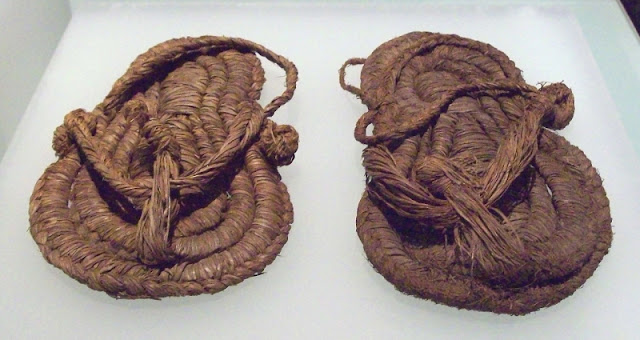
   * Esparto culture in Spain: Use of the esparto plant for weaving goes back at least 7,000 years, when baskets and shoes of that age were found in a cave, Cueva de los Murciélagos, Albuñol, Granada. Declared a 'national fiber,' it is known for making the best quality ropes and a host of other items such as shoes, furniture, open weave snail baskets for collecting snails, and waterproof esparto canteens that were used to carry water. The list of esparto items is much longer, but a student will find this out when they pick this topic.

------------- PICTURE GALLERY -------------

ROPE: 40 ka
Direct evidence has been found of rope strands from the late Middle Paleolithic. Microscopic photos confirm that sophisticated rope-making was taking place before the Upper Paleolithic. (Hardy et al., "Direct evidence of Neanderthal fibre technology...")


LEFT: Reconstruction of a Neolithic loom around the time that Otzi, the Neolithic frozen 'ice man' natural mummy, was alive (ca. 3300 BCE), 
RIGHT: Clothing woven by this loom, in archeoParc in Schnals, South Tyrol, Italy.
(archeoParc Val Senales - Ötzi Museum) 


A few examples of knots from an old Larousse book no longer under copyright. This shows the virtually infinite number of combinations of rope and knotting that are possible


A finished weaverbird's nest.
Detail of the above finished bird nest.


File:Kendall Jenner Met Gala.jpg
Kendall Jenner at the Met Gala.


Examples Of Different Fish Traps (Tools) From Around The World Made With Basket Weaving Technology.
(TOP LEFT) A traditional basket for gathering snails in Southern Spain.
(TOP RIGHT) Fish Trap, Aitutaki (Cook Islands).
(BOTTOM LEFT) Braided fish trap, Indonesia.
(BOTTOM RIGHT) "Bamboo fish pot or trap in general use in Porto Rico."


Traditional reed/fiber boats from around the world.
TOP LEFT: "Tankwa or tangwa: Traditional Ethiopian embarcation from Lac Tana, made of papyrus by Nagades people."
TOP RIGHT: "Reed boat at Ekehagen Prehistoric village outside Åsarp, Falköping Municipality, Västergötland, Västra Götaland County, Sweden." 
BOTTOM LEFT: "Reed boat; exhibition in the Doria Castle of Castelsardo, Sardinia, Italy"


Reed and woven-fiber technology at its height.
[TOP] This large reed boat is an artist's conception of a boat docking at a Mesopotamian city around 5000 years ago. While a fanciful painting, it is probably not an inaccurate representation of the highly developed reed technology at that time.
While still in the public domain, the link to this picture is no longer available.
[BOTTOM] Like reed cathedrals, large vaulted mudhifs, as they are called, were made entirely from reeds, including the rope. The largest and best-made ones were used for ceremonial purposes and community gatherings. The interiors often displayed dazzling patterns of light as the light came through the intricate weaving work. 
https://commons.wikimedia.org/wiki/File:Mudhif_Reception_Hall_(30943793762).jpg

An entire indigenous pre-Incan community in South America today
(the Uru or Uros people)
made with woven-fiber technology: 
the boats, the houses, the clothes, and even the floating island,


Sunday, May 22, 2022

Neolithic Concepts of Time

 The Neolithic Cognitive Leap:

More Than a Revolution the New Stone Age
Involved a New Understanding of Time
By Rick Doble

Model of a Neolithic village. City Museum: Wels (Upper Austria).


ABSTRACT:
While all agree that the Neolithic era was a revolution, the change was even more monumental. While I believe Upper Paleolithic people could work with and plan short-term projects and processes, their way of life was generally one of immediacy. They did not store and save food for times of scarcity, for example. But in the Neolithic era, an understanding of long-term linear time allowed the societies to radically change their way of life by planning their farming over a year's time and then developing a large number of processes that required long-term conceptions. And it was this ability that allowed the Neolithic cultures to flourish.


INTRODUCTION

Imagine that after climbing a hill the member of a small nomadic hunter-gatherer tribe looked down on a Neolithic village for the first time. They would have seen hundreds of people wearing woven cloth garments who lived in one place with solid houses surrounded by carefully cultivated fields of grain. Because it was so strange, so fantastic, he or she might have thought it was a dream or mirage or believed it was from another world. 

In our modern world, we need to recapture this sense of awe. Because the Neolithic (New Stone Age) way of life was dramatically different from the earlier Paleolithic (Old Stone Age) nomadic hunter-gatherer lifestyle. While it used stone-age implements, it was a completely different way of living with its own unique technology. Instead of looking at the Neolithic era from a modern point of view that sees it as crude and primitive, we need to look at it from the POV of earlier humans who had lived successfully for millions of years as nomads and who lived in small bands as they foraged for food. They must have been astonished to see this very different way to live and survive.

In other words, to understand the Neolithic we need to put ourselves back into their time period and see it from that point of view. 

The problem, oddly, is that the Neolithic way of life is, in a way, familiar. It is like life in small villages that we know today. Yet because of its stone-age technology, this way of life is seen as backward. But we are the ones who have it backward. Small villages are based on Neolithic villages because they were invented by these cultures.

Model of a Neolithic village. City Museum: Wels (Upper Austria).

It is my contention that the modern age begins with the Neolithic era. For example, until about a hundred years ago and the impact of the industrial revolution, small farming villages were the norm for most nations around the world. In 1900 in the United States, for example, 40% of people farmed and 60% lived in rural areas. (Lusk, The Evolution of American Agriculture)

The great first civilizations of Mesopotamia and Egypt took the Neolithic model and made it much bigger, more sophisticated, and complex but it was dependent on a sedentary lifestyle supported by agriculture, domesticated animals, trade, and specialization that had been established in the Neolithic era.

Even the invention of metal technologies owed their origins to Neolithic skills. The Bronze Age, seen as a clear break from the 'primitive' stone age, depended on Neolithic inventions. Neolithic pottery kilns were able to achieve high temperatures which had not been possible before. And this ability led directly to the even higher temperatures necessary for metallurgy. Furthermore, the use of New Stone Age tools continued for thousands of years after the invention of bronze because they worked well, were easy to make, and were inexpensive (see more in this article).

"From the standpoint of tools, the potter's kiln and art were necessary steps to metals, for a modification of the kiln probably provided the high temperatures ..."

A fanciful depiction of early civilized life in the Assyrian city of Nimrud ca. 1350 BCE.
From Myths and Legends of Babylonia & Assyria by Lewis Spence, 1910.

THE NEOLITHIC GIANT LEAP

For two to three million years, hominins had lived as nomadic hunter-gatherers in small bands of 100 at most. (Birch-Chapman et al., Estimating population size, density and dynamics of Pre-Pottery Neolithic villages...)

We also know from contemporary hunter-gatherers that when food was found it was eaten immediately and saving food for times of scarcity did not happen. 

"Hunter-gatherers have little or no stored food, and no concentrated food sources, like an orchard or a herd of cows: they live off the wild plants and animals they obtain each day." (Diamond, The Worst Mistake...)

But in a relatively short period of time -- about ten to twenty thousand years -- some nomadic hunter-gatherers adopted a sedentary way of life where they lived in villages with many hundreds of people and grew crops. And this was revolutionary. But as I continued to study, I realized that it was much more. It was a giant cognitive leap, it was a major breakthrough in human understanding.

While there are many aspects to this cognitive leap, I would suggest the principal one was a new understanding of time.

Life as hunter-gatherers was immediate and of the moment. Life as Neolithic farmers was quite different. It required an understanding of the yearly cycle of seasons and also how to plant, grow, harvest, process, and store grains at just the right times and in the right way which involved planning and preparation.

However, I believe these Neolithic cultures also saw 'big time' or cosmological time as cyclical. Sunrise to sunset, the phases of the moon, winter, spring, summer, fall, birth, and death were all cyclical. But within those cycles humans could work with linear time.

For Neolithic people, there were plenty of examples of linear time within cyclical time. The seasons occurred in the same order every year. In early spring seeds were planted which then sprouted and grew through the summer and then were harvested in the fall. Agriculture was a process that had to be done in sequence. This was both a linear progression and also a cycle that repeated itself year after year. Preparing the soil, planting and harvesting had to be done in the correct order and at the right times to ensure a bountiful harvest.

Once Neolithic cultures grasped how linear time functioned within cyclical time, it opened the door to an understanding of processes in general which created a wide variety of new tools and products and also gave people a new control over the environment.

Neolithic time marked the beginning of our modern concept of time, of long-term linear time, time that is conceptualized as something that can be controlled. Time could now be planned or managed or used as a resource. Time did not just flow uncontrollably, it could be harnessed and used to human advantage.

NEOLITHIC TIME CONCEPTS

We do not know any Neolithic languages because writing had not been invented. Nevertheless, we can infer a significant amount of information about the Neolithic ability to work with time from their technology. 

We know, for example, that with agriculture they wisely focused on grain crops, which they learned how to harvest and then place in long-term storage which became insurance against droughts and famines. But that was just the start. They learned to domesticate these crops so that their yield increased substantially. In addition, they chose crops whose seeds remained on the stems -- which was a mutation but which was useful because it made harvesting much easier; it was an aberration that humans wisely took advantage of because normally plants allowed seeds to blow and scatter so they could grow in the wild.
"Domestication is the process by which farmers select for desirable traits by breeding successive generations of a plant or animal. Over time, a domestic species becomes different from its wild relative.
 "Neolithic farmers selected for crops that harvested easily. Wild wheat, for instance, falls to the ground and shatters when it is ripe. Early humans bred for wheat that stayed on the stem for easier harvesting." (History.com, Neolithic Revolution: Plant domestication)
From the above and other technological innovations (more next), we can surmise that Neolithic cultures had a complete toolbox of shared linear time concepts that allowed them to plan, coordinate and work together for short-term, medium-term, and long-term goals. And judging from all other languages, many of these concepts were probably expressed in words.

"Time reference is a universal property of language..."
Jacqueline Lecarme, Ph.D., Linguistics 
(Lecarme, Nominal Tense and Tense Theory)

These concepts would also have made it possible for them to develop and refine processes. Processes such as making cloth from flax or pottery from clay required a number of specific steps in sequence so an understanding of linear time was key. 

I believe this understanding of processes had been developing for hundreds of thousands of years, but with the Neolithic era, there was a flowering of knowledge, understanding, skill, technology, and careful observation. Because it was at this point that technology reached a kind of critical mass in which very new things were possible. Some techniques or processes were so useful and so well thought out, that they are still used today or until recently. I describe some of these later in this article.

ABOUT ANIMAL TIME, PALEOLITHIC TIME, AND NEOLITHIC TIME

It is my contention that early humans, i.e., hominins, slowly emerged from their animal sense of immediate time to gasp a new sense of linear time that had a past, present, future, and duration. It may have taken millions of years but by the Upper Paleolithic, I believe Homo sapiens had a fully developed sense of linear time but still saw time as being primarily immediate. This could be called 'short-term ' linear time. By this, I mean that Upper Paleolithic people could plan to make sophisticated bows and arrows with a variety of materials or plan a group hunt of migrating animals, but understanding linear time as it related to seasons or the yearly cycle was not part of their mindset.

There is one clear example of this in the time concepts of the nomadic hunter-gatherer Piraha tribe in the Amazon.

A Piraha community. The Pirahas are hunter-gatherers who live in the Amazon.

The Piraha tribe in the Amazon adheres to an Immediacy of Experience Principle according to linguist Dr. Daniel Everett. Their time frame and concepts are built around the moment. This is integral to their language but also to their culture and their technology. When he asked them what the Amazon jungle was like thousands of years ago, they said it had always been the way it is now -- not believing in any long-term past. The culture rejected any mention of time beyond the Piraha's accepted concepts and this was part of their technology -- as they were not interested in expanding their skills to include longer planning. (Colapinto, Has a remote Amazonian tribe upended our understanding...)

The Neolithic sense of time was quite different. Neolithic cultures understood long-term linear time within the context of yearly cyclical time. In other words, a long-term sense of time was essential to the Neolithic way of life because it was necessary for an understanding of the seasons and agriculture. This sense of time also played a part in their ability to work with and improve a variety of processes such as pottery, weaving, and tool-making that were time-consuming and required a number of steps in sequence.

The most dramatic and clear-cut example of the difference between a nomadic hunter-gatherer lifestyle and that of the Neolithic is shown in the way each group handled food. For the Piraha mentioned above, food is consumed immediately and there is no thought about planning. 

The Piraha eat what they catch in the river and gather in the jungle and are quite good at doing this on a day-to-day basis. While they could preserve food for future use, Dr. Everett found they were not interested, even though there were days when they went hungry. (Colapinto, Has a remote Amazonian tribe upended our understanding...)

Neolithic societies, however, spent considerable thought and effort on creating storage systems so that they would have food for the long term. The following describes examples of storage designs.
"The granaries represent a critical evolutionary shift in the relationship between people and plant foods...The transition from economic systems based on collecting and foraging of wild food resources before this point to cultivation...[of] managed resources in the PPNA (Pre-Pottery Neolithic) illustrates a major intensification of human-plant relationships.
"People in the PPNA were the first in the world to develop systematic large-scale food storage.
"All of the granaries [ED: found in this study] were circular structures ˜3 × 3 m on the outside and were built with suspended floors for air circulation and protection from rodents and insects." (Kuijt & Finlayson, Evidence for food storage and predomestication granaries 11,000 years ago...)

"In the... Neolithic periods, hermetic storage was used in the form of underground pits. Found in the Middle East as well as in Europe, these pits were used to store dried food.
"Simply put, hermetic storage has a gas-tight and moisture-tight environment that kills off insects and inhibits mold growth." (GrainPro, A Brief History Of Hermetic Storage)

 An Example Of A Long-Term  Process

Weaving is a good example of a long-term process that began in the Neolithic era. First flax had to be carefully planted and harvested, next there were complicated procedures to extract fiber from the flax plant, then the fiber had to be spun into thread and finally woven on a Neolithic loom. The last step was to cut and sew the cloth to make a garment. 

Click on the next link to see detailed descriptions of the 12 steps that are typically involved in the process of making linen from flax. 
From Flax to Linen: https://ulsterlinen.com/flax-to-linen/


EVIDENCE FOR AN UNDERSTANDING OF YEARLY TIME

The Importance Of The Winter Solstice To Neolithic Societies

Today it is hard for us to understand the importance of knowing the time of the winter solstice when the solstice occurs. Having such knowledge allowed Neolithic people to be in touch with the precise cyclical nature of reality and also yearly time and the beginning of a new year.

But even when carefully observed, the math involved with a yearly repeating calendar was daunting, especially since a year is not an even number (roughly 365 1/4 days) and the moon phases do not stay in sync with the sun's yearly cycle. Thousands of years later classical societies, such as Rome, struggled with this problem for centuries causing the calendar to be off a large number of days. This continued until the Julian calendar was adopted.

Knowing the sequence for days and months was easily calculated using the phases of the moon. But the moon's cycles and the sun's yearly cycle did not match. So Neolithic societies needed to find a way to make sure that these cycles worked together.


Each year the calendar had to be reset so that farmers knew the sequence of  the moon's phases in relation to the sun's yearly cycle. Otherwise using only a lunar calendar could cause major miscalculations. In an agricultural society, this would be crucial. 

Aubrey Burls & Clive Ruggles (two of the most respected authorities) agree that a "concern with the moon...is ‘significant’, (i.e. cannot be coincidental) is widespread and is a feature of Early Neolithic sites."
(Mercer, Background notes to Neolithic cosmology)

The Neolithic  'calendar' in general was the sun and the moon and the stars. Time was indicated by the change in these cycles. Understanding these cycles was crucial for understanding the passage of time.

So what the Neolithic people did was not only smart it was brilliant and a cognitive leap. 

They realized that knowing when the winter solstice occurred would allow them to reset the year's calculations and bring their timekeeping into line. However, the winter solstice is very difficult to determine as the lengths of the days around the solstice only vary by a few seconds and the angle of the sun on the horizon hardly varies at all. Moreover, the sun rises later each day after the solstice for about two weeks, which must have been confusing. 

Chart of December sunrise times and day lengths in Dublin Ireland in 2021
(close to Newgrange) around the time of the solstice.
This chart is derived from information at the following website:

The Neolithic societies had to create a way to determine the day of the solstice or the time period around the solstice. So many of them created a kind of 'instrument' that was sensitive to the angle of sunlight. When the time around the solstice occurred, the sun would light up a narrow opening.

The passageway at Newgrange allows sunlight to enter it only during the time of the solstice.
Coffey, George. Drawings of Newgrange from the late 1800s. Published in: The Dolmens of Ireland,, by William Copeland Borlase. Published by the University of Michigan Library (January 1, 1897).

The passage tomb at Newgrange in Ireland is the most dramatic example of this capability because its passageway allows light to enter the monument only during 5 days around the time of the solstice and it may even be able to determine the day of the solstice in real-time, although this has not yet been confirmed. 

LEFT: "A section of the passage leading towards the chamber
of the Newgrange passage tomb in Ireland."
RIGHT: The light of the solstice in the passageway in 2013.

But it is now clear that generally speaking, this was a widely known Neolithic skill. For example, more than a hundred Neolithic 'circular enclosures' have been discovered in Northern Europe and many were designed to determine the time around the winter solstice. These have only just been discovered in the last thirty years from post-hole patterns. 
(Neolithic Circular Enclosures in Europe)

For example, in 1991 the 'Goseck Circle' in Germany (4,900 BCE - 4,700 BCE) was discovered with areal photography that revealed a pattern of post holes. It was a kind of wooden stone henge. The Goseck Circle had narrow openings that were aligned with the sunrise and sunset of the winter solstice. 

LEFT: Goseck Circle.
MIDDLE: A diagram showing how the solstice sunrise and sunset entered the openings in the Goseck circle.
RIGHT: An interior shot of the Goseck circle recreation.

Archaeologist Ralf Schwarz believes that the construction of the site made it possible to coordinate the lunar phases with the more difficult measurements of the solar cycle.
(Schwarz, Neolithic Circular Enclosures in Europe)

On the island of Malta the Neolithic temple, Mnajdra, (c.3600 BC – c.3200 BC) is aligned with the summer and winter solstices and also to the equinoxes. It is like a yearly 'clock' because the time of year can be read each morning by the position of the sun's rays on the stone. 


 Writing about Neolithic monuments and megaliths, Michael Gantley of National Geographic wrote,
"The incorporation of astronomical alignments suggests that Neolithic ceremonies were closely bound with the changing seasons. These cycles were critical to agrarian communities..."
(Gantley, Europe’s Mighty Megaliths "Rock" the Winter Solstice)


ABOUT THE NEOLITHIC TIME PERIOD

While scholars refer to the Neolithic time period, the start and end vary considerably depending on the location and the materials that were available. About 10,000 years ago some of the first Neolithic cultures came about in the Middle East; they made many of their items with reeds. Around three thousand years later, the Neolithic emerged in Europe with wood being a major material.

In addition, there was a transitional time period called the Mesolithic which occurred between the Upper Paleolithic and the Neolithic. During this time nomadic tribes often settled into one place for several months during the year. Like the Neolithic, the Mesolithic time period and nature of the transition varied considerably.


SPIRALS AS SYMBOLS FOR LIFE CYCLES

LEFT: Ancient Greek Pottery: Greek Prehistory Gallery, National Museum of Archaeology, Athens, Greece.
RIGHT: Romanian pottery, 5th millennium BCE. Museum of Prehistory and Early History, Berlin. 

Drawings and images of spirals occur throughout Neolithic societies. The most famous, the triple spiral, was found in the monument at Newgrange Ireland. But these images appear in most Neolithic cultures. Many experts today think that these spirals represent the cyclical nature of the year and of reality itself. 


In Ireland, for example, the triple spiral is thought of as a symbol for the universal cycles of life.

"The triple spiral is thought to represent Birth, Life, and Death, or Man, Woman, and Child, signifying the unending cycle of life"
"This close pattern of spirals is the most common of all motifs decorating Celtic tombs, and one that is basic to all Celtic art."
(Irish Traditions, The Spirals of Newgrange)

TOP: The large stone at the entrance to Newgrange
BOTTOM: A drawing of the large stone showing the spiral engravings.
Coffey, George. Drawings of Newgrange from the late 1800s. Published in: The Dolmens of Ireland,, by William Copeland Borlase. Published by the University of Michigan Library (January 1, 1897).

The following quote is consistent with my ideas about Neolithic time being long-term, unlike Paleolithic time which was immediate. If spiral images did represent yearly cyclical time, it is significant that these symbols did not take hold until the Neolithic.

"The spiral motif is rare in European rock art sites from the Upper Palaeolithic [approximately 40,000 to 12,000 years ago]. According to Genevieve Von Petzinger, it is strange that it is not present more often considering...how central this motif becomes in later time periods...The spiral does not become a regular occurrence in Europe until after the Upper Palaeolithic."
(Bradshaw Foundation, Ancient Symbols in Rock Art: The 'Spiral')

______________________________________________
THE NEOLITHIC ABILITY TO 
WORK WITH COMPLEX PROCESSES

Building on the experiences of the Paleolithic era, Neolithic societies had an in-depth knowledge of the properties of plants, animals, and minerals. With plants, for example, this knowledge not only included the composition of the vegetation but also its cycle -- as some qualities were only present at certain seasonal points. And they were skilled at developing and refining processes to suit their needs. They knew, for example, that properties could be altered through processes such as heating clay to a high temperature to make pottery.

POTTERY (NEOLITHIC)

The ability to make successful pottery was "linked to improved skills in pyrotechnology (firing at the correct temperature) and was finally gratified during the Neolithic Period.
"Pottery art is a complex and time-consuming process that presupposes a knowledge of all its stages: choice of suitable clay, removal of impurities (manually or by sieving) and clay preparation...and firing at a temperature up to 850-900 Celsius (1562-1652 Fahrenheit)"
(Hellenic Foundation, Neolithic Pottery)

LEFT: Cucuteni (a Neolithic Culture) kiln reconstruction, Cucuteni Neolithic Art Museum, Piatra Neamt, Romania.
RIGHT: Pottery, Neolithic, the Cucuteni Culture, 4300-4000 BCE. Found in Scânteia, Iasi, Romania. Collected by the Moldavia National Museum Complex.


5,000 YEARS OF MAKING LINEN: THE HISTORY OF NEOLITHIC FLAX PROCESSING

"Archaeobotanists Ursula Maier and Helmut Schlichtherle reported evidence of the technological development of making cloth from the flax plant (called linen). [ED: during the Neolithic]
"Making cloth from flax is not a straightforward process.
"Flax is a bast fiber plant--meaning the fiber is collected from the inner bark of the plant--which must undergo a complex set of processes to separate the fiber from the woodier outer parts.
"They report that evidence for Alpine lake house [Neolithic] flax fiber production includes tools (spindles, spindle whorls, hatchets), finished products (nets, textiles, fabrics, even shoes, and hats)...They discovered, amazingly enough, that flax production techniques at these ancient sites were not dissimilar from that used everywhere in the world through the early 20th century."
(Hirst, 5,000 Years of Making Linen)

LEFT: Woman's linen dress, Smolensk Linen museum, Smolensk, Russia.
RIGHT: Man's outfit, Smolensk Linen museum, Smolensk, Russia.

-----------------------
THINKING BIG
One of the characteristics of the Neolithic era was that they could 'think big'. So basic basket weaving technology could be used to make small reed boats and then very large boats, for example, as described next. And that same basket weaving technology could be used to make small reed huts for a family and then very large buildings for a community.
-----------------------

THE NEOLITHIC ORIGINS OF SEAFARING IN THE ARABIAN GULF

"Navigation in the Gulf during the Neolithic and Ubaid periods 
"The new discoveries...allow us to speculate on the mechanics of trade during the sixth and fifth millennia BC. First, the question of whether boats were used during the Neolithic period has been answered positively. The vessels were made of reed bundles, lashed together, and then coated with a bitumen amalgam – a technology that prefigures the techniques used to build trading vessels during the Bronze Age, some 3000 years later."
(Carter, Neolithic origins of seafaring in the Arabian Gulf)

While this large reed boat would have been constructed for a post-Neolithic Mesopotamian civilization, smaller ships with this general design were used in the Neolithic.
LINK

BITUMEN

"Analysis of the material from Ras al-Jinz has shown that the bitumen was combined with chopped reeds, carbonates, and possibly fish oil, to make an amalgam. This process changed the physical properties of the bitumen, making it adhesive, tough, flexible, and light." [ED: This shows that during the Neolithic era, an understanding of materials and their properties was quite advanced.]
(Carter, Neolithic origins of seafaring in the Arabian Gulf)


MUDHIF

"A mudhif, a traditional Marsh Arab guesthouse made entirely out of reeds.
The Marsh Arab live a lifestyle that dates back 5,000 years." 
(U.S. Army Corps of Engineers, A mudhif) 
LEFT: "The village headmans house, people of the marshes 1978."
RIGHT: Mudhif Reception Hall.

NEOLITHIC (NEW STONE AGE) TOOLS WERE A MAJOR ADVANCE OVER OLD STONE AGE TOOLS

When I was in college I asked my Modern Civilization professor what was the reason for polished stone tools in the Neolithic era, the technology that defined the era and gave it its name, the New Stone Age. He did not have an answer. I asked another knowledgeable person several years ago and they did not know either. Clearly, this has not been understood until recently when some archaeologists used such tools to cut down a few trees and, as a result, began to see their value. These tools were not just somewhat advanced; they worked very differently and effectively. For example, they chopped down trees quickly and the tools remained sharp. They also worked well when it came to carving and shaping wood to make a variety of items. But dismissing these tools as merely a slight advance in stone tool technology was a mistake and was one of the reasons why the New Stone Age has not been given its due.

LEFT: Paleolithic 'flake tools'.
RICHT: Neolithic polished tools.
Page 280, Volume 15 of the German illustrated encyclopedia Meyers Konversationslexikon, 4th edition (1885-1890).

"The Neolithic Period, or New Stone Age, the age of the ground tool, is defined by the advent around 7000 BCE of ground and polished celts (ax and adz heads) as well as similarly treated chisels and gouges...A ground tool is one that was chipped to rough shape in the old manner and then rubbed on or with a coarse abrasive rock to remove the chip scars...Polishing was a last step, a final grinding with fine abrasive. That such a tool is pleasing to the eye is incidental; the real worth of the smoothing lay in the even cutting edge, superior strength, and better handling. The new ax would sink deeper for a given blow while delivering a clean and broad cut; its smooth bit, more shock resistant than the former flaked edge, had less tendency to wedge in a cut."
(Britannica, Neolithic Tools)

Read the excellent complete detailed 
but concise Britannica articles
about Neolithic hand tools
And the Neolithic Era in Europe


"A Neolithic stone axe with a wooden handle. Found at Ehenside Tarn, now in the British Museum."

"The polished Neolithic ax, a heavy implement, was in sharp contrast to the delicate small-rock work of the last stages of the Paleolithic period.
"In a revealing experiment, 4,000-year-old polished rock axes, furnished by the Danish National Museum and carrying the sharpness left after their last use 4,000 years ago, were fitted with ash handles modeled after that of a Neolithic hafted ax preserved in a bog, giving the ax an overall length of nearly 63 cm (25 inches). (A modern steel felling ax has a 91-cm [36-inch] handle.) When these were used in a Danish forest, it was soon found that the violent action of the modern technique of swinging a steel ax and putting shoulder and weight behind the blade to give long and powerful blows was disastrous, either ruining the edge or breaking the blade. Proper handling meant short quick strokes that chipped at the tree...
"After getting into form, the men found it possible to fell an oak tree more than 0.3 metre (1 foot) in diameter in half an hour or a pine 61 cm (2 feet) in diameter in less than 20 minutes. One-eighth acre (600 square yards, or 0.05 hectare) of silver birch forest were cleared by three men in four hours. One axhead cut down more than 100 trees on its original (old) sharpening."
(Britannica, Neolithic Tools)


WOOD TECHNOLOGY BEGAN AS A RESULT OF NEOLITHIC TOOLS

A Neolithic hut at the archeoParc in Schnals, South Tyrol, Italy.

"Wood began its broad role in human life with the ground and polished tools of the Neolithic. Home and fire, furniture and utensils, cradle and coffin were products of the ax, adz, and chisel, which could fashion wood intricately and with precision. This kit of tools turned wood into an almost universal building material, for a host of new things was now possible, such as dugout canoes of oak, paddles and framing for hide-covered boats, sledges, skis, wooden platters and ladles, as well as other household gear."
(Britannica, Neolithic Tools)

Reconstructed Neolithic longhouse in the Archaeological Open-Air Museum in Oerlinghausen, Germany.


NEOLITHIC SHOES (OF OTZI THE ICEMAN)

The discovery of a ca. 5000-year-old (between 3400 and 3100 BCE) natural mummy called Otzi the Iceman, who was found frozen in the Alps, uncovered a wide range of new information about Neolithic technology. He was discovered in 1991 and is part of the current rethinking about the sophistication of the Neolithic time period. His equipment and shoes, for example, showed that Neolithic people used natural materials in an extremely complex way. They understood animal, plant, and mineral properties and often combined them for maximum effect. But they also understood design, as Otzi's shoes were practical and comfortable.

His well-preserved shoes, scientists discovered were carefully made of different skins and fibers, each used for its particular qualities. "Microscopic studies of the leather showed that it came from calf on the bindings, deerskin on the uppers, and bearskin on the soles. Following the boot’s structure, the researchers re-created a net made of thin bark strips and stuffed it with hay, which formed a lining that kept the foot warm and cozy." Then according to Hlavacek, a bootmaker who walked in the Alps in these reconstructed shoes, "these boots offered more contact with the ground’s surface than modern shoes and felt like 'walking barefoot, but only better.'" 
(Origjanska, Expert re-creates the shoes of 5,300-year-old Ötzi the Iceman)

Reconstruction of the Ötzi shoes by Anne Reichart.
"The inner braid is made of twisted and twisted cords made of linden bast, the outer shoes made of deerskin with bearskin soles. An insulating layer of dry grass is held in place around the shoe by an inner mesh made of twisted and twisted linden bast cords." (Reichert, wikipedia.org) 

THE LASTING LEGACY OF THE NEOLITHIC ERA

Many important industries and practices began in the Neolithic and continue until today or until recently. This not only demonstrates their skill but their ability to create and craft important long-lasting processes.

WEAVING

Weaving basics remain essentially the same after its invention in the Neolithic.

LEFT: Reconstruction of a Neolithic loom around the time that Otzi, the Neolithic frozen 'ice man', was alive (ca. 3300 BCE), archeoParc in Schnals, South Tyrol, Italy. 
RIGHT: Clothing woven by this loom, archeoParc in Schnals, South Tyrol, Italy.


The famous Anni Albers of the Bauhaus School had this to say.
"During the 4,500 years or, in some estimates, even 8,000 years that we believe mankind has been weaving, the process itself has been unaffected by the various devices that contributed to greater speed of execution. We still deal in weaving, as at the time of its beginning, with a rigid set of parallel threads in tension and a mobile one that transverses it at right-angles."
This basic insight about right-angles has never been overshadowed. Anni Albers went on to say, "And weaving, even the most elaborate, can be done, given time, with a minimum of equipment...Fabrics of great accuracy have been executed without much mechanical aid."
(Albers, On Weaving)


WARP-WEIGHTED LOOM

Reconstruction of Neolithic warp-weighted loom
at the National Museum of Textile Industry in Sliven, Bulgaria.

Warp-weighted loom: Some of the Neolithic-type looms were still being used up until about 50 years ago in Scandinavia.


FOUNDER CROPS AND THE ORIGINS OF AGRICULTURE

Many core crops of the Neolithic are still important today.

NOTE: While einkorn wheat and emmer wheat are not grown as much today as they used to, they were major crops until recently. But five of these founder crops are still widely consumed today.

"The Eight Founder Crops, according to long-standing archaeological theory, are eight plants that form the basis of origins of agriculture on our planet. All eight arose in the Fertile Crescent region (what is today southern Syria, Jordan, Israel, Palestine, Turkey and the Zagros foothills in Iran) during the Pre-Pottery Neolithic period some 11,000–10,000 years ago. The eight include three cereals (einkorn wheat, emmer wheat, and barley); four legumes (lentil, pea, chickpea, and bitter vetch); and one oil and fiber crop (flax or linseed).
These crops could all be classed as grains, and they share common characteristics: they are all annual, self-pollinating, native to the Fertile Crescent, and inter-fertile within each crop and between the crops and their wild forms."
(Hirst, The Eight Founder Crops)


POTTERY

Based on detailed information from the visual-arts-cork.com pottery timeline, virtually all pottery/ceramics fundamentals had been invented in the Neolithic, including tourneys/tournettes which were early potter's wheels (4700 BCE). 
(Visual-Arts-Cork, Pottery Timeline)


CORACLE BOATS

Still widely used today in the Middle East and in Asia, the coracle was a boat of the Neolithic era.

LEFT: Small coracles are still widely used throughout the world.
RIGHT: A coracle can be quite large and carry over 10 tons.


"Neolithic navigation: The coracle was surely used for fishing, hunting, and commercial activities."
(Ancient-Cities, Neolithic navigation: The coracle)

The Use Of Stone Tools Continued For Thousands Of Years
And Was Not Quickly Replaced By Metal Tools

"Stone tools maintained themselves during the Metal Age, yielding only slowly to the new material, which was expensive and the product of special skills. The copper and bronze tools and weapons... that constitute impressive displays in museums were rare luxuries. "
(Britannica, Neolithic Tools)

CONCLUSION

For this article, I chose a range of technologies that showed how the Neolithic cultures met basic needs, those of food, clothing, and shelter plus tool and utensil making. 

While I spent a good deal of time detailing how these cultures developed and used these technologies, my main point is the following. They could not have done any of this without a clear understanding of long-term linear time. Their way of life and their processes required long-term linear thinking. Their technology could not have been accomplished otherwise.

So I believe that by going into detail I have shown that they must have possessed this new sense of time. And this new sense was quite different from the immediacy of the Paleolithic era. It was a game-changer. I think they believed that cosmological time was cyclical, but season to season time was linear and that within the cycle of yearly time, long-term linear time was how the world operated.

Understanding this meant that humans had a new productivity tool. Learning to work with extended linear time and plan long-term gave them a power that they never had before. 

Neolithic long-term linear time was a concept that was similar to our own. And this was a radical break with earlier conceptions of time. The main difference between modern time and Neolithic time is that Neolithic cultures saw overall time, cosmological time, as being cyclical. But now in the modern world, we see all time as being linear -- starting with the Big Bang 13.8 billion years ago.

Yet the basic idea of long-term linear time began in the Neolithic. Instead of seeing time as a flow over which they had no control, time was now seen as something that could be understood and used to human advantage; it could be harnessed. Time was now seen as a commodity, a resource that could be tamed and domesticated, just like the crops and the farm animals.

And this new conception of time was a giant cognitive leap for mankind. 

"Whether a temple or a grave, ancient people often brought their mundane activities into cosmic synchrony - a cadence of time and space frozen into stone."
(NASA, Designing Your Own Newgrange Tomb!)


__________________________
AFTERWORD

Long-lasting Neolithic designs

LEFT: A reconstruction of a Neolithic building
"The Stone Age Horton House as constructed at Butser Ancient Farm 2020." Petersfield, England.
RIGHT: Making a modern thatched roof today.


LEFT: Anatomy of a fish hook.
RIGHT: "Fishing hook of bones from the Stone Age, found in Skåne, Sweden."


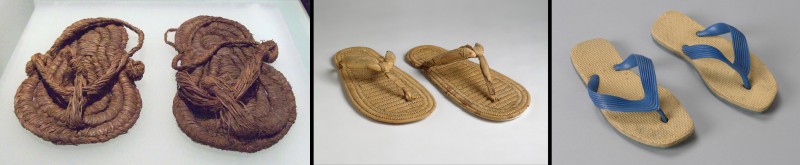
Flip-flops: A Neolithic design that is still widely used today.
LEFT: A pair of 'flip-flop' sandals from the Middle Neolithic (5200 and 4800 BCE), Cueva de Los Murciélagos, Albuñol (Province of Granada, Andalusia, Spain).
MIDDLE: Ancient Egyptian flip-flops, circa 1580 –1479 BCE, Metropolitan Museum of Art.
RIGHT: Children's flip-flops, 1960, Museum Rotterdam, Rotterdam, the Netherlands.

______________________________________
ENDNOTES

Albers, Anni. On Weaving: New Expanded Edition. Princeton University Press, Oct 24, 2017, page 4.

Ancient-Cities forum. Plinio.Lisboa: "The coracle was surely used for fishing, hunting, commercial activities." Forum.Ancient-Cities.Com, Nov '18. https://forum.ancient-cities.com/t/neolithic-navigation/4942

Birch-Chapman, Shannon; Jenkins, Emma; et al. (2017) "Estimating population size, density and dynamics of Pre-Pottery Neolithic villages in the central and southern Levant: an analysis of Beidha, southern Jordan, Levant." The Journal of the Council for British Research in the Levant, Volume 49, 2017 - Issue 1. https://www.tandfonline.com/doi/full/10.1080/00758914.2017.1287813

Bradshaw Foundation. "Ancient Symbols in Rock Art: The 'Spiral'." https://www.bradshawfoundation.com/ancient_symbols_in_rock_art/ancient_symbols_in_rock_art.php

Britannica. "Neolithic Tools." Britannica.com. https://www.britannica.com/technology/hand-tool/Neolithic-tools

Carter, R.A. "Neolithic origins of seafaring in the Arabian Gulf." Archaeology International, 2912. pp 44-47. DOI: http://dx.doi.org/10.5334/ai.0613

Colapinto, John. "Has a remote Amazonian tribe upended our understanding of language?" The New Yorker Magazine, April 16, 2007. https://www.newyorker.com/magazine/2007/04/16/the-interpreter-2

Diamond, Jared, UCLA School of Medicine. "The Worst Mistake in the History of the Human Race" Discover Magazine, May 1987, pp. 64—66.

Gantley, Michael J. "Europe’s Mighty Megaliths 'Rock' the Winter Solstice." National Geographic, November 12, 2017. https://www.nationalgeographic.com/history/history-magazine/article/history-europe-megaliths-solstice

GrainPro. "A Brief History Of Hermetic Storage." Grainpro.com. https://news.grainpro.com/a-brief-history-of-hermetic-storage

Hellenic Foundation, Greece. "Neolithic Pottery." http://ime.gr/chronos/01/en/nl/culture/nl_pottery.html

Hirst, K. Kris. "5,000 Years of Making Linen: The History of Neolithic Flax Processing." Thoughtco.com, May 20, 2019. https://www.thoughtco.com/making-linen-history-neolithic-flax-processing-171347

Hirst, K. Kris. "The Eight Founder Crops and the Origins of Agriculture Re-imagining the Beginning of Farming." Thoughtco.com, updated August 31, 2018. https://www.thoughtco.com/founder-crops-origins-of-agriculture-171203

History.com. Neolithic Revolution: Plant domestication. History.com Editors, Updated Aug. 23, 2019.

Irish Traditions. "The Spirals of Newgrange." Irishtraditionsonline.com, 2016. https://irishtraditionsonline.com/the-spirals-of-newgrange/

Kuijt, Ian & Finlayson, Bill. "Evidence for food storage and predomestication granaries 11,000 years ago in the Jordan Valley." Pnas.org. July 7, 2009. https://www.pnas.org/doi/full/10.1073/pnas.0812764106 https://doi.org/10.1073/pnas.0812764106

Lecarme, Jacqueline, Ph.D., Linguistics. "Nominal Tense and Tense Theory." Empirical issues in formal syntax and semantics, 1999. https://www.academia.edu/2486019/Nominal_Tense_and_Tense_Theory

Lusk, Jayson. "The Evolution of American Agriculture." Jaysonlusk.com, June 27, 2016. http://jaysonlusk.com/blog/2016/6/26/the-evolution-of-american-agriculture

Mercer, R. "Background notes to Neolithic cosmology." 2014 ScARF Downloads. https://scarf.scot/wp-content/uploads/sites/15/2014/02/Mercer_cosmology_2014_0.pdf 

NASA. "Designing Your Own Newgrange Tomb!" P8Newgrange.pdf, p.1. http://spacemath.gsfc.nasa.gov/SED11/P8Newgrange.pdf

Neolithic Circular Enclosures in Europe, International Workshop in Goseck (Saxony-Anhalt, Germany) 7.-9. Mai 2004 (abstracts).

Origjanska, Magda. "Expert re-creates the shoes of 5,300-year-old Ötzi the Iceman, down to the bearskin soles and hay-stuffed lining." Thevintagenews.com, Dec 12, 2017. https://www.thevintagenews.com/2017/12/12/otzi-the-iceman-shoes/

Schwarz, Ralf. "Neolithic Circular Enclosures in Europe. Circular ditch systems of the Stichbandkeramik culture in Saxony-Anhalt." (Kreisgrabenanlagen der Stichbandkeramikkultur in Sachsen-Anhalt.) International Workshop in Goseck (Saxony-Anhalt, Germany) 7-9 May 2004.

U.S. Army Corps of Engineers Digital Visual Library. "A mudhif, a traditional Marsh Arab guesthouse made entirely out of reeds."  https://commons.wikimedia.org/wiki/File:Iraqi_mudhif_interior.jpg

Visual-Arts-Cork. "Pottery Timeline (c.26,000 BCE - 1900)." Encyclopedia Of Art. http://www.visual-arts-cork.com/pottery-timeline.htm