
How to Follow Your Hunches
When Doing Scientific Research
on the Internet
_A.jpg)
"Picture of a Peruvian boat at the Floating Islands, on Lake Titicaca, Puno, Peru."
The boats, the houses, and even the floating island itself are made from local fiber, showing both the versatility and sophistication of woven-fiber technology (also called basketry). I was not aware of these communities when I started my research into this subject. So this is a good example of following a hunch to discover things that you did not know when you started.
Photo_Floating_Islands_(Puno,_Peru).jpg
TAKING A LEAP
There comes a point where the mind takes a leap — call it intuition or what you will — and comes out upon a higher plane of knowledge, but can never prove how it got there. All great discoveries have involved such a leap.
~ Albert Einstein ~
Intuition is the supra-logic that cuts out all the routine processes of thought and leaps straight from the problem to the answer.
~ Robert Graves ~
The man who arrives at the doors of artistic [or scientific] creation with none of the madness of the Muses would be convinced that technical ability alone was enough to make an artist... what that man creates by means of reason will pale before the art of inspired beings.
~ Plato ~
An intuitive educated guess is one that has taken into account current knowledge and then sees that it points in a direction that has not yet been explored.
~ Rick Doble ~
DICTIONARY DEFINITIONS
INTUITION
-- the ability to understand something immediately, without the need for conscious reasoning.
-- a thing that one knows or considers likely from instinctive feeling rather than conscious reasoning
---- GOOGLE DEFINITION ----
-- the power or faculty of attaining to direct knowledge or cognition without evident rational thought and inference
-- quick and ready insight
-- immediate apprehension or cognition without reasoning or inferring
---- MERRIAM-WEBSTER ----
ETYMOLOGY
Middle English "intuycyon," from Late Latin "intuitio" (the act of contemplating) from Latin "in-" + "tueri" or "intuEri" (to look at)
You can observe a lot by just watching.Yogi Berra
_________________________________
INTRODUCTION
The Internet has now made it possible to follow an idea, a hunch, an intuitive thought, an educated guess -- call it what you will -- so that you can often prove its correctness or not.
Intuition can be both a clear thought and a strong feeling at the same time -- it is a thought that can literally *hit* you with its importance and comes unexpectedly, out of the blue. It is often emotional or appears like a bright light of clarity. But it can come to you in a variety of ways, there is no 'normal' flash of insight.
For creative minds, the Internet can open a door that had not and could not be opened before.
In the days before the Internet, I spent hours going through dozens of books at the large Wilson Library at UNC-Chapel Hill, to research one of my original ideas, often coming up with nothing to show for my efforts.
Now things are quite different. In a couple of hours, I can nail down a proof and possible evidence or be sure that there is no evidence or support for my idea.

Some have interpreted this etching by Rembrandt
to be a moment of revelation, a moment of sudden knowledge.
to be a moment of revelation, a moment of sudden knowledge.
Verhaeren - Rembrandt, Laurens p125.jpg
And to be clear, hunches are often wrong. But the more you follow your hunches, the better you will get at it. And testing your hunches is a good way to learn.
And one more thing. Never be afraid to apply logic or reasoning when following your hunch. A mixture of intuition and solid reasoning is often the best approach.
Some personal skills:As a life long professional photographer, I knew how to quickly skim through hundreds of images to find what I was looking for. I also knew that photographs could often be thought of as direct evidence.And, since I had done research for a professor when I was in graduate school, I learned how to quickly skim an article, so that I focused on finding the information I was looking for and did not get bogged down with reading the rest of the article which was not relevant to my search.
Here are some examples of hunches that I followed recently in my series of blogs about woven-fiber technology, a technology that I have come to believe was crucial for human survival, human evolution, and the development of technology. And I believe it is much older than previously thought. I also included two sections about hunches relating to ancient science.
For this kind of research, I found that my hunches often had certain characteristics. The most common was to connect things that had not been connected before. Also to believe that something was more important or less important than previously thought. Or to believe that things originated earlier or later or continued longer than previously thought. Or to believe that skills or technology existed earlier or later than previously thought.
If you are familiar with my blog, you may have read some of the following stories before. But in this blog, I want to tell these stories from the point of view of investigation. It is one thing to have an idea, it is quite another to find indirect and direct evidence plus other researchers who provide supporting ideas and opinions. So, in a sense, I am telling a detective story. In this post, I want to describe a hunch or educated guess and then detail and explain the steps involved to finding evidence that added support or proof.
Each of these hunches suggested ideas that were quite different from previously accepted ideas and in many ways if accepted, change the understanding of human development.
I have provided a link to each blog-article that is associated with each section. Please read the full article to see the complete level of research and evidence that I found.
_________________________________
EXAMPLES OF HUNCHES I FOLLOWED
PLEASE CLICK ON THE LINKS
TO THE ASSOCIATED ARTICLES
FOR MORE DETAIL AND DOCUMENTATION
BASKETRY OR WOVEN-FIBER TECHNOLOGY
I have learned quite a lot about the qualities of basketry by observing.
In 1950 my Dad drove from Mexico City to Cape Cod Massachusetts with Mexican straw furniture that he had lashed to the top of his car. The furniture had a basic wood frame but the seat and back of the chairs were woven with straw. And tables were done the same way. It has now been seventy years and I still have this furniture, it is still in good condition, and we still use it.
My wife has bought a number of baskets over the years, from large to small. One basket could hold or carry a hundred pounds or more. Each basket was woven in a different way and they were often made of different materials. We have had these baskets for years.
Then, on our way to Charleston, South Carolina, she and I stopped at a traditional shop that sold baskets made by the local Indians. And although I already knew this, it reinforced the idea that basketry was a traditional craft. When I looked it up, baskets were made by virtually every culture out of local plant material.
And, as I kept up with science news, I was aware that the explorer Thor Heyerdahl had made a very large reed boat that he had successfully sailed for six months.
And one more thing, when I thought about it I was quite sure that almost every household in the world had several baskets, although today they would be made of plastic.
So when I was working on this blog it came to me that basketry was a worldwide traditional craft, that there were many ways to weave and construct a basket, that baskets were light and strong, and that the weaving could be scaled to just about any size. So when I put all of these ideas together, it was my hunch that basketry or woven-fiber technology was a very old technology that might have taken hundreds of thousands of years to develop.
Until about thirty years ago, it was an accepted fact that basketry and weaving were no older than approx. 8,000 years old. This was based on the oldest baskets that had been found. But, since baskets decay, evidence of their earlier existence was hard to find.
Fortunately, about thirty years ago, it was proven, by impressions in clay, that weaving and basketry were at least 27,000 years old.
Through my research, I confirmed that basketry and woven-fiber items were found in virtually all cultures and that these were made from local plants. Moreover, all anthropologists agreed that early hominins must have used plant and natural material but the anthropologists had not come to any conclusion about how they used it. And an anthropologist, who had compiled a list of cultural universals (technologies that appear in all cultures worldwide) listed weaving as one of four basic technologies, and another researcher listed containers as a universal. So all of these things suggested that this technology had been part of human existence for a very long time.
This led to two possible hunches:
#1. That basketry or woven-fiber technology was much more versatile, sophisticated, worldwide, and advanced than previously believed.
#2. Because it was so advanced, it was likely that it had developed over many thousands of years and was much older than previously thought.
I decided that my first task was to find photographs and diagrams that showed the full range of items that were possible with this technology.
So I compiled a list that became much longer than I had first imagined. Then I was able to find publicly available photographs of most things and these photographs provided direct evidence. So in addition to hundreds of basket designs (from very small to very large), I found evidence of sandals, hats, various traps and cages, nets, rain gear, clothing, furniture, fences, roofs, small and large boats, small and large houses, and several types of bridges.

A traditional rope suspension bridge in South America.
TOP: "Weaving' a new bridge.
BOTTOM: The finished bridge.
I even found a full range of waterproof baskets used for carrying water and baskets used for cooking.
Evidence for a Basket Weaving Technology in the Paleolithic Era
NOTE: I wrote the above blog-article 3 1/2 years ago. Since then I have found many more products that have been made with woven-fiber (basket weaving) technology, such as soft bags, backpacks, saddles for horses, belts, canteens, rugs, and fans. I would also add mats as a major product because mats were used for many different purposes. And although I was concentrating on basket weaving technology in my first article, I would now add a wide variety of rope, twine, and thread (cordage) as these would have had many different uses in Paleolithic times. Direct evidence of cordage has now been dated to the Middle Paleolithic, cordage that was made by Neanderthals.

LEFT: "The [basket that this] grandmother is weaving about herself
is to be used as a store for grains and vegetables."
is to be used as a store for grains and vegetables."
This storage basket is very similar to an early Neolithic basket that was just found.
"Relatively few tribes of American Indians understood pottery, except in the crudest form. As for basketry, it may be said that every Indian from the land of the Esquimaux down through Mexico was a basket weaver." This is a quote and a colorized b&w photo from American Indians: first families of the Southwest by Huckel.
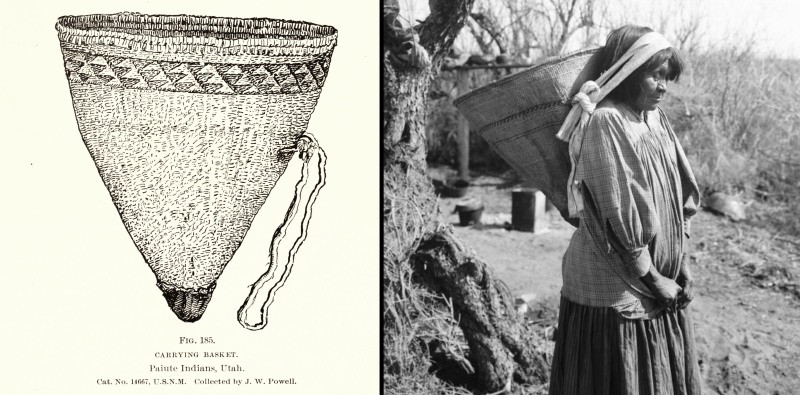
RIGHT: From small to very large, baskets can be scaled.
Annual report of the Board of Regents of the Smithsonian Institution (1902)
Annual report of the Board of Regents of the Smithsonian Institution (1902)
The level of sophistication indicated that this technology must have begun long ago. This got me thinking that maybe I could find a way to show that this technology could have begun hundreds of thousands of years ago. But, how I would do that, I did not know.
But when I was researching this blog post, there was a hint about the possible origins of basketry and weaving.
"The idea of interlacing materials together to create a weave was probably inspired by nature; by observing birds’ nests, spider webs and various animal constructions..."The History of Weaving. Wild Tussah, September 2014. https://wildtussah.com/history-weaving-2/.
Based on this idea, I began to look at birds' nests to see if I could discover a possible link. I went on the Internet and came across a weaverbird nest which was my next 'Aha' moment. These nests were well-made and intricate and contained the basic techniques required for basket weaving.

LEFT: Example of weaverbird knots.
I was surprised to learn that birds could make a variety of complicated knots.
I was surprised to learn that birds could make a variety of complicated knots.
Friedmann, Herbert. "The Weaving of the Red-Billed Weaver Bird in Captivity." Zoologica:. Scientific Contribution of the New York Zoological Society,
Volume II, Number 16, page 363. The Society, The Zoological Park,, New York, 1922.
Volume II, Number 16, page 363. The Society, The Zoological Park,, New York, 1922.
RIGHT: A weaverbird in a partially completed nest.
Discovering this felt like a bolt of lightning; I had the strong feeling I was onto something.
I can remember the night that I discovered this. I immediately looked up where weaverbirds lived and found it was in Africa. And when I looked further I found that it was in the same area, Oldowan Gorge, where the Leakeys had found early human bones and stone tools. But there was a problem: just because weaverbirds were in that area today did not mean they were in that area hundreds of thousands of years ago.
And then came the major hunch. I decided to search for documents that might tell me if weaverbird remains were in Oldowan Gorge in the same layers where evidence for early hominins was found.
So I searched for "Oldowan Gorge Ploceidae" (using the scientific name for weaverbirds) and voila in a matter of seconds a PDF file came up which I downloaded and searched and there it was. Fossils of weaverbirds were found in the same layers as evidence of hominin activity, specifically Lower Paleolithic stone tools. And this layer was more than a million years old, much older than my hunch.
Paleolithic Evidence Shows
That Homo Habilis
Could Have Learned Weaving
From Weaverbirds (Ploceidae)
So I had shown that hominins had lived in the same area as weaverbirds and as a result, it was likely that hominins were aware of their nests.
This, of course, was not proof that hominins copied or learned to make baskets from these birds, but it made it possible and worth researching.
And so this led to my further research. I found that weaverbirds often abandoned their nests which would fall to the ground. So hominins could have gathered and studied them. The weaverbird nests contained many of the fundamentals needed for basketry: a basic sturdy skeleton structure that was then filled in with opposing strands made of more flexible material that was woven over and under to create strength. The birds also made elaborate knots in these nests.
Next, I discovered most anthropologists agreed that early hominins in this part of Africa lived close to Baobab trees where they could gather fruit from the trees and also where honey was often found. And Baobab trees were also a favorite environment for weaverbirds. So if hominins and weaverbirds lived in close association, this added to the idea that hominins learned basketry and weaving from weaverbirds. In addition, hominins could have observed how the birds made their nests which could take two days to two weeks.

A weaverbird starting to build a nest. He starts with a basic skeleton and then adds strands of different thicknesses, widths, and strengths to complete the nest.
Homo Habilis Learned Basket Making from Weaverbirds
What I had uncovered altogether showed that there was an extensive woven-fiber technology and that some of its skills were practiced at least by 27kya in the Paleolithic era but its sophistication suggested it was much older. And its origins could have begun more than a million years ago when early hominins could have learned to weave from weaverbirds.
None of this was conclusive proof, but it did make it a theory that was worth exploring.
WERE SOME NEOLITHIC CULTURES
MORE ADVANCED THAN
GREEK OR ROMAN CULTURES?
MORE ADVANCED THAN
GREEK OR ROMAN CULTURES?
My second hunch that I will describe in this post was a little different. I needed to prove a negative. I needed to prove that something had not happened.
This hunch was about the Neolithic era. I have always thought that Neolithic cultures had never been given the respect they deserved. Because they did not have writing and used stone tools, they were seen as vastly inferior to later civilizations such as Rome and Greece.
As Lewis H. Morgan wrote about 1870, he believed the evolution of humanity went from savagery to barbarism to civilization, meaning that the Neolithic cultures were barbaric. And even though the Neolithic period has now been seen as revolutionary (the Neolithic Revolution) this attitude has remained.
My point of view was quite different. Neolithic cultures were able to create sophisticated structures, for example, because they had a compelling need. These societies did not have writing because they were not large and so did not need it. And while they used stone tools, the tools were well made, well designed, and did the job. Metal tools, often seen as a dividing line between Neolithic and early civilizations, were rare and expensive, although many researchers have missed this point. While not well known, early civilizations continued to use stone tools for thousands of years.
My study of the passage tomb at Newgrange brought all of these ideas to a head. The passageway at Newgrange has lasted about 5200 years and when it was built, according to NASA it was perfectly aligned with the sunrise of the winter solstice sun. Constructing a building that could indicate the exact time of the winter solstice in real time was a monumental achievement, almost equivalent to building a space telescope today. The reason that it is so difficult is due to the fact that the sun barely moves for almost a week. The word solstice comes from Latin and means solar standstill.

While this looks crude to our modern eyes, the alignment and placement of the stones were exact and could determine the day of the solstice in real-time, which was very hard to measure through direct observation.
TOP LEFT: "A section of the passage leading towards the chamber
of the Newgrange passage tomb in Ireland."
TOP RIGHT: The light of the solstice in the passageway in 2013.
BOTTOM: Overview of the stone passageway at Newgrange.
Coffey, George. Drawings of Newgrange from the late 1800s. Published in: The Dolmens of Ireland,, by William Copeland Borlase. Published by the University of Michigan Library (January 1, 1897).
But, and this is the key point, my hunch was that Greek and Roman technology could not determine the time of the solstice in real-time. So my task was to find a way to prove this. After much digging around on the Internet, I found the following:
It is most likely, then, that equinoxes and solstices were determined by observing noon solar altitudes for a series of days before and after the events. [ED: my emphasis] When the Sun is crossing the meridian at noon, it is relatively easy to measure its altitude, and then knowing the geographical latitude, to compute the declination. From the declination, it is easy to compute the Sun’s position on the ecliptic (the longitude), and we know that Hipparchus knew how to do it. But it is only at noon that such an easy determination is possible. It is then fairly straightforward to estimate the time that the Sun’s declination reaches some specific targeted value: 0° for an equinox, and maximum or minimum for a solstice.That series of daily altitude measurements were used to determine the time of cardinal events can hardly be doubted, even though no surviving ancient source has documented such an episode. Especially for the solstices, it is essentially the only viable option... [ED: my emphasis]
Dr. Dennis Duke, Four Lost Episodes in Ancient Solar Theory, Journal for the History of Astronomy, (2008)
In other words, the Greeks and Romans could calculate the day of the solstice by interpolating various astronomical measurements around the time of the solstice, but they could not do it in real-time. If true, this meant that Neolithic Newgrange was more advanced in this regard.
This idea turns many widely held views of cultural evolution, upside down. How could stone age cultures be more advanced than civilizations?
This means we need to rethink our ideas of human development and not assume that development always happens in an orderly fashion. The people at Newgrange did the observations, the science, the math, the engineering, and the architecture because these agrarian societies needed to know exactly when the sun had reached its lowest point. When they knew this, they could make an accurate calendar that would guide them in their agriculture.
The people at Newgrange felt the need to build such an "instrument," as I have called it, because the winter day was very short at that northern latitude. It was about seven and a half hours on the day of the solstice while the shortest day in Rome was about nine hours.
Newgrange is much farther north than Rome or Greece, so knowing the time of the solstice was critical for this largely agricultural society. As I said earlier they had a compelling need and so they used their intelligence to meet that need.
But Newgrange was not the only Neolithic society that had a compelling need. Northern Neolithic societies in Germany, whose shortest day was about seven hours and fifty minutes, also built wooden circular structures that indicated the time of the solstice. The most famous of these is the Goseck Circle but it is estimated that there were over a hundred. They have only just been discovered from post-hole impressions that showed up in aerial survey photographs.
Computing the Winter Solstice at Newgrange:
Was Neolithic Science Equal To or Better
Than Ancient Greek or Roman Science?
Was Neolithic Science Equal To or Better
Than Ancient Greek or Roman Science?
THE REED INDUSTRY IN MESOPOTAMIA
There is considerable evidence that shows there was a large reed industry in the first civilizations in Mesopotamia, an industry and technology that had started thousands of years before in the Neolithic era. However, scholarly writing barely mentions its overall importance and instead focuses on brick-making, bronze and copper smelting, wooden ships, and mass-produced pottery.

While the inner city in Mesopotamia (see two artists' conceptions above) was composed of buildings made of sun-fired bricks and looked like a modern city, it is likely that the buildings in the outlying areas were 'grass huts' made of reeds. It may be due to our modern conception of cities that it was assumed that rectangular brick-type buildings were dominant. However, these were expensive and so only the wealthy and the government could afford to build them.
TOP: A fanciful depiction of early civilized life in the Assyrian city of Nimrud ca. 1350 BCE.
From Myths and Legends of Babylonia & Assyria by Lewis Spence, 1910.
BOTTOM: A central ziggurat in Babylon.
In the distance can be seen two other ziggurats as well.
Entitled "Babylon and its three towers."
Nevertheless, I found extensive research that detailed a wide variety of important products that were part of the Mesopotamian cultures. One researcher found that comfortable grass huts (as they were called), that were made entirely out of reeds, were more common than homes made out of bricks. Another scholar stated that there was a large fleet of small and large reed boats which was crucial to the navigation of the marshes and croplands.
Even today traditional grass huts and large buildings are still being made entirely out of reeds including rope made from reeds. Many experts believe this technology began in the Neolithic. Furthermore traditional round coracle boats, known as basket boats made of reeds, are still being made in Iraq today.

TOP: Technical description and edifications for making a mudhif.
Sophisticated reed housing began in the Neolithic.
"A mudhif, a traditional Marsh Arab guesthouse made entirely out of reeds. The Marsh Arabs live a lifestyle that dates back 5,000 years." Quoted from: https://commons.wikimedia.org/wiki/File:Iraqi_mudhif_interior.jpg
BOTTOM: Mudhif Reception Hall
Evidence of large Neolithic sea-going reed ships has been found along with evidence of commerce in the Persian Gulf. Ubaid Neolithic pottery made in one location was found throughout the Persian Gulf indicating that it was probably brought by boat.
Reeds were a primary resource because high-quality reeds grew wild in the mashes and the supply was unlimited. In addition, high-quality bitumen bubbled naturally from the ground. Boats, houses, irrigation buckets, and parts of levees used reeds coated or soaked in bitumen for waterproofing.
So to prove my point I needed direct evidence from Mesopotamia itself. And there was plenty of that such as a copper relief of soldiers in reed boats, and a picture of a house made of reeds. There were, in addition, multiple references in Mesopotamian myths and writings about sturdy reed baskets that were used to dredge the marshes and carry clay to make bricks.
The problem was to overcome the accepted perception that reeds and baskets were minor and not important to these cultures, while I believed the reed industry was crucial.
So my third major hunch was that I could find solid evidence that supported my ideas.
Again, with the Internet, I was able to do this. To begin I found a lexicon of Mesopotamian words that listed over 100 words relating to the craft of working with reeds. As anthropologists know, words and phrases, especially ones that repeat, are an indication of their importance.
But next came the proof I had been looking for. Two different websites had translations of cuneiform tablet receipts of "economic content" deliveries. In one case bundled reeds was the largest product that was delivered. On the other website, cuneiform tablets showed that a large number of reed bundles were delivered but did not list the numbers. Both listed these deliveries 500 years after the beginning of bronze smelting and also when large amounts of wood were being imported, showing that the reed industry continued to be essential.
To be strictly scientific, it is important to say that the total number of cuneiform receipt tablets was not large, about 1600 altogether. For definitive proof we may have to wait for the translation of more commerce receipts. Yet this is a good start and suggests that this line of inquiry would be worth exploring.
The Crucial Importance
of Basket Weaving Technology
for the World's First Civilizations
MESOPOTAMIAN MISCONCEPTIONS:
Incorrect Assumptions and
Misinterpretations of Sumerian Technology https://deconstructingtime.blogspot.com/2021/06/mesopotamian-misconceptions.html
HOW A REJECTED ANCIENT IDEA
HELPED CREATE OUR MODERN MACHINES
HELPED CREATE OUR MODERN MACHINES
My fourth major hunch was played out over decades.
As a freshman at the University of North Carolina at Chapel Hill, I was taking the required Modern Civilization course. When we got to the part about the Copernican revolution and the new idea that the Earth went around the Sun (heliocentric) rather than the Sun went around the Earth (geocentric), the teacher projected a slide of astronomer Ptolemy's geocentric conception of the solar system, a specific geometry that had been accepted for over a thousand years.
Ptolemy had mapped out a series of epicycles, or circles within circles. So the planets did not just circle the Earth, they rotated around a point as they moved. The teacher began to make fun of this concept and told us how ridiculous it was compared to the simple orbits of the Copernican universe.
For some reason, this made me very angry. Ptolemy had made a system that worked well and that later science would be built upon. To ridicule this meant that the teacher did not understand how science developed and progressed. But something else jumped out. When I looked at the diagram, it reminded me of gears I had seen. I think it was the open back side of a pocket watch.
In any case, I did not think about this until I began to write this blog when it suddenly hit me. I had a hunch that Ptolemy's system was the basis for gearing and gearing was a key component of the industrial revolution.
And this turned out to be fairly easy to prove. First of all, Ptolemy's system was quite accurate. When I researched it, I found it was only off by one day every one hundred years. So his system worked. Then, when I began to investigate, I found that dozens of large clocks were made during the 14th, 15th, 16th, and 17th centuries whose gearing was based on Ptolemy's model. I can say that for certain because the Copernican model did not exist or had been accepted during those time periods.
The first documented astrarium clock was completed in 1364 by Giovanni de' Dondi (1318–1388)... The original clock, consisting of 107 wheels and pinions, was lost..., but de' Dondi left detailed descriptions which have survived, enabling the reconstruction of the clock. It displays the mean time, sidereal, or star, time and the motions of the Sun, moon and the five then known planets Venus, Mars, Saturn, Mercury, and Jupiter. It was conceived according to a Ptolemaic conception of the solar system.[ED: my emphasis] http://en.wikipedia.org/wiki/Astrarium

Two clocks built on the Ptolemy model, the geocentric model, of the solar system, about 300 years before the Copernican model was accepted. Both clocks are still working today.
RUGHT: "The Prague Astronomical Clock is the world's oldest working one of its kind. Installed in 1410..." Quoted from:
Czech-2013-Prague-Astronomical_clock_face.jpg
RIGHT: Early 15th century (i.e. around 1400) clock in Bern
Zytglogge_Bern_Astronomical_Clock_1.jpg
What Ptolemy achieved with his circles within circles was an advanced design of gears and gearing -- gearing that worked well and was quite reliable -- as had been shown in the creation of clocks. The ability to create such gears was not only critical to the construction of clocks but later to the design of engines and machines such as the early Watt steam engine -- the mechanical device that kick-started the industrial age and the Industrial Revolution.

"A simple illustration showing the basic elements of Ptolemaic astronomy. It shows a planet rotating on an epicycle which is itself rotating around a deferent inside a crystalline sphere."
Picture and quote from:
Picture and quote from:
Then I came across this quote from one of the acknowledged experts on the history of the machine.
Clocks were the
"key machine of the modern industrial age."
"key machine of the modern industrial age."
Strandh, Sigvard (1979). A History of the Machine.

Clockwork in the "Zytglogge", Bern's clock tower
which shows how Ptolemy's geometry was translated into gear movement.
Sigvard pointed out that clockmakers were in high demand because they understood the necessary gearing in machines as they became part of the industrial age.
So my hunch had been correct. This discredited system was a key component of our modern age. The car you drive probably has gearing based on Ptolemy's system.
How the Discredited Geocentric Cosmos
Was a Critical Component of the Scientific Revolution
Was a Critical Component of the Scientific Revolution
OR
How Ptolemy's Geocentric Astronomy
Helped Build the Modern World
_____________________________________________
HUNCHES I'M WORKING ON
THE PRECISION OF THE NEWGRANGE SOLSTICE INSTRUMENT
While it is now generally agreed that Newgrange was a major achievement, there is still a discussion about how accurate it was. I believe the Newgrange "instrument" as I have called it, could determine the actual day of the solstice in real-time and if the sky was cloudy it could indicate the day of the solstice by calculating from an earlier or later day when light came down the passageway. In other words, it was remarkably precise. But this level of precision has yet to be proven. I think a computer simulation could show this, but it has not yet been done.
There is a key point about the Newgrange "instrument" (as I have called it since it is like a scientific instrument) that has been missed. This instrument *magnified* the movement of the sun and amplified the effect of the sun's angle when light came into the passageway. As modern science knows, magnification can reveal detail that can make major distinctions between two different states. In this case, the magnified light would be different on different days before and after the winter solstice. And there would be enough of a difference to distinguish one day from another. I am the only researcher that I know of, who has mentioned the term 'magnification' in connection with Newgrange and its importance.
THAT THE BABYLONIAN GRID MAP OF THE SKY WAS BASED ON BASKETRY
My hunch is that the Babylonian grid map of the night sky (which is still used today) was derived in part from basketry since a basket can be made with horizontal and vertical strands just like the declination and right-ascension coordinates in the Babylonian map. There is plenty of evidence that Babylonians gave weaving and baskets a high value -- such as in their creation story. But I think there could be direct evidence, such as a Babylonian statement about astronomy, that stated the "sky is like a basket."
But we may have to wait for the hundreds of thousands of cuneiform tablets to be translated if such a statement exists.
The Babylonian grid was mapped out in hours, minutes, and seconds which became the basis for today's time-keeping. This basic grid was accepted by Ptolemy in the West around 150 CE. Then his ideas and geometry lead directly to our modern system of time-keeping (as I showed earlier in this blog post). So if Babylonian astronomy was based in part on basketry, it suggests that the long history of making baskets and basketry had a lot to do with time concepts and the development of time as I have suggested in my years of writing this blog.

LEFT: A Neolithic basket from the Cueva de los Murciélagos in Spain.
RIGHT: "Map of the night sky: star positions
from the Bright Stars Catalog, 5th Edition. Rasterized." 2006.
This modern map of the stars visible in the Northern Hemisphere
is based on the Babylonian model. The white curved line is the zodiac. Notice the faint horizontal and vertical grid lines which are very similar to the way a basket can be constructed as shown on the left.
_____________________________________________
WHAT I LEARNED ABOUT HUNCHES
From my research a number of possible conclusions have emerged:
#1. Prehistoric people, going back millions of years, were much smarter (within the limits of their brain size) than we have believed.
#2. Developing a technology from scratch, a technology that had never existed, with a limited brain size, a struggle for survival, and a short life span took a very long time.
#3. Remarkable breakthroughs by early cultures were achieved when there was a compelling need -- such as the passageway at Newgrange.
#4. Technology and cultures do not necessarily progress in an orderly fashion -- inventions, processes, and skills could have happened earlier or at different times even though these things have been associated with a specific time period.
#5. It is important to question commonly held assumptions. Please note I said 'question' not reject. The problem with assumptions is that they prevent investigating ideas that disagree. And in many cases, this has choked off a full line of inquiry that could have been fruitful. Assumptions are particularly difficult to deal with as they are taken for granted and people usually accept their truth without question.
I made a list of such assumptions in this blog:
HUT ARTICLE
Rick Doble's Theory About
The Human Understanding of Time (HUT)
A good example is that it was assumed Upper Paleolithic people could not have made baskets because it was too time-consuming. Yet my research into hunter-gatherers who lived a stone age lifestyle in North America, i.e., North American Indians, (it is agreed this was similar to a Paleolithic lifestyle) revealed that they made a wide variety of woven-fiber items, from small baskets to huge burden baskets worn on the back, snow shoes, fish traps, bowls, plates, and even baskets for cooking and carrying water plus strong twine and rope. They developed sophisticated basketry because of a compelling need. Nomadic hunter-gatherers needed a technology that could create a variety of designs and was strong and light and could be made of local plants. But, because of assumptions, research in this vein was discouraged.
_____________________________________
CONCLUSION
WHAT DID I PROVE OR DID I PROVE ANYTHING?
There are many levels of proof
-- Not proven
-- Evidence cited indicates that this idea may be possible
-- Evidence cited = idea is probable
-- Evidence cited = idea is likely true
-- Evidence cited = definitive proof, the idea appears to be true
The various proofs I found range from possible to definitive.
-- I feel I proved that woven-fiber technology was able to create a wide variety of items. I found photographs of each item so these were direct evidence: from small to large, from sandals to boats, from hats to houses, from fences to bridges. So I think this was a definitive proof.
-- I feel that I showed early hominins lived in close association with weaverbirds. So their nests could have been a model for early baskets and containers but this is speculation. I feel this proof falls under the possible category, the lowest level of proof.
-- It is hard to prove a negative. But I did show that the Romans probably did not have a way to indicate the day of the winter solstice in real-time. So I put this in the probable level of proof.
-- I was able to show that there were a variety of important products that were necessary for the functioning of Mesopotamian societies, products that relied on woven-fiber technology, specifically reed technology. Next, I was able to find over 100 words that referred to reed items or skills. And then I was able to find receipts from commerce deliveries that indicated that bundled reeds were a major commodity. So I believe I gave credence to the idea that the reed industry and technology were crucial. So I put this in the highly probable level of proof category.
-- Finally, it was fairly simple to show that Ptolemy's geometry of the stars was used to make clocks long before the Copernican revolution was accepted. And then clocks became the key machine for the Industrial Age. So I consider this to be definitive proof that Ptolemy's discredited astronomy was a key to the Industrial Revolution.
___________________________________________
AFTERWORD
IDEA-INCUBATION
Another related idea is called: idea-incubation
This is a term coined by the poet T.S. Eliot. This is similar to the Aha moment (see below). In this scenario, you work hard and probably logically to find an answer but finally give up and do something else. Then out of nowhere, when you least expect it, the answer appears to you.
The best example is Mendeleev's discovery of the periodic table, the table of elements. He ordered them in a way that scientifically expressed their relation to each other. Mendeleev put together the first working chart of the elements that make up all matter.
To begin he had put each element and what he knew about it, such as its atomic weight, on a card and then laid out these cards as though he was playing a kind of solitaire. He did this for a number of years until one night, exhausted he fell asleep and then had a dream where he saw all the elements almost perfectly arranged.

Dmitri Mendeleev
"I saw in a dream a table where all elements fell into place as required. Awakening, I immediately wrote it down on a piece of paper, only in one place did a correction later seem necessary."Dmitri Mendeleev
When Mendeleev completed his chart, he made it public but with little response. Scientists started paying attention when they realized that his chart had blank spots in his arrangement which predicted elements that had not been found and then were found. It was only then that scientists realized he had found the long-sought key to an understanding of matter.
This is considered one of the greatest discoveries in scientific thought, as he had now made a grand overview of all matter.
BE AWARE OF OTHER SOURCES
When I decided it was likely that early humans had made baskets based on bird nests, I then wondered what kind of baskets they could have made. The idea of a random weave came to me and it turned out that there were baskets made with a random structure. The only problem was that I could not find any pictures, which was very important to making a case for this idea.
Then, out of the blue, a friend of mine, Nan Bowles, told me that she had been inspired to make some baskets out of vines that happened to be lying around after doing some cutting at her house in the country. The vines when green were quite flexible and wove well together in an opposing over and under construction. And when they dried the basket was both light and sturdy. Moreover, it was strong as a small basket could carry several kilos.

LEFT: Weaverbird nests are well-designed and strong. Abandoned ones fell down from Baobab tree limbs (trees where hominins often camped) which early hominins could have collected. "Weaverbird (Southern Masked Weaver) nest of dry grass, near Pretoria, South Africa"
RIGHT: A random weave basket made from vines by Nan Bowles. It was constructed with green flexible vines that later dried to make a light, stiff, strong basket. (Basket/Photo by Nan Bowles)
So in this case, I kept my eyes open for confirmation from other sources and as luck would have it, there it was.
______________________________
POSTSCRIPT
YOUR IMAGINATION
One of your greatest assets when following your hunches will be your imagination.
Einstein engaged in 'thought experiments' as did Galileo hundreds of years before.
Einstein engaged in 'thought experiments' as did Galileo hundreds of years before.
Einstein imagined riding or chasing a beam of light when he was a teenager. He thought about this for years. Then, one night in Bern, Switzerland, he heard the ancient clock chime the hour and it triggered a thought experiment with light and time that led to
the Special Theory of Relativity.
the Special Theory of Relativity.
Einstein's Clocks
OR
A Flight Of Imagination
That Revealed The Real World
In 1905
About Einstein's thought experiment
and his ability to imagine in the moment

Late one night
after struggling with the physics of light,
Albert heard the distinctive ring
of Bern's Zytglogge clock tower, (left)
with its 500-year-old bell
struck by a figure
representing Chronos, the Greek god of time. (right)
In a flash
he was riding a streetcar
at the speed of light
and looking back at the time
on the Bern clock
which froze
because the light from its later time
could never catch him.
Yet he could see the minutes
on his pocket watch were
continuing.
And then he knew
time was relative.
MORE BLOGS BY RICK DOBLE ABOUT INTUITION
How To Be Intuitive: Intuition, Imagination, and Discovery
https://deconstructingtime.blogspot.com/2016/11/how-to-be-intuitive-intuition.html
https://deconstructingtime.blogspot.com/2016/11/how-to-be-intuitive-intuition.html
The AHA Moment: My Personal Story




A.jpg)


.JPG)


_(14775904322).jpg)
_(17814870494).jpg)
.jpg)


.jpg)


_Monument,_Donore,_%C3%89ire_-_31630728177.jpg)


.jpg)


_BHL21584712.jpg)
.jpg)


