An Expanded Hypothesis
That Relates the History
of the Human-Experience-Of-Time
to Culture, Technology and Belief Systems
in Addition to Language
By Rick Doble

________________________________________
INTRODUCTION
In my last blog, the blog-article before this one (scroll down below this post to read it), I proposed the following hypothesis: As language evolved from the beginning, it developed in tandem with a growing sense of time. In this blog-post, I now want to expand that idea to not only include language but technology, culture and belief systems.
READ MY INITIAL POST
ABOUT THE DEVELOPMENT OF LANGUAGE
AND THE HUMAN-SENSE-OF-TIME
Toward a Comprehensive Hypothesis
About the Development of Language and the Human-Sense-Of-Time
Based in Part on Daniel Everett's 'How Language Began'
OR DOWNLOAD THAT BLOG POST AS A SEPARATE PDF DOCUMENT
In my last blog, I proposed a comprehensive hypothesis that linked the development of human timekeeping with the evolution of language. I believe that most of our conceptions about time are embedded in our language and that our language contains various time-tools that allowed us to work with planning and forecasting at different stages of human development. But each stage was quite different and so, in my hypothesis, the concept of time during the Paleolithic era was quite different from the concept of time during the Neolithic era which, in turn, was different from our modern era.
After seven years of writing this blog, I am now convinced that there were a number of ways that an awareness of time was conceptualized and acted on in the past. Therefore an understanding of this idea can help explain and illuminate the evolution of not only language but society, technology, and belief systems.
Family portrait in Western Culture, 1965.
Like the demands of the environment, humans had to learn to work with time to gain the greatest survival advantage. Time in many ways is like any environmental condition or resource. It is one thing to know which fish can be eaten in certain parts of the river, but it is another thing to know when is the best time to catch those fish. A proper understanding of time could produce bountiful catches of fish, for example, or allow the complicated planning needed for a hunt of large animals during migration seasons.
Then later large complex civilizations such as Babylonia, four thousand years ago, needed a completely different understanding of time to organize their cities, their officials and their armies. They were the first to measure time carefully and divide it into hours and minutes.
This means that the way people worked with and understood time was quite different in each era.
A portrait of a family in the Sami nomadic culture around 1900.
While language contained/contains the basic concepts about time, the customs and rituals of the civilization, the technology, and the belief systems reflected/reflect the sense of time that was/is in place during each era. They, in turn, also affected/affect concepts and ideas about time in the language.
________________________________________
THE THREE DIMENSIONS OF TIME
As I have discussed in this blog there are three kinds of time or three dimensions of time.
#1. There is momentary time which is the fundamental aspect of time. Everything that exists exists in the moment or did exist in the moment or will exist in the moment.
#2. There is cyclical time such as morning to morning, Saturday to Saturday, month to month and year to year. In addition, there is cyclical time in terms of a culture, such as birth, procreation, and death. These also repeat but with new individuals.
#3. And third, there is linear time which only goes forward. In our modern society linear time has been emphasized due to the 'progress' of science which keeps building on past achievements to make new breakthroughs. And in our societies, we teach our young from an early age to get an education which forms the foundation for building a career.
All three dimensions of time are always present, whether an organism is aware of them or not. For example, while deer might live in the moment and be aware of cyclical changes in the daylight or changes in the seasons, they are not aware of linear time. Humans are the only animals that can state 'when' something happened in the past or conceptualize 'when' something will happen in the future. Yet an individual deer is subject to the ravages of linear time, i.e., birth, mating, death, nevertheless. For more about this read: William Roberts, Are Animals Stuck in Time?
These three dimensions of time have always been a part of the human culture but one dimension has often been stressed over another during various periods of human history. And this changing emphasis did not necessarily progress from the first dimension to the last. For example, the Middle Ages emphasized cyclical time whereas the Romans before them had emphasized linear time.
And even in a particular era, some professions emphasize one aspect of time over another. Individual personalities often favor one dimension over another. A successful actor told me once that he had always been a grasshopper instead of an ant, referring to the famous story of the grasshopper who played while the sun shone in the summer and the ant that stored food for the winter. But being a grasshopper was quite appropriate for him because as an actor he needed to be in the moment when he was acting.
Also, one individual or endeavor can involve all three dimensions at the same time. A painter, for example, could enjoy painting at a regular time each afternoon (cyclical time), and enjoy the momentary pleasure of painting, while at the same time hoping that their work would get better and reach a larger audience over the years (linear time).
It is also important to note that linear cultures will have time periods and holidays when momentary time or cyclical time is quite important and that appropriate behavior is expected of everyone. Even though the United States is a linear time culture, a person watching an important basketball game is expected to be totally wrapped up in the moment-to-moment activity of the game. At Christmas, a cyclical festival, everyone is expected to put a tree inside their home, decorate it, give presents and then attend a family dinner on Christmas day.
The following very brief outline and overview of different cultures throughout history illustrates how culture, technology and belief systems along with language may have developed and used their concepts of time.
________________________________________
MOMENTARY TIME:
THE PIRAHA LANGUAGE, CULTURE AND TECHNOLOGY
I have written at length about the Piraha tribe in the Amazon who adhere to an Immediacy of Experience Principle according to linguist Dr. Daniel Everett. Their time frame and concepts are built around the moment. This is integral to their language but also to their culture and their technology. Please read this blog for more about them.
https://deconstructingtime.blogspot.com/2018/11/comprehensive-hypothesis-human-sense-of-time.html
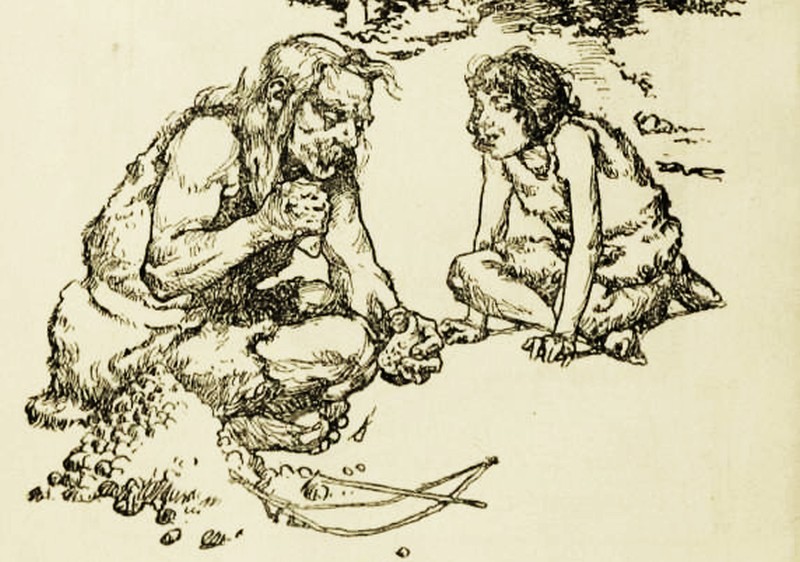
The Piraha language may be an ancient and early kind of language according to Dr. Everett. There is no other language on Earth like it. It is spoken by a people whose roots go back perhaps thousands of years as hunter-gatherers in the Amazon. So it is possible, as I have hypothesized in my earlier blog, that other early cultures such as Paleolithic societies and their languages were present-oriented and they operated primarily in the moment.
The few vowels and phonemes of the Piraha language make this one of the simplest known languages which is why Dan Everett decided it was an earlier form of language, a G2 language as he called it, rather than a G3 modern language. However, it would be a mistake to think of it as 'primitive'. Until Dan came along no one from the outside was able to master it, demonstrating how unusual the language is. In addition, it contains a number of features that do not exist in modern languages but are essential for these hunter-gatherers. For example, it can be sung while in the Amazon forest, which is a way for members of the tribe to keep track of each other over a distance. And the Immediacy of Experience Principle, as Dan calls it, means that there are 65,000 possible combinations of indicators that can be added to a verb stem. These indicators give precise information about the direct knowledge a speaker has. As Dan points out it does the job quite well for this hunter-gatherer culture.
HOW LANGUAGE BEGAN
AND THE HUMAN UNDERSTANDING OF TIME
Daniel Everett's New Theories About The Evolution Of Language
A photo of a Piraha tribe (above) and the Amazon jungle where they live (bottom)
A person who carefully studied the Piraha language wrote: "To the verb stem are appended up to 15 potential slots for morphological markers that encode aspectual notions such as whether events were witnessed, whether the speaker is certain of its occurrence, whether it is desired, whether it was proximal or distal, and so on. None of the markers encode features such as person, number, tense or gender."
Gordon, Peter. Numerical Cognition Without Words: Evidence from Amazonia
"Pirahã also uses suffixes that communicate evidentiality, a category lacking in English grammar. One such suffix, -xáagahá, means that the speaker actually observed the event in question."
But just as important as the language is the culture and the technology of the Piraha. When Dan Everett, who studied the Piraha for thirty years, brought up ideas that could not be verified or he talked about people he had never met, the Piraha were not interested because their culture required verification. When he asked them what the Amazon jungle was like thousands of years ago, they said it had always been the way it is now -- not believing in any long term past. And their belief system did not have a creation myth either.
The Piraha eat what they catch in the river and gather in the jungle and are quite good at doing this on a day to day basis. While they could preserve food for future use, Dan found they were not interested, even though there were days when they went hungry.
My point is that in addition to the language, the culture rejected any mention of time beyond the Piraha's accepted concepts and this was part of their technology -- as they were not interested in expanding their skills to include longer planning. And they were not interested in considering a creation story or mythology about the past -- the Amazon jungle had always been there just as it is right now.
________________________________________
CYCLICAL TIME:
THE NEOLITHIC ERA
Map of Neolithic monuments in Malta, some of which
can accurately indicate the day of the seasonal equinoxes and solstices.
While we cannot know the language of the Neolithic period or even their beliefs, we can take an educated guess about their timekeeping. In the last half century it has become clear -- from the passage tomb in Newgrange in Ireland to the Goseck circle in Germany (along with hundreds of other such circles in northern Europe) down to solar aligned monuments in Malta -- that keeping seasonal time was very important to Neolithic societies. All of these structures could determine the winter solstice with remarkable accuracy, for example.
It is likely that they needed to know the exact yearly time because their farming technology depended on it. It also appears likely that the many buildings they built, which could indicate the time, were also considered sacred and served a religious purpose. So their concept of time and their religion were closely intertwined.
Experts now believe that megaliths stood at the very heart of ritual practice for the networks of communities scattered across western Europe later in the New Stone Age, or Neolithic period, that had begun around 10,000 B.C. Their function was both Earthly and celestial: a focus for rites concerning the movement of the heavenly bodies across the skies, a memorial to the community’s ancestors, and an awe-inspiring site to cement local loyalty and solidarity. The incorporation of astronomical alignments suggests that neolithic ceremonies were closely bound with the changing seasons. These cycles were critical to agrarian communities, whose leaders would benefit from this essential knowledge.
Later in the Middle Ages this sense of seasonal cyclical time would return but with the added instrument of the clock.
________________________________________
THE BEGINNING OF LINEAR TIME:
THE BABYLONIAN CULTURE, SCIENCE AND BELIEF SYSTEM
The star, top left, was the symbol for the goddess Ishtar -- see her picture next.
"(1186–1172 BCE): The king presents his daughter to the goddess Nannaya.
The crescent moon represents the god Sin, the sun the Shamash and the star the goddess Ishtar."
The sacred, powerful and central Babylonian goddess Ishtar.
Her symbol was the star and she was associated with the planet Venus.
" 'Burney Relief' ...from about 1800-1750 BC."
In a sense the Babylonian empire invented modern time. As one of the first large empires and bureaucracies in the West, it needed to manage time on a daily basis in a systematic and orderly fashion. Managing such a far-flung empire with millions of people would have been very difficult otherwise.
So beginning in the 14th century BCE the Babylonians invented hours and minutes -- the same we use for timekeeping today. They also invented 360 degrees for a circle with (a math system based on twelve) which they projected onto the sky and which they then used to tell time. Many of their notions about time were derived from astronomy. And their astronomy -- which they knew was the most accurate timekeeper -- was quite sophisticated. Their division of the sky into 360 degrees is still used today, virtually unchanged from Babylonian days.
The Babylonian GU text arranges stars in 'strings' that lie along declination circles [ED: i.e., the circular positions of stars according to the Babylonian 360 degree conception of the sky] and thus measure right-ascensions or time-intervals, and also employs the stars of the zenith, which are also separated by given right-ascensional differences.
Babylonian astronomy was the basis for much of what was done in ancient Greek astronomy, in classical Indian astronomy, in Sasanian, Byzantine and Syrian astronomy, astronomy in the medieval Islamic world, and in Central Asian and Western European astronomy. Neo-Babylonian astronomy can thus be considered the direct predecessor of much of ancient Greek mathematics and astronomy, which in turn is the historical predecessor of the European (Western) scientific revolution.
But there is more: Astronomy and their belief system were one and the same. They had an objective and precise mathematical way of measuring the movement of the stars and planets including accurate predictions of eclipses (the Saros Cycle) and the Metonic 19-year cycle that reconciled the Moon's cycles with the yearly Sun cycles. Yet at the same time, they believed the planets were gods and their changing alignment in the stars of the Zodiac affected our worldly domain -- an idea which is still alive in astrology today. In other words, their concept of time, their civilization, their technology, and their belief system were intertwined. The men who studied the stars and planets held an elevated position in Babylonian society and were known as astronomer-priests, showing the close connection between science and religion at that time.
During the 8th and 7th centuries BCE, Babylonian astronomers developed a new approach to astronomy. They began studying philosophy [ED: the original term for science was natural philosophy] dealing with the ideal nature of the ... universe and began employing an internal logic within their predictive planetary systems. ... [S]ome scholars have thus referred to this new approach as the first scientific revolution.
"The Venus tablet of Ammisaduqa (Enuma Anu Enlil Tablet 63) refers to the record of astronomical observations of Venus, as preserved in numerous cuneiform tablets dating from the first millennium BCE. It is believed that this astronomical record was first compiled during the reign of King Ammisaduqa (or Ammizaduga), the fourth ruler after Hammurabi. Thus, the origins of this text should probably be dated to around the mid-seventeenth century BCE. (according to the Middle Chronology). The tablet recorded the rise times of Venus and its first and last visibility on the horizon before or after sunrise and sunset (the heliacal risings and settings of Venus) in the form of lunar dates. These observations are recorded for a period of 21 years."
________________________________________
THE MIDDLE AGES:
SACRED CYCLICAL CLOCK TIME
After the classical linear-time era of Rome, a complex sophisticated machine was developed in the Middle Ages to tell time. It was known as the clock.
In the first book of the Bible (a sacred text to Christians, Jews, and Muslims), in Genesis 1:14, (Common English Bible): God said, "Let there be lights in the dome of the sky to separate the day from the night. They will mark events, sacred seasons, days, and years." Since this occurred on the fourth day of creation, it was clear that timekeeping was an important part of the world God had made and it was an important duty for humans to keep track of time. Therefore to Jews, Muslims and Christians an understanding of time was given to them by God who expected them to carefully follow the progression of the stars and thus honor God at sacred times.
The invention of the clock was originally part of that sacred understanding. This machine was based on the movement of the stars, the moon, the sun, and the planets -- using the perfect circles and epicycles of the geocentric (Earth-centered) astronomy of Ptolemy. The heavens were seen as God-given and sacred. The clock reflected that spiritual belief.
The seasonal cyclical panels from Les Tres Riches Heures du Duc de Berry, ca. 1400.
So the clock was first used in monasteries to provide an accurate way to regulate the activities of monks. The clock, in the beginning, was about cyclical repeating time as was the era of the Middle Ages. Soon clocks were everywhere in Europe but they often showed not just the time but the position of the heavenly bodies. Humans had now, in a sense, made a copy of God's handiwork and brought it down to Earth. The round clock symbolized the repeating and cyclical nature of time.
Mechanical clocks became widespread in the 14th century when they were used in medieval monasteries to keep the regulated schedule of prayers. The earliest medieval European clockmakers were Catholic monks. Medieval religious institutions required clocks because they regulated daily prayer- and work-schedules strictly, using various types of time-telling and recording devices https://en.wikipedia.org/wiki/History_of_timekeeping_devices
Most of the first clocks were not so much chronometers as exhibitions of the pattern of the cosmos ... Clearly the origins of the mechanical clock lie in a complex realm of monumental planetariums...
White, Lynn Jr. (1966). Medieval Technology and Social Change.
So, in this case, an advance in technology did not lead to a more complex dimension in time, i.e. linear time, time which had characterized the Roman empire, but instead revived cyclical time which had characterized farming communities in the Neolithic era.
Yet all three dimensions of time are always present. While the activities of monks were centered around cyclical time, each monk, in a sense, also lived in a kind of spiritual linear time in which he hoped he would come closer to god.
NOTE: We live in a linear age of complex technological urban civilizations. For this reason, the Middle Ages has often been seen as the Dark Ages when not much was developed or advanced -- an era when human innovation was stymied. Clearly, this is the prejudice of one culture in linear time looking at another culture in cyclical time. In any case, the Middle Ages brought about many worthwhile things, things that are very important to our modern societies. And not surprisingly these 'things' are more of a spiritual nature or a romantic nature. The idea of a "knight in shining armor" and the code of chivalry, a magic castle as in Disney World, the stunning cathedrals that have lasted as long as a thousand years, and perhaps most importantly the belief in romantic love are all from that era.
As I said during the Middle Ages, the first mechanical clocks were invented based on a sacred geometry of the heavens. Then these clocks were perfected. And it was these clocks that would be central to the later development of manufacturing in the Industrial Revolution. It is also interesting to note that in England alone there were about 6000 water mills in the 11th Century and these mills were used for a variety of purposes. There were gristmills, sawmills, textile mills, rolling mills, and wire drawing mills. These mills along with the gearing of the clock would later form the basis for the Industrial Revolution.
How the Discredited Geocentric Cosmos
Was a Critical Component of the Scientific Revolution
CATHEDRAL THINKING
Perhaps the most important contribution of the Middle Ages to our current age is the concept of Cathedral Thinking. This concept has now become very relevant as we face the consequences of industrial development which may lead to climate change and yet not be felt for a hundred years or so.
Cathedral thinking is about the work and the time required to build a great cathedral. In the past many of the workers never saw their work completed and did not expect to. Nevertheless, they were committed to the grand vision of building a magnificent cathedral which became a source of pride to the local community and provided an experience of reverence for the faithful. The work of the builders was seen as an expression of devotion to their spiritual beliefs.
An example is the York Minster Cathedral in England which was built from 1220 to 1472 or more than 250 years. While other cathedrals did not take this long to build, a hundred years or so for their construction was not unusual.
Today, as I write, there is another such example, the remarkable Sagrada Família (Church of the Holy Family) in Barcelona Spain which was designed by the innovative architect Antoni Gaudí and begun in 1886. It is still under construction and will not be finished until 2026.
Gaudi's Sagrada Família (Church of the Holy Family) in Barcelona Spain
which has taken more than a century to build and will not be completed until 2026.
CATHEDRAL THINKING IN TODAY'S HI-TECH WORLD
A modern-day CEO of a major corporation, Jim Rogers, CEO of Duke Energy, had this to say. The following was paraphrased from a speech he gave. Modern-day cathedral thinking is about,"the care and commitment of people who contributed to building the cathedral... Its implications on vision and strategy development seemed to be about their outcome, a recognition that the successful implementation of the strategy may not be measured until long after it's authors have moved on. More specifically, Rogers was looking at the influences and impacts of energy on the environment, noting that climate change is not immediate and that policies and practices put in place today will have their benefits measured only decades from now.This article went on to say"Key considerations ... are intentionality and responsibility. In one aspect, “cathedral thinking” is a bit of hubris, a call to imagine and believe in the grandeur of our pursuit and to equate it with the divine. Another aspect is the call to mindfulness of the future in all that we do, evoking a certain humility and humanness in what we do." https://cathedralthinking.com/thinkers-cathedral-thinking/
________________________________________
THE BEGINNING OF MODERN LINEAR TIME:
THE SCIENTIFIC REVOLUTION
Starting with Galileo around 1600 CE modern science came into its own. It is important to note that time and timing was critical to this new science. Galileo's formulas for gravity and the acceleration of a falling body were the first scientific formulas to include a complex understanding of time as a factor.
Measure what is measurable, and make measurable what is not so.
Galileo Galilei
Galileo realized he needed to know how to measure time accurately. Legend has it that one day during a church service he saw a lamp swinging back and forth, a lamp that was on a long cord that dropped down from the ceiling. As he observed it, he thought he saw a regular pattern. Using his pulse for timing, he was able to determine that each swing of the lamp took the same amount of time. This later became the basis for incredibly accurate clocks.
While clocks had been constructed for about 300 years prior to Galileo, measuring time precisely second to second had not been that accurate. Galileo made this an important part of his life's work and was able, through a variety of experiments, to confirm that a falling body increased its acceleration (i.e. time squared) second to second.
Free Falling Object.
The value of g [ED: gravity] is 9.8 meters per square second on the surface of the earth...An object that moves because of the action of gravity alone is said to be free falling.
Free Falling Object - Glenn Research Center - NASA
Later the formulas of Isaac Newton incorporated Galileo's ideas and used time in the mathematics of calculus. So a key to the scientific revolution was a scientific and mathematical understanding of time that could then be calculated and used to build machinery.
When Newton discovered the laws of gravity and how the heavenly bodies moved, God began to be thought of differently. He was now seen as the "Great Watch Maker" because the objects in the sky moved in mathematical precision over time just like a mechanical clock.
Mathematics is the language with which God has written the universe.
Galileo Galilei
In addition, modern calculus, which Newton invented along with Leibniz, had now incorporated time into an understanding of how the universe operated. Calculus is defined as "the mathematical study of continuous change" (Calculus - Wikipedia) and continuous change occurs over time. Much of calculus is about the mathematical study of time -- which was key to the Industrial Revolution as machines operated very much like clocks and their repetitive sequential motions were at the heart of their ability to produce.
Isaac Newton And Linear Time
A specific formulation of linear time began with Isaac Newton who maintained that there was an absolute time in the Universe that continued in a line, like an arrow, from past to present to future. This was an objective reality that was independent of our human existence and our perception. Newton's linear time was important because his calculations needed linear time to work properly. This was also considered the time that God had put in place when He created the Universe. Although it began as a scientific principle, it eventually became part of the common conception of time.
________________________________________
SCIENTIFIC-INDUSTRIAL LINEAR TIME:
MODERN-DAY TIME IN DEVELOPED COUNTRIES
Composite night shot of electric lighting in the United States in the eastern states.
Modern time is decidedly linear. Because we are in a scientific age with significant technological innovations, we know that new discoveries built on old knowledge are the order of the day. Technology is changing rapidly, so rapidly you can be sure that when you buy the latest cell phone it will be out of date in a couple of months or a year at the most.
Science and technology and mass production and manufacturing have given us the modern world with all of its benefits and shortcomings. Yet with linear time in a fast-changing society, we are often discontented. Our consumer society fosters dissatisfaction -- we could own a better car or a bigger house, for example.
Perhaps the best example of modern linear time is the invention of the moving assembly line. In one stroke early automaker Henry Ford translated the "time is money" concept into a workable system which would be copied and modified to make everything from airplanes to doughnuts today.
In 1913 Henry Ford implemented the first moving assembly line. The increase in production and the reduction in cost was dramatic. Before his assembly line, it had taken twelve hours to assemble a car but now it took only two and a half hours. At the beginning of 1913 the Ford plant was turning out 100 Model-Ts a day, by the end, it was turning out 1000 Model-Ts a day. But there was more, much more to this idea. Because the assembly line had simplified the job of installing parts into a car, it did not require highly skilled workers. Instead, Ford needed reliable workers who showed up on time and who did what they were told. And he was able to get just the people he wanted because he paid them much more than the going wage. In other words, Ford's idea was a total concept: dramatically decrease the time it took to assemble a car, pay workers well, and reduce the price of a car. By understanding the dynamics of linear time Ford did all three and in many ways invented the modern industrial world of mass production we live in today.
The downside of Ford's vision was that the work was demanding and repetitive. Many workers could not handle the strain and quit. Work was no longer creative or fulfilling but simply a long extended chore that had to be accomplished. The work had little meaning for the workers and it changed the relationship between workers and the work they did.
This is the legacy of modern technology and it forms much of the world we now live in and the way we think about time.
________________________________________
THE INDIVIDUAL AND MODERN LINEAR TIME
The mid-life crisis is a good example of the psychological cost of linear time. A psychologist schooled in "the human experience of time" might approach a particular mid-life crisis from the point of view of different expectations about time and also a better way of relating to time.
The mid-life crisis problem:
First: The problem is that the person has not gotten ahead, should be further along, is lagging behind, is not high enough on the ladder of professional success and this is the source of anxiety.
Second: There is a conflict with the regular daily, weekly, monthly, yearly demands of a family, a marriage, children, friendships, activities. These concerns are more about cyclical time and repeating time than linear time. Yet in many ways, cyclical time may be more important.
Part of solving the problem may come down to defining success: Which is more important? A good marriage or a successful climb up the career ladder. And while being successful is a worthy goal, the cost of that success needs to be taken into account. For example, does the work on a daily basis give the patient satisfaction? The work one does each day should have meaning and some level of enjoyment. As a friend of mine, Dave Canalos, used to say "The quality of the day" matters. Also is there a way to reconcile the demands of a job with the personal demands of an individual's life?
In this kind of therapy, a patient would learn about the different dimensions of time as it related to her or his situation. So an understanding of momentary time, cyclical time and linear time would be used to bring the patient into better harmony with his or her lifestyle. Rhythm would also be a key element.
Traffic frustration in the modern world of grid-lock.
For example, a professor I knew who worked at a stressful job at a major university, would immediately dig in his garden after work so that he could unwind. The contact with dirt and natural plants helped him restore his own natural rhythm.
In the modern Industrial world, time is man-made. Rather than noticing the position of the sun we notice numbers on a clock. Time has now become quite abstract and yet is no less stern as a taskmaster. With billions of people on the Earth and most living in an urban environment, a precise way to measure and synchronize time is essential for societies to operate effectively and efficiently. This has also allowed us to build a complex man-made industrial world that has brought us the benefits of a much longer life span and creature comforts such as air conditioning and automobiles. Yet it has also created problems of a widespread sense of alienation among many young people. In a recent study, a pervasive feeling of loneliness and isolation was felt in almost half of the people in the US, for example.
While we think in linear terms in our consumer age, we also treat time as a commodity because of our consumer culture. We can "save" time, or "spend" time or "waste" time or "set aside" time or even "invest" time. This point of view comes directly from our way of thinking due to our modern consumer culture. But it would not make sense to a hunter-gatherer or a Neolithic farmer.
Despite all my rage I am still just a rat in a cage
Bullet With Butterfly Wings
The Smashing Pumpkins
My wife tells the story of a teacher who pointed to a round circular clock and asked her students to work until a certain time. The only problem was that the students did not know how to read the clock. They were only familiar with numbers for hours and minutes that progressed in a linear fashion as on a cell phone.
Here is a good example of how technology has affected our understanding of time. Consider the phrase, "recorded live." While this does not seem strange to us, imagine trying to explain this concept to a person a hundred and fifty years ago.
Some people have trouble accepting that there could be quite different concepts of time in the past that are dissimilar from the modern world. However, in our modern world, it is not problematic to talk about quality time and dead time. The idea of quality time has become so important in our mechanistic age where everything has been reduced to mundane numbers, there is now an abbreviation everyone understands, i.e., QT for quality time.
There is a saying in the US: A bad day fishing is better than a good day at work.
IT MEANS
Having free time, even if it is not a good experience, is better than a joy you may have at work?
aiyu Senior Member
Everyone understands what this means: The passage of time is quite different being on or near the water with a fishing rod in your hand with no deadline or person telling you what to do vs. sitting at your desk at work. A search of the Internet yielded hundreds of times this saying was quoted along with a full range of t-shirts and even coffee cups with those words.
https://www.teepublic.com/t-shirt/3249599-a-bad-day-of-fishing-is-better-than-a-good-day-at-
SUPERTRAMP LOGICAL SONG
Songwriters: Richard Davies / Roger Hodgson
When I was young, it seemed that life was so wonderful
A miracle, oh it was beautiful, magical ...
But then they send me away to teach me how to be sensible
Logical,.. Oh clinical, oh intellectual, cynical...
Won't you please, please tell me what we've learned
I know it sounds absurd
Please tell me who I am
________________________________________
CONCLUSION
My point here is quite simple.
Time permeates everything. However, humans can conceptualize time and use time in quite different ways. I went into some detail about this in my earlier comprehensive hypothesis about language and time. And the same basic idea of time, as a key component but with different characteristics, applies to cultures, and technologies and belief systems.
This means that a larger comprehensive hypothesis about time should also include the development and evolution of civilizations, societies, and cultures along with their technology and their spiritual beliefs.
I realize this is a tall order. But if past societies and eras are looked at in terms of time, we might gain a better understanding of our own time and our own situation.
Also if there is any lesson to be learned, it is that Cathedral Thinking is what is needed today. We must learn to think a hundred or more years into the future, even though we will never see that future.
________________________________________
AFTERWORD
SCIENCE VS. RELIGION?
Until about one hundred and fifty years ago, science and religion were closely intertwined. Astronomy, in particular, was the first exact science. The study of astronomy led to a precise understanding of time but the heavenly bodies were also assumed to be part of the supernatural.
Isaac Newton was an alchemist in addition to working out the laws of physics. It is also clear that Neolithic societies were able to create accurate instruments that indicated when the winter solstice occurred, but at the same time, these societies saw the seasonal movement of the sun in mythological terms.
However, starting with perhaps Darwin, science began to separate from religion. So in our scientific age, we often dismiss mythical concepts as superstitious.
Nevertheless, in a sense, we are still linked to earlier belief systems because the planets Mercury, Venus, Mars, Jupiter, and Saturn are named for Greco-Roman gods.
Even today, religious and mythical ideas have influenced science and led to some major breakthroughs, such as the concept of the Big Bang (the beginning of time) which was formulated by a Jesuit priest, Georges Lemaître. He, nevertheless, made it clear to those in the church that he did not want his science to become part of Catholic dogma.
All religions, arts and sciences are branches of the same tree.
Albert Einstein