Monday, April 25, 2022

Neolithic Science: A Camera Obscura Project

Neolithic Science:
A Student Hands-On Project

How To Build a Large Portable Pinhole Camera or Camera Obscura to Explore How Neolithic Optics at Newgrange Were Able To Accurately Determine the Time of the Winter Solstice

The solar eclipse of January 24, 1544, seen in a camera obscura building.
"First published picture of camera obscura in Gemma Frisius' 1545 book De Radio Astronomica et Geometrica."

ABSTRACT
This article explains how to build and experiment with a room-sized, but inexpensive, camera obscura which would have been possible in the Neolithic era.
This how-to article explains how a pinhole camera or camera obscura arrangement could have been possible in the Neolithic era which could have been used to measure the sun's position at the time of the winter solstice in real-time and by direct observation. This article describes how students or others could inexpensively make a large room-sized camera and configure it so that it magnifies or enhances the image of the sun. With a basic prehistoric optical device, the very difficult measurement of the position of the sun during the winter so1tice might have been determined. This determination was so difficult the Romans could not do it with direct observation 3000 years later and often made mistakes even when using other methods. 


INTRODUCTION

“In the case of Neolithic astronomy,
we are dealing not with the prehistory of science,
but with science in prehistory.”
(McClellan et al., Science and Technology in World History)

This article explains how to build and experiment with a room-sized, but inexpensive, camera obscura which would have been possible in the Neolithic era.

This how-to article explains how a pinhole camera or camera obscura arrangement could have been possible in the Neolithic era which could have been used to measure the sun's position at the time of the winter solstice in real-time and by direct observation. 

This article then describes how students or others could inexpensively make a large room-sized camera and configure it so that it magnifies or enhances the image of the sun. With a basic prehistoric optical device, the very difficult measurement of the position of the sun during the winter so1tice might have been possible. This determination was so difficult the Romans could not do it with direct observation 3000 years later and often made mistakes even when using other methods. 

THE PROBLEM WITH MEASURING THE SUN'S POSITION AROUND THE TIME OF THE WINTER SOLSTICE

The problem with measuring the sun's position at the time of the winter solstice is very simple, in a way. For about five days or about two days before and two days after the day of the winter solstice, the sun's declination (the sun's angle) hardly moves. And the movement is so slight that any attempt to measure it is made even more difficult due to atmospheric refraction and atmospheric conditions.

To be specific "the diameter of the sun is 0.5 degrees which is 30 arcminutes or 1800 arcseconds." according to NASA and the sun moves less than 30 arcseconds a day around the time of the solstice or 1/60 of the diameter width of the sun (1800/30 = 60). [See 'Summary Of Numbers' below for references.]

And to make things even more complicated sunrise occurs later after the solstice not earlier. However, the days are longer, meaning that the sunset is later. But the sun continues to rise later for about two weeks even though the days are lengthening.

The modern word 'solstice' comes from Latin. Sol = sun; sistere = to stand still. So solstice means the standstill of the sun which is how it appeared to the Romans. 

Nevertheless, the Neolithic astronomers at Newgrange were able to detect the slight movement and build a huge monument that revealed this movement.

But 3000 years later the Greeks and Romans could not determine the day of the solstice by direct observation in real-time. Moreover, the Romans made a number of miscalculations and mistakes even using other methods.
It is clear from practical considerations that no one could have reliably and routinely simply noted the moment when the Sun’s declination was at a given value: ±23;43° for a solstice.
(Duke, Ancient Astronomy - Lecture 2)

Accounts do not survive but Greek astronomers must have used an approximation method based on interpolation... This method consists of recording the declination angle at noon during some days before and after the solstice, trying to find two separate days with the same declination. When those two days are found, the halfway time between both noons is estimated solstice time.
(Dokras, Scientific Borobudur)

Some astronomical tables and quotes from Romans show that they often got the date wrong. The summer solstice was just as difficult as the winter solstice to measure.
P. Oxy. LXI.4148 is a [Roman] table of dates of summer solstices over a series of years. The dates are in error by about five days...
(Duke, Ancient Astronomy - Lecture 2)
Numerous Romans thought that the solstice occurred on Christmas day.
In the 5th century, the calendar of Polemius Silvius has an entry for 25 December:
25: Birthday of the Lord in the flesh; solstice and beginning of winter.
(Pearse, Christmas Day On The Winter Solstice)
I have made the following point in other articles. Neolithic people did not create something unless there was a compelling need. The length of a day in Rome at the time of the solstice was an hour and a half longer than at Newgrange so the Romans did not feel the need to be as accurate as the societies around Newgrange. The people at Newgrange needed to know (and probably celebrate) the exact point when the sun ended its travel toward darkness and began its return to light. 


THE PRECISION OF THE ASTRONOMICAL ALIGNMENT AND PASSAGEWAY AT NEWGRANGE

LEFT: Soon after sunrise. Sunrise is the "instant at which the upper edge of the Sun appears over the eastern horizon in the morning."
RIGHT: "A photograph of the entrance to the Newgrange Monument."

The well-respected magazine, Popular Mechanics, had this to say: 

Ireland, 3200 B.C.
On roughly 4 days every year, the winter solstice sun pokes through the top of this Stone Age monument and onto the floor of the interior chamber, filling the ancient temple with light for about 17 minutes. Built before Stonehenge, Newgrange was likely used to track the passing of the years with a PRECISION AHEAD OF ITS TIME. [ED: my emphasis] 
(Newcomb, The World’s 20 Most Impressive Ancient Builds)
The astronomers at Newgrange were able to observe the days around the time of the winter solstice with considerable accuracy because they had created a specially designed 'roof-box' above the passageway which enhanced the light.

LEFT: Close-up of the gate to the passageway (bottom) and the roof-box (top).
RIGHT: Close-up of the roof-box and the funnel stones. The solstice light comes through this roof-box and this opening not through the passageway.
For 17 minutes, therefore, at sunrise on the shortest day of the year, direct sunlight can enter Newgrange, not through the doorway, but through the specially contrived slit that lies under the roof-box at the outer end of the passage roof.
(O'Kelly et al., Newgrange: Archaeology, Art and Legend.)
LEFT: "A section of the passage leading towards the chamber
of the Newgrange passage tomb in Ireland."
RIGHT: The light of the solstice in the passageway in 2013.

 I noticed from my photographs that it [ED: the shaft of light] was in a different position each day. As the solstice approached the beam of light seemed to penetrate further each day, beginning on the left and ending on the right. However after the solstice the beam withdrew from the furthest point of entry and penetrated the central chamber less each day until it eventually failed to enter the central chamber at all.
(O'Brien, Reflections on Loughcrew and Newgrange)

A further study by Tim O'Brien showed that at the time of construction the sun-beam was so accurately framed by the roof-box aperture that Newgrange could be used to determine the exact day of solstice.
(Murphy, Mythical Ireland)

While I agree with Tim O'Brien that the Newgrange setup could determine the day of the winter solstice in real-time, which no other culture could do for about 5000 years, there was even more. The roof-box only allowed light from about Dec. 18 - Dec. 23 to enter the passageway. And on each of these days, the light and timing of the sunrise had a unique signature. This means that if the sky was cloudy, the day of the solstice could still be determined by this unique signature that indicated which day it was around the time of the solstice.

My Thoughts:
Sunrise on the days before the solstice occurred earlier and days after the solstice occurred later. Since these Neolithic scientists were so good at determining the day of the solstice, we can assume that they were skilled in nighttime astronomy as well. The position of the stars at the time of each sunrise around the solstice would have indicated the specific time of each sunrise.

Just how precise was it? Here is what NASA had to say.
"Today the first light enters about four minutes after sunrise, but calculations based on the precession of the Earth show that 5,000 years ago, first light would have entered exactly at sunrise."
(NASA, Designing Your Own Newgrange Tomb!)

 
Coffey, George. Drawings of Newgrange from the late 1800s. Published in: The Dolmens of Ireland,, by William Copeland Borlase. Published by the University of Michigan Library (January 1, 1897).


MAGNIFICATION WAS THE KEY

"Measure what can be measured,
and make measurable what cannot be measured."
Galileo Galilei

The roof-box setup greatly magnified the sunlight and its movement after sunrise. And as we modern people know, magnification can reveal much more detail and information and make distinctions that could not be made without magnification. For example, the sun's light could be seen widening and moving down the passageway in real-time because the sun's motion had been magnified. 

While this kind of magnification is unusual it is not unprecedented.
"The Giant Sundial of Jantar Mantar in Jaipur, India, also known as the Samrat Yantra (The Supreme Instrument), stands 27m tall. Its shadow moves visibly at 1 mm per second, or roughly a hand's breadth (6 cm) every minute." http://en.wikipedia.org/wiki/History_of_sundials 

Chart of December sunrise times and day lengths in Dublin Ireland in 2021
(close to Newgrange) around the time of the solstice.
This chart is derived from information at the following website:

The roof box had two main components. The 'box' was recessed above the passageway. It was set-back with two side walls in front of it, one on each side. These narrow walls served as baffles that restricted sunlight from any time other than the solstice to enter the roof-box. When the solstice light did enter the roof-box it was funneled through a slit that then projected light onto the passageway. When the light was funneled through the roof-box, it was in a sense 'processed' to use the modern idea of processing.
The Importance Of The Roof-Box
The significance of the roof-box as a unique, purpose-built device, constructed during the Neolithic period and designed to admit the light of the rising sun on the winter solstice can hardly be overstated. So far, no comparable feature has been found among the thousands of other megalithic sites across Western Europe.
The form of the roof-box and what was found within it are without doubt the most persuasive evidence we have of the special importance the winter solstice held for Neolithic communities in Ireland.
(Williams, Re-discovering the ‘lost’ records of the Newgrange roof-box.)
When O’Kelly uncovered the structure in its entirety he found that it consisted of a funnel-shaped box, its top made of overlapping slabs and its sides consisting of low dry-stone walls capped by two slabs, one on each wall. It was closed to the rear by the front edge of the second roofslab. Thus he coined the term ‘roof-box’ to describe it. Deep inside the roof-box, a single quartz block was positioned lengthwise along the back edge of the roofslab. 
(Williams, Re-discovering the ‘lost’ records of the Newgrange roof-box.)
I find it very significant that "deep inside the roof-box, a single quartz block was positioned" because quartz is generally transparent or translucent or reflective meaning that it might have acted as a kind of lens or mirror.

"Pure quartz is colorless and transparent or translucent."

A landscape lit by early morning light.
As filmmakers know, the low angled light right after sunrise or just before sunset can reveal fine detail. In movie making it is known as the 'golden hour' for its golden light but also for the richness of detail. This low angle can allow a clear display of patterns in textures, for example, that cannot be seen when the sun is higher up. The same was possibly true in the passageway at Newgrange, when the low-angled early morning light delivered more 'information', to use the modern idea, than later in the day. The long shadows caused by this light also gave more information about the quality of the sunbeam.
https://commons.wikimedia.org/wiki/File:Haltern_am_See,_Westruper_Heide_--_2015_--_8371-5.jpg

NEOLITHIC OPTICS

While there has been much speculation about why this monument was built, there has been very little interest in the science that they used.

"How important it was to the people who visited it and what role exactly it played in ancient spirituality is one of the most highly theorized facts about the monument." (What is Newgrange?)

As the above quote shows, there has been considerable interest in the reasons and the purpose of constructing Newgrange, but I cannot find much information about Neolithic science, even though it is clear that it was performed and it was accurate. 

I am mainly talking about Neolithic optics and their understanding and use of optics. As a result, Neolithic scientists accomplished a number of things at Newgrange. 
  • First: They identified the exact day of the winter solstice. 
  • Second: They built an "instrument" that was perfectly aligned and could ascertain the day of the solstice in real-time. 
  • Third: They built an instrument that processed the light from the sunrises around the time of the solstice and magnified them.
I like to think of Newgrange as the Neolithic equivalent of the Hubble Telescope. They both were precise instruments that took more than a decade to design and build and required hundreds of workers to complete the project.


ABOUT CAMERA OBSCURAS (or pinhole cameras)

How a camera obscura projects an image from the outside.

Long before the invention of photography, in fact, more than 2000 years before, people were aware of a strange phenomenon. When bright light went through a small opening, it projected the scene outside the opening onto a back-surface upside down. 

LEFT: "Numerous displays of a solar eclipse on the ground in the shade of tree leaves, due to the camera obscura effect created by light passing through small gaps between the leaves. The photo was taken during the solar eclipse on October 3, 2005 in Madrid."
RIGHT: Projections of the "sun during a solar eclipse through the leaves of a tree. St. Juliens, Malta"

Aristotle noted the phenomena but did not understand it ca. 350 BCE.
"Why is it that an eclipse of the sun, if one looks at it...through leaves, such as a plane-tree or other broadleaved tree, or if one joins the fingers of one hand over the fingers of the other, the rays are crescent-shaped where they reach the earth?" (Aristotle's work Problems – Book XV)

What Aristotle did not understand was that the rays were crescent-shaped because the hole through the leaves was projecting the crescent shape, the moon partially covering the sun during an eclipse, onto a surface.

It was about 1000 years later that the brilliant Arab scientist Alhazen (the western spelling) showed that when light enters a tiny constricted opening it projects the image outside the opening onto the surface behind the hole, upside down.


While these two instances mentioned above occurred thousands of years after Newgrange, they show that this phenomenon was known to the ancients and also that it occurred naturally. So observant Neolithic people could have noticed this in their own environment when light came through tree leaves, for example.

Around 1500 the first published picture of a construction that utilized this phenomenon was printed. Called a camera obscura, it was a closed darkened room that was often used to observe eclipses since looking directly at the sun was damaging to the eyes.

LEFT: The solar eclipse of January 24, 1544 viewed in a camera obscura building.
"First published picture of camera obscura in Gemma Frisius' 1545 book De Radio Astronomica et Geometrica."
RIGHT: A modern camera obscura at the University of North Carolina - Chapel Hill, my alma mater.

The name 'camera obscura' comes from Latin and means a dark chamber. And the first camera obscuras were actually buildings so making a building was not unusual. The modern word camera comes from this Latin term.

A CAMERA OBSCURA AT NEWGRANGE?

This is a quote from my earlier article about Newgrange:
As a photographer it struck me that the setup at Newgrange is very much like a camera: there is an opening with a lens or aperture, there is a dark chamber, there is an exposure (a period of time that light is allowed into the camera and then shut off), i.e., the 17 minutes that the light shines down the passageway. (Doble, Computing the Winter Solstice at Newgrange)

A camera obscura design could magnify the sun's position. If the back wall is far from the opening that lets in the light, (e.g., the pinhole in a pinhole camera), the object being looked at and its position (in this case the sun) would be greatly magnified. In a sense, it is as though a Neolithic astronomer was looking at the light via a telephoto lens. The image of the sun would be dimmer, but in a totally darkened chamber (when eyes had adjusted) it would be clear. [See 'Summary Of Numbers' below for references.]

A pinhole aperture is only one option. An enclosed darkened chamber could use a roof-box type of design to try out different configurations.

Please note, I am *not* saying that the Neolithic people at Newgrange made something similar to a camera obscura, but only that it was possible in the Neolithic era along with variations on a Newgrange type roof-box with a slit that was able to concentrate the beam of light at the time of the solstice.

However, I believe it must have taken a very long time, thousands of years, to observe the heavens, realize that the years were cyclical based on the sun's precise repetitive movement, and then realize that the lowest point of the sun was the beginning of the next year after which the sun began to move back from its lowest point -- along with probable religious ideas of rebirth and renewal. (I'll go into why in a future blog-article.)

The origins of Newgrange remain somewhat mysterious. Across Ireland, over two hundred similar passage tombs are found, some of which are considerably older than Newgrange... A progression in the scale and sophistication of construction of these passage tombs...may be observed, which taken together indicate a lengthy process of development. [Its origins are] an island-wide story of incremental changes over hundreds of years...
(Hensey, First Light: The Origins of Newgrange)

Yet when Newgrange was finally built, its designers and engineers were very sure of themselves. NASA estimated that it took a workforce of 300 laborers at least 20 years to build. They would not have started on such a grand scale if they were not certain that it would work.
(NASA, Designing Your Own Newgrange Tomb!)


MORE ABOUT NEOLITHIC OPTICS

It is my opinion that the roof-box and slit arrangement were quite sophisticated 'focusing', magnifying, and enhancing devices that are still not entirely understood today. 

In the case of the Newgrange roof-box and slit design, the beam of light was greatly magnified to its maximum length and width around 8 1/2 minutes after it entered the 'roof-box' at Newgrange on the day of the solstice.

"O'Kelly also stated that in 17 minutes the 'first pencil' of direct sunlight widened to a 17cm band and then narrowed before disappearing entirely." (O'Kelly et al. Newgrange: Archaeology, Art and Legend.)

The length of the passageway is 19m (62ft) and in 17 minutes the beam of light reached the furthest end of the passageway before it receded the full distance. So in 8 1/2 minutes (510 seconds) the light went 19m. Doing a basic calculation, this means that the beam of light moved up the passageway at about 3.7cm (about 1.4 inches) per second (1900cm/510sec).

The above shows the dramatic enhancement and magnification that these Neolithic scientists were able to achieve with their roof-box and slit design. I believe this enhancement was accurate enough that it could show the distinction between each day before the solstice, the day of the solstice, and each day after the solstice.


HERE ARE BASIC NUMBERS AND CONCEPTS 
FOR A CAMERA OBSCURA TYPE ARRANGEMENT
IN THE NEOLITHIC TIME PERIOD

THE CAMERA (CHAMBER)
-- An enclosed totally dark chamber which could be a tent, a hut, a small stone building, etc. It would have to be big enough for a person to be inside. I describe how to make an inexpensive portable totally dark A-frame tent (ridge tent) below.
-- The chamber must have a way to make a very small hole at the front that allows light to enter and project onto a back wall. Or a way to position a roof-box type device at the front that is light-tight except for a slit in the box. So the box must be sealed around the edges.

THE EXPOSURE
There are four variables needed to compute a correct exposure. In photography, the term 'exposure' is the total of the variables. Together these are needed to determine how to get a workable image.

-- The brightness of the light source, in this case, the sun (measured in foot-candles).
-- The sensitivity of the light-sensitive material such as film or digital light sensors, but in this case the sensitivity of the human eye in total darkness (ISO)
-- The amount of time it would take to make an exposure (the shutter speed) but in this case, the shutter speed indicates how bright the image will be. A quick shutter speed (approx 1/2 - 2 seconds or less) indicates that a bright workable image could be rendered on a back wall.
-- The f/number that is determined by the size (usually the diameter) of the hole, i.e., the aperture, that lets in the light. This is calculated in combination with the focal length.
----------
The f/number calculation is simple: the distance of the hole from the back wall divided by the diameter of the hole. "For example, the formula for a pinhole camera with a focal length of 100 mm and a pinhole 0.4 mm in diameter is: 100/0.4 = 250, hence the f-number is 250 expressed as f/250."
Determining Exposure Times For Pinhole Cameras
NOTE: While pinhole imaging uses the same formulas as photography, the numbers are often much larger. 

ABOUT THE SENSITIVITY OF THE HUMAN EYE IN TOTAL DARKNESS (ISO)
The human eye is quite remarkable. It can change its sensitivity to light depending on the brightness or darkness of the situation.

When I researched human eye sensitivity in darkness on the Internet, I came up with two figures:
-- ISO 800 for the human eye in low-light conditions
B&H Photo Video Digital
BUT
-- ISO 15,000 when the human eye has been in total darkness for about half an hour.
"If the lowest ISO of our eyes is 25, and our eyes are 600 times more sensitive in the dark, that means that the maximum ISO of the human eye would land somewhere around ISO 15,000 or so."
The Photo Teacher

ABOUT MAGNIFICATION 
The photographer must determine the amount of magnification needed and also the degree of sharpness needed. These are determined as follows:
-- The focal length of the camera determines the magnification. The focal length is the length, normally in mm, from the pinhole to the back wall that the image is projected onto.
-- The f/number is the distance of the pinhole from the back wall divided by the diameter of the hole. The f/number is needed to determine an exposure.
-- A rough rule of thumb is that the focal length in millimeters divided by 40mm will be the magnification. So if the back wall is 2000mm (2 meters)  from the pinhole the magnification will be 2000/40 = 50X.
[See 'Summary Of Numbers' below for reference.]

VARIABLES
-- The larger the hole, the brighter the image but it will be less sharp; the smaller the hole the sharper the image but it will be dimmer (indicated by a longer shutter speed when calculated).

A STANDARD REFERENCE EXPOSURE
-- Photographers will need to make initial calculations based on a known correct exposure which is then recalculated for the tiny pinhole aperture and the extreme brightness of direct sunlight. These numbers are then plugged into the online calculator I have listed at the end of this section.
-- I recommend you work from what is known in photography as a 'Bright Sunny Day' or BSD, i.e., a normal exposure on a sunny day. The formula is that at f/16 the shutter speed will be the inverse of the ISO. So for a camera that has an ISO setting of 400, the exposure would be f/16 at 1/400.
-- B&H Camera wrote that the ISO of the human eye is 800 in darkened conditions. So using the formula above the exposure would be f/16 at 1/800.
-- However, in this case, the ISO is the sensitivity of the human eye after half an hour in total darkness which is perhaps 10,000. 
[See 'Summary Of Numbers' below for reference.]

ABOUT DIRECT SUNLIGHT
Bright direct sunlight is at least 10X brighter than an exposure on the ground (BSD) although the light from a sunrise would not be as bright, perhaps only 5X. This means that an initial working exposure can only be determined by trial and error and direct experience. Yet the numbers listed here give a starting point. [See 'Summary Of Numbers' below for reference.]

While some web pages have listed higher numbers, than these I list next, for the brightness of the sun and the human eye ISO adjusted for total darkness, the numbers I have proposed (10,000 ISO and sunrise = 5X the foot-candles on a BSD) are a middle ground and easy numbers to work with.

So here is an example using all these numbers:
-- aperture diameter = .5 mm for a sharp image (make this larger for a brighter image, smaller for a sharper image)
-- a focal length of 2 meters or 2000mm = 50X magnification (2000/40)
-- the reference exposure (direct sunrise light) is 5x brighter than a BSD so the standard exposure is (10,000 ISO X 5) or 50,000.
-- The above results in a 1.25-second shutter speed meaning that the image should be bright enough to work with. It also yields an aperture of f/4000 (I warned you that the numbers would be large :).


USING THE ONLINE EXPOSURE CALCULATOR

Once a standard exposure is decided, it should be used with the online calculator (next) for all calculations. Change the pinhole size and the focal length to see the magnification and the shutter speed which should be about 1/2 - 2 seconds (but again experiment with this). The online calculator will also suggest an optimal pinhole size. If you use that number you will need to rerun the calculations with that number.

USE THIS EXCELLENT ONLINE CALCULATOR TO WORK WITH THESE VARIABLES

I suggest you plug in f/16 with a shutter speed of 1/50000 and then vary the pinhole size and the focal length to adjust the magnification

Initial Pinhole Calculator. Change the inches to metric top left.
(C) Bob Manekshaw (www.photostuff.co.uk)

Sample starting exposure settings.
(C) Bob Manekshaw (www.photostuff.co.uk)

"Taking photographs with a pinhole camera is always something of an experiment and requires a bit of playing around."


HOW TO MAKE A
PINHOLE/ROOF-BOX
CAMERA OBSCURA

HOW TO BUILD THE ROOM-SIZED CAMERA

A tunnel tent (left) and an A-frame or ridge tent (right).

A large portable light-tight A-frame (ridge) tent can be cheaply and easily made with a wide roll of heavy black plastic, some wooden poles, some rope and twine, a few stakes, and black duct tape (use the Gorilla brand). Make sure that the highest point of the tent allows you to stand up otherwise it can become very uncomfortable after a while. While the middle (the sides) and the floor of the tent can be one continuous piece of black plastic, the black plastic covering for the front and back will need to be sealed with black duct tape. The back could be used as the entrance with a flap that opens under overlapping black plastic and then closes, light-tight, after entry.


A tunnel tent can be made almost as easily with poles that bend and are joined at the top. Then the black plastic is hung on these poles.

No matter what techniques or approach is used, magnification is important, in fact, it is crucial for determining the position of the sun around the time of the solstice. Because it is only with magnification that slight differences can be enlarged and then evaluated. Magnification is possible with both approaches.


Students could make a light-tight A-frame or tunnel tent, for example, and then hang a white foam board or some such thing at different distances from the pinhole to determine the optimal focal length and magnification.


They could do this at any time of the year to try out various designs, settings, and configurations -- it does not have to be on the solstice. Students could pick any five sunrises in sequence to study initially. When perfected, they could then turn the tent toward the solstice. 

Various types/sizes of pinholes or apertures could be tried out such as a horizontal slit. A piece of thin aluminum over a cut-out hole in the front plastic could be made with several different holes, for example. The holes that were not being used could be covered with black duct tape, the tape could then be removed when a particular hole was used.

NOTE: Ventilation. Inexpensive small darkroom vents can be attached to the plastic tent. This is recommended because a light-tight closed-in tent would need some ventilation.

A ROOF-BOX CONFIGURATION

As I said, another approach would be to make a light-capturing device based on the 'roof-box' and slit at Newgrange. It would send a beam of light down the tent. It could be made out of cardboard. The roof-box could be placed in the front supported by a table behind the black plastic. A large rectangular hole would need to be cut in the plastic for the roof-box; its edges would then need to be sealed with black duct tape. In this case, students could observe how the light moves over time, how it spreads, and what differences they could discern from sunrise to sunrise such as the different angles of light.

It should not be hard to make a small cardboard replica of the 'roof-box' and slit and then see how light is directed through this structure, especially when changing the size or shape of the slit. An adjustable set of sliding horizontal tabs could be made that would allow a student to make the slit longer or shorter and another set of vertical tabs could make the slit wider or narrower. These tabs should be painted black. Once the box is made, students could also play with different configurations, such as using tin foil to funnel the light. 


SUMMARY OF THE NUMBERS

Sunny Day Landscape normal exposure (the reference exposure)
The f/16 ISO rule.

Sunny Day Landscape
A normal bright sunny day (BSD) exposure of the landscape in foot-candles.

Direct Sunlight From the Sun
The brightness of direct sunlight in foot-candles:
11, 802 foot-candles (127,000 lumens/10.76 lumens per foot candle) or more than 10X the exposure for a sunny landscape.

A quality pinhole photo showing what is possible with pinhole photography.

Sensitivity Of The Human Eye 
The sensitivity of the human eye in darkness:
In darkened conditions: ISO 800
In total darkness with the eye adjusted to the darkness for half an hour:
ISO 10000 or 15000

Pinhole size:
Optimal for normal pinhole photography is about .3mm. 
But with a long focal length, 1-3 mm may be necessary.
There are two main considerations, sharpness and contrast. 
Making, Measuring and Testing the “Optimal” Pinhole: Pinhole Adventures Part 3 – by Sroyon
---------
This website has detailed information about the needle size and the hole it makes. BUT the information is in inches which, in photography, needs to be in millimeters. So convert the inches to millimeters. When making a pinhole rotate the pin so that you have an evenly round hole.
Pinhole Camera Aperture Chart

'Solargraphs' taken with pinhole cameras. 
LEFT: Pictures of the sun's path at different times of the year. "Solarography Summer solstice, equinox and winter solstice in Skopje."
RIGHT: "1 year exposure taken on the whole year of 2014. The Sun leaves trails in her apparent motion from East to West. From the third elevation on Sashegy, Buda, Budapest, Hungary."

The size of the sun
1800mm
NASA, Space Math

The amount of movement around the days of the solstice is 30 mm.
Scientific Borobudur
Dr. Uday Dokras
2021, Indo Nordic Author's Collective

Focal Length
The focal length is the distance in millimeters between the pinhole and the back wall or the surface that the image is projected onto.

Magnification:
Focal length divided by 40 mm, approx.
Based on the calculations made with the Pinhole Calculator


__________________________
AFTERWORD

MY PINHOLE BACKGROUND

Years ago I worked with pinhole cameras for a while.

LEFT: A pinhole camera made from a Quaker Oats box.
RIGHT: A photograph taken with a pinhole camera similar to the Quaker Pinhole (right).

I designed and taught a pinhole photography workshop with young people at the Durham Museum of Life and Science for a couple of years. We used a Quaker Oats box for the camera. We then cut a small opening in the middle, attached tin foil over the hole, and then made a pinhole in the tin foil. For film, we used regular photographic printing paper which resulted in a negative image when developed. The kids could then make a positive by contact printing. The negative was placed on top of an unexposed piece of print paper and then a light source was turned on above it. When developed the bottom paper was a positive.

How I made a 'zoom' Polaroid pinhole camera. :)
A Zeiss Ikon bellows camera of 1925 (left). A Polaroid Big Swinger (middle); I cut the back off with a hacksaw and then attached it to the back of the Zeiss Ikon camera with epoxy. Polaroid Film pack (right). This film pack went into the Polaroid back now attached to the Zeiss Ikon camera.

I also invented (sort of) a zoom pinhole Polaroid camera. Really! Someone gave me an old Zeiss Ikon bellows camera made around 1925. I took off the front lens and covered the hole where the lens had been with tin foil. Then I made a pinhole in the tin foil. Next, I took off the Zeiss Ikon film back which was designed for 6X9cm sheet film, and attached the back of a plastic Polaroid 'Big Swinger' camera that I had cut in half with a hacksaw. I used epoxy to join the camera to the Swinger film back. The Swinger used the early Polaroid peel-apart film. Because the bellows could compress to just a few mm in front of the film, making it a wide-angle lens, and then rack all the way out to about half a meter from the film, making it a telephoto lens, I had a zoom pinhole camera. 


A real shaft of sunlight in my home.
This moving image is made from real undoctored photographs that I put together in sequence to make an animation. They are about a surprising 'light show' that happened by chance in our home 20 years ago. The animation was made by shooting regular photographs in sequence and then sandwiching them together to make a GIF animation.
About a month after the spring equinox, a beam of light came through our small kitchen window soon after sunrise. The light then continued through a doorway that funneled the light onto an oil lamp sitting on a shelf 20 feet from the kitchen window. I also observed that the light moved very quickly over the lamp during this time, about 3.5 inches a minute. About ten minutes later the light beam was gone and a week later this event stopped entirely. 
This happened 20 years ago but today, after writing about the light in the passageway at Newgrange, it makes more sense. First: It happened by chance, so similar chance happenings in a forest, for example, could have happened in prehistoric times. Secondly: The way the light was funneled and its distance from the window magnified its movement. 
I am also quite sure that living with changing light from dawn to dusk and from season to season was something that the Neolithic people understood much better than we do today since we spend so much time indoors under artificial light. 

________________________
ENDNOTES

Doble, Rick. "Computing the Winter Solstice at Newgrange: Was Neolithic Science Equal To or Better Than Ancient Greek or Roman Science?" Newgrange.com/winter-solstice-newgrange.htm. https://www.newgrange.com/winter-solstice-newgrange.htm

Dokras, Dr. Uday.  Indo Nordic Author's Collective, 2021, p. 27. https://www.academia.edu/45293374/Scientific_Borobudur

Duke, Dennis, PhD. Department of Physics, Florida State University, Lecture 2. https://computingreimagined.com/~dduke/lectures/lecture2.pdf

Hensey, Robert. First Light: The Origins of Newgrange, Oxbow Books, 2015. The review cites information from this book. https://www.newgrange.com/origins-of-newgrange.htm

McClellan, James E. III; Dorn, Harold. Science and Technology in World History: An Introduction, third edition. Johns Hopkins University Press; third edition, 2015, p. 23. 

Murphy, Anthony. "101 facts about Newgrange. " Mythicalireland.com. https://mythicalireland.com/ancient-sites/101-facts-about-newgrange/

NASA. "Designing Your Own Newgrange Tomb!" P8Newgrange.pdf, p.1. http://spacemath.gsfc.nasa.gov/SED11/P8Newgrange.pdf

Newcomb, Tim. "The World’s 20 Most Impressive Ancient Builds." Popular Mechanics, April 8, 2021. https://www.popularmechanics.com/technology/infrastructure/a35867403/ancient-architecture/

O'Brien, Tim. "Reflections on Loughcrew and Newgrange." www.newgrange.com. https://www.newgrange.com/loughcrew-newgrange.htm

O'Kelly, Claire. Illustrated Guide to Newgrange and the Other Boyne Monuments. 1978, p. 112.

O'Kelly, Michael J.; O'Kelly, Claire. Newgrange: Archaeology, Art and Legend. Thames & Hudson, 1982.

Pearse, Roger. "Christmas Day On The Winter Solstice." Roger-pearse.com/weblog. https://www.roger-pearse.com/weblog/2009/12/26/christmas-day-on-the-winter-solstice/

What is Newgrange? Whatisarchaeo.wixsite.com/whatisarchaeology/newgrange. https://whatisarchaeo.wixsite.com/whatisarchaeology/newgrange

Williams, Ken. "Re-discovering the ‘lost’ records of the Newgrange roof-box." Shadowsandstone.com/newgrange-roofbox https://www.shadowsandstone.com/newgrange-roofbox

Wednesday, February 16, 2022

Pre-Pottery Neolithic Basket Weaving

Basket Weaving
and Woven-Fiber Technology
in the Pre-Pottery Neolithic (PPN)
By Rick Doble

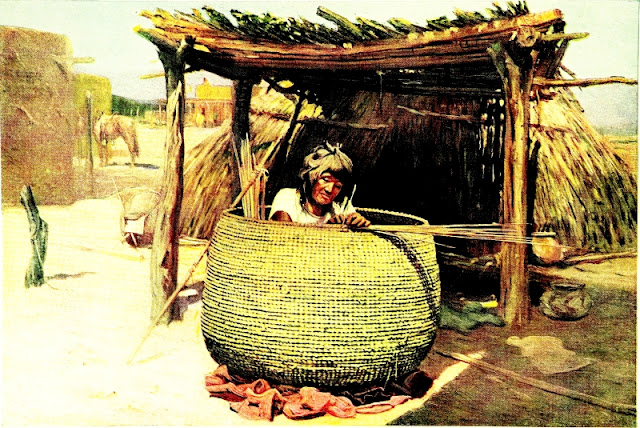
"The [basket that this] grandmother is weaving about herself
is to be used as a store for grains and vegetables."
This storage basket is very similar to an early Neolithic basket that was just found.
This is a colorized b&w photo from 
American Indians: first families of the Southwest by Huckel.
"Relatively few tribes of American Indians understood pottery, except in the crudest form. As for basketry, it may be said that every Indian from the land of the Esquimaux down through Mexico was a basket weaver."


ABSTRACT
It is clear from the fact that pottery had not been invented until late in the Neolithic era, that other tools and implements must have been fabricated during the Pre-Pottery Neolithic (PPN). Serge Svizzero points out in his quoted article that agriculture would have required a necessary set of support tools and containers to be successful; it is not enough to say that the Neolithic way of life occurred because of agriculture and the domestication of animals. In this article, I present direct and indirect evidence of Neolithic basketry to show that many of these implements could have been made using woven-fiber technology or basket weaving skills, a technology that may have been passed down from Upper Paleolithic societies. And I suggest these skills continued to be employed all during the Neolithic time period. Furthermore, I suggest these skills were passed on to the emerging civilizations in Mesopotamia and Egypt who made full use of this technology when needed.

INTRODUCTION

There is a large gap in the commonly accepted timeline of Neolithic technological development. Agriculture, domestication of animals, polished stone tools, pottery, and textiles are the accepted hallmarks of the Neolithic time period. But pottery did not occur until about 6,500 BCE and the domestication of pack animals did not occur until 3,500 BCE. This means that during the early part of the Neolithic, or for at least 3500 years, a large number of containers, implements, and tools were made with pre-pottery, pre-pack animal technology. And the technology that probably provided many of these things was basket weaving technology or woven-fiber technology as I have suggested this technology be called. Yet when I researched this topic, I could find almost no mention of basket weaving technology in the early Neolithic even though there is now direct evidence of basket use. However, I was able to find a substantial amount of information about Neolithic pottery. Clearly, baskets played a major role in the establishment of Neolithic settlements and were widely used before and after pottery took hold. 
THE NEOLITHIC TIME PERIOD: It is generally agreed that the time period of the Neolithic in the Levant went from ca. 10,000 BCE to ca. 4000 BCE when the first cities began to emerge in Mesopotamia. The first part of the Neolithic era, known as Pre-Pottery Neolithic A & B (PPN), ran from ca. 10,000 to ca. 6,500 BCE. This was followed by the Pottery Neolithic time period which ran from ca. 6,500 - ca, 4,000 BCE. In other words the PPN eras lasted about 3500 years and its technology proceeded the later Pottery Neolithic which lasted about 2500 years.
NOTE: These dates can only be roughly assigned and will change as discoveries are made. At the moment the above applies to the areas around the Tigris and Euphrates Rivers and the Persian Gulf.
This is another example of basket technology being taken for granted or simply not considered, even though it was crucial for Neolithic development and furthermore it had become highly developed and useful in the time period before the Neolithic. Later it would be just as important to the first civilizations. 
ABOUT THE NEOLITHIC TIME PERIOD
The Neolithic is not a fixed time period. It is a time after the Upper Paleolithic (the late Old Stone Age) and before the emergence of civilization when hunter-gatherers settled into a permanent sedentary life of villages and agriculture. For example, in Europe the Neolithic ended much later than in Mesopotamia and Egypt. The first civilizations in Mesopotamia emerged about 6000 years ago while the first European civilizations began less than 4000 years ago.
NOTE ABOUT THE MESOLITHIC: There is a time period between the Upper Paleolithic and the Neolithic called the Mesolithic which was a transitory period when many hunter-gatherers became semi-nomadic, for example. In this blog-article I mainly am concerned with the Neolithic time before the emergence of civilization. 


WOVEN-FIBER TECHNOLOGY AND NEOLITHIC CULTURES

It is my contention that advanced woven-fiber technology by nomadic hunter-gatherers of the Upper Paleolithic (see my earlier blog-article) was passed on to Neolithic cultures. Then during the Neolithic sedentary way of life people were able to expand and develop these technologies to create a kind of "infrastructure" that would allow them to farm and settle in villages. As Svizzero points out (see next), the Neolithic was not just about farming and domesticating goats and sheep, it required a wealth of support items many of which were woven-fiber based, such as large grain storage baskets used to store seeds for next year's harvest, waterproof woven fiber containers (often coated with bitumen) for irrigation and carrying water, grass houses, small boats, sandals, hats, fences, and much more.

WOVEN-FIBER TECHNOLOGY IN THE NEOLITHIC ERA

When the Neolithic revolution -- or more likely a slow transition -- occurred, there must have been a large number of support implements and methods that developed but are not often mentioned. The following quote makes this clear.
 Persistent Controversies About The Neolithic Revolution
"The domestication of plants and animals is a necessary but not a sufficient condition for the transition from foraging to an economy fully-based on agriculture to occur. Indeed, domestication can be seen as an innovation but many other innovations are required for the whole human population to be fed from agropastoralism activities. 
"These additional innovations are respectively related to the production of food resources, their processing, storage and consumption. Even if we consider agriculture in its first stage, specific tools and techniques are required, for instance, a digging stick to sow grains, an irrigation system, even if it is very basic or a sickle to harvest cereals. Once they have been harvested, domestic cereals require human activity, in the form of threshing and winnowing, to separate and disperse seeds. Once the seeds were obtained, they had to be stored in order to reduce the seasonal food risks. This requires some storage systems.
"Even though the innovations listed above seem us to be very basic they were all necessary for a complete transition to agriculture."
(Svizzero, "Persistent Controversies About The Neolithic Revolution")
PACK ANIMAL, any domesticated animal that is used to carry freight, goods, or supplies. The ass or donkey is the oldest-known pack animal, having been in use possibly as early as 3500 BCE


WHAT WAS USED BEFORE PACK ANIMALS? BURDEN BASKETS?

Although the following is only an educated guess, I believe it is worth considering as it provides a logical way that harvesting and processing grain, for example, would have been done before pack animals. 

I suggest that early Neolithic people employed 'burden baskets'. These are often huge baskets, carried on the back, that are capable of carrying a substantial amount of harvested plants. These baskets are still in use by hunter-gatherers today and were widely used by nomadic Native American Indians and other tribes. They were so important many Indian tribes had a unique design and also a unique name for these baskets as they had a special status. And they are still in use today in virtually every region of the world. Of course, like all baskets, we do not have direct evidence as these baskets from long ago would have decayed and left no indication of their existence. But their wide cross-cultural use, use by contemporary hunter-gatherers, and continued recent use on farms suggest that they could have been made in the Neolithic time period and would have helped accomplish the work these societies needed to bring in the harvest.

Contemporary pygmy hunter-gatherers use burden baskets for a variety of purposes.
<https://commons.wikimedia.org/wiki/File:Pygm%C3%A9es_(RDC).jpg>


Back baskets in Slovenia ca. 1963.


LEFT: "Haymaking - man collects grass in a pannier"
RIGHT: Harvest in Argenteuil (France) at the beginning of the 20th century.
<https://commons.wikimedia.org/wiki/File:046_Fienagione_-_uomo_raccoglie_l%27erba_in_una_gerla.jpg>
<https://commons.wikimedia.org/wiki/File:Vendange_argenteuil_95.png>


LEFT: Pima Carrying Frame
(Aboriginal American Basketry, 1904, Fig. 100, p. 294)
RIGHT: "Pima Indian woman...carrying firewood in her Kathak"
(University of Southern California, 1904, Pima Indian woman)


LEFT: Carrying Basket, Paiute Indians, Utah.
(Aboriginal American Basketry, 1904, Fig. 185, p. 494)
RIGHT: "Apache Indian woman carrying a "Kathak" on her back, Arizona, ca.1880."
(University of Southern California, ca.1880, Apache Indian woman carrying a "Kathak")


"Silva, 3 years old, goes to the field with her mother in 1954," Slovenia.
<https://commons.wikimedia.org/wiki/File:Silva,_3_leta,_Planina,_gre_s_koškom_z_materjo_na_njivo_1954.jpg>

Burden baskets are just one example of woven-fiber technology that could have been used in the Neolithic era. And even when pack animals were common, they carried baskets, such as these esparto donkey panniers pictured here.


BASKET IMPLEMENTS IN THE PRE-POTTERY NEOLITHIC 

As I pointed out earlier, for more than half of the Neolithic era, there was no pottery,  yet these agricultural societies clearly needed a wide variety of containers and related items for harvesting, winnowing, milling, sifting, and storing plus household items for cooking. 

I argue that many woven-fiber items were invented, created, and used for agriculture. But as I wrote in the article before this one, much of this technology had been handed down from Paleolithic societies. Here are some examples of grain processing baskets that Native American Indians used around 1900 when these photos were taken. As I have pointed out in my previous article, many Native American Indians lived a way of life that was roughly equivalent to the Upper Paleolithic in Europe so studying their technology may be helpful.

Examples of milling baskets; Pomo milling baskets. 
(Aboriginal American Basketry, 1904, Plate 97, explanation p. 350)


From this photo, it appears that the 'paddle' this Pomo Indian woman used was carefully constructed. It has a wrapped handle and a strong paddle surface for hitting plants so that she could collect their seeds in a burden basket.

BASKETS ARE TOOLS
For some reason, baskets are not often included as tools, but they are. Thinking of baskets as tools changes the way that they are evaluated and also elevates their importance.


BOTTOM:


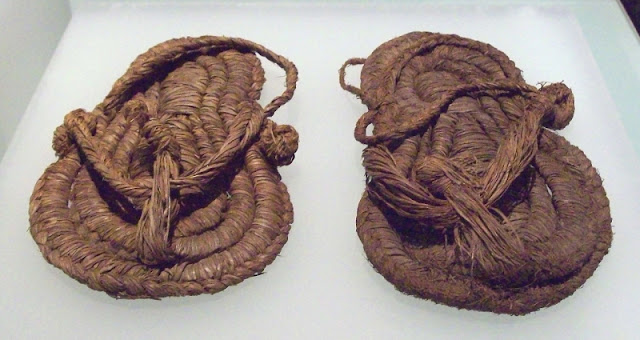
ESPARTO WOVEN-FIBER ARTIFACTS

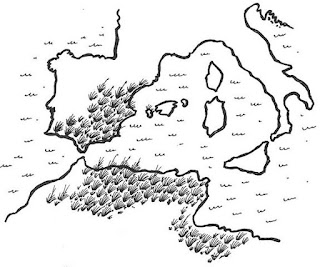
Just how versatile was this technology? What kind of products could it provide? Woven-fiber technology was dependent on the plants that grew wild locally. So reeds were plentiful and versatile around Mesopotamia, papyrus was widely used in Lower Egypt, and in Spain and in North Africa the esparto plant was valued for its many uses.

Fortunately, in the case of esparto, we have direct evidence since many baskets, shoes, and mats from the Neolithic era  (5200-4600 BCE OR 7200-6600 BP. Los Murcielagos Cave, Albunol, province of Granada, Andalusia) have survived intact. They were found in a dry cave near Granada Spain. The existence of these items also shows that basketry and weaving technologies were being widely used in the Neolithic. 

 
The following is quoted from:
Traditional Craft Techniques of Esparto Grass (Stipa tenacissima L.) in Spain
"Numerous archaeological artifacts and remains of esparto basketry have been discovered that date from the Neolithic period in southeast Spain. THESE PIECES DEMONSTRATE HIGH STANDARDS OF QUALITY COMPARED WITH MORE MODERN PIECES. [ED. My emphasis] In addition, there are many imprints of esparto basketry in clay or pottery (Ayala and Jiménez 2007). Among the abundant archaeological remains, some of the most outstanding are the artifacts dating back to 7,200– 6,600 BP, which were found with several mummies in Cueva de los Murciélagos (Granada). These pieces represented clothes, hats, tunics, sandals, baskets, and ropes—ALL MADE WITH THE FINEST TECHNIQUES. [ED. My emphasis]  In some cases, the artifacts included colored espartos." (Fajardo et al. "Traditional Craft Techniques of Esparto Grass...")
The authors list all the things that can be made with esparto:
Baskets (wide variety), Beehive, Belt for mules and donkeys, Bottle and container covers, Bowls, Canteen, Chair, Cheese mold, Clothing, Covered basket, Donkey pannier, Dough basket, Espadrilles Esparteñas, Fan, Ferret basket, Fishing net, Fish trap, Fodder basket to feed animals, specially mules and horses, Hat Sombrero, Long rug, Net for fishing or to carry straw in the cart, Oil mill basket for pressing olive pulp, Pitcher, Rope, Round rug, Saddle, Saffron basket to collect saffron flowers, Sandals, Shepherd spoon, Provisional spoon to eat curd, Shutters to keep the home fresh, Shepherd’s slings, Snail basket to catch snails, Sowing basket, Stool, Swarm catcher to catch bee swarms, Table mat, Toys and ornaments, Tunics.


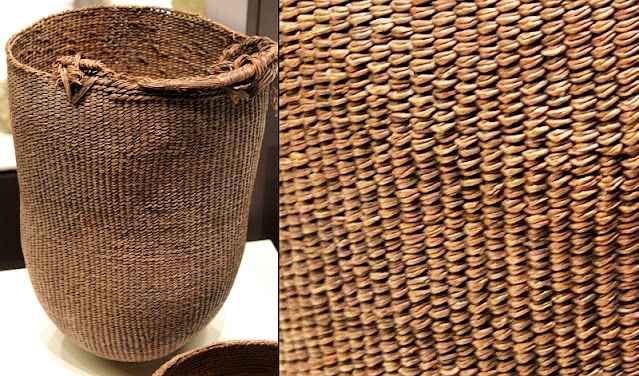
Baskets, Shoes, And Mats From The Neolithic Era  (5200 - 4600 BCE or 7200 - 6600 BP)
Found In Los Murcielagos Cave, Albunol, Province Of Granada, Andalusia, Spain.


LEFT: Recreation of a Neolithic snail basket,
a traditional basket for collecting and gathering snails 
RIGHT: Detail snail basket

There are also many ways of processing the esparto plant and many ways of weaving the plant for various purposes which show the depth of knowledge people had.


DIRECT EVIDENCE OF NEOLITHIC BASKETRY IN AGRICULTURE

In 2021 in Israel the world's oldest complete basket, including lids, was discovered and dated to 10,500 years ago (BP), or near the beginning of the Neolithic era.
This large basket could hold about 92 liters or about 24 gallons, about as big as a human torso. According to Dr. Haim Cohen of the Israel Antiquities Authority project, "the ancient people who manufactured it probably...used it for storage."
This find was a major discovery. It was direct evidence of basketry in the early part of the Neolithic.(Palace "Oldest Basket Ever Found") 

This basket looks remarkably like this Native American Indian basket pictured next. The size, the shape, and even the lids are similar.

Coiled Granary, Pima Indians
The newly discovered basket in Israel looks remarkably like this
large Native American Indian one which was also used for storage and had similar lids.
(Aboriginal American Basketry, 1904, Fig. 203, p. 524)

OTHER NEOLITHIC BASKET FINDS
"The oldest basketry found in Egypt dates to the Neolithic period (ca. 5900–4000 BCE). In the Fayum Oasis, about 100 km (60 miles) southwest of Cairo, grain storage pits were excavated in the desert floor, lined with coarse straw basketry." "Near the Neolithic grain storage pits part of an extremely finely coiled basket was found, dated to about 4200 BCE, made of separate bundle and winder materials..." (Wendrich "Basketry in Ancient Egypt")

"Basketry is known from the earliest sites in Egypt [ED: Neolithic]. Remains of baskets have been found in the Fayum dating to the Neolithic period, about 5000 BCE. Basketry found in a predynastic context [ED: i.e., Neolithic] is often of very high quality, not surpassed later." (Bizzari "Weaving And Basketry In Ancient And Modern Egypt")
This direct evidence indicates that basket weaving was an essential technology in the Neolithic. But baskets are not the only example of woven-fiber technology. Weaving cloth, building large grass houses, and thatching roofs, were also highly developed. This has been well established. So weaving skills were widespread and very much a part of Neolithic life.


ABOUT WEAVING AND NEOLITHIC LOOMS

The establishment of weaving and making cloth throughout Neolithic societies, both in the Levant and later in Europe, indicates that in the early Neolithic these societies were well acquainted with the art of weaving in general and also skilled in the making of thread.

Impressions of plain-weave have been found in clay and dated to 23,000 BCE. However, it is an educated guess that these early impressions came from small handlooms for making belts and narrow strips.

"Guatemalan woman, handloom, 1970s."

The large looms necessary to make fabric and clothing, which are characteristic of the Neolithic era, probably looked like this.

This is a recreation of a Neolithic warp-weighted loom about 5300 years ago. The recreation is by The ArcheoParc Schnals Museum of South Tyrol, Italy. The clothing pictured here is also a recreation by the museum and part of their loom display.
<https://commons.wikimedia.org/wiki/Category:Archeoparc_Schnals_-_Museum#/media/File:Archeoparc_-_%C3%96tzi_Webstuhl.jpg>

"The first proof of true weaving [ED: weaving wide cloth] occurs circa 7000 B.C.E. at the start of the Neolithic, with impressions of plain-weave and basket-weave on clay at Jarmo (north-east Iraq) and a pseudomorph (minerals having outward characteristics of organic materials) of a plain-weave textile on a bone at Çayönü Tepesi (southern Turkey). These fabrics are too well done to be the start of weaving." (Barber "Prehistoric Textiles")


NEOLITHIC BUILDINGS

Weaving was also an important part of building. In the early Neolithic, homes were often made with weaving skills. 

Recreation of Neolithic huts 
in the Steinzeitdorf Kussow open-air museum, Damshagen, Germany.
<https://commons.wikimedia.org/wiki/File:Kussow,_Steinzeitdorf.jpg>

Some Native American Indian buildings, such as this one below, showed sophisticated weaving skills. As I have argued, I believe that Upper Paleolithic and Mesolithic technology was highly developed and was passed on to Neolithic societies. And again, as I have argued, the skills of Native American Indians around 1900 can be seen as similar to those of the Upper Paleolithic and Mesolithic in Europe.
“While it is now certain, that perishable fibre industries were part of the first Americans, [ED: Native American Indians] they also seem to have been part of Upper Palaeolithic techno-economic suite for much longer than we have imaged.” (Soffer "Recovering Perishable Technologies")

Later homes looked more like modern houses but still had thatched roofs. And thatching has continued to this day.

RIGHT: Roofer covering a modern thatched roof house in Escheburg, Schleswig-Holstein, Germany


CONCLUSION

It is clear from the fact that pottery had not been invented until late in the Neolithic era that other tools and implements must have been fabricated during the Pre-Pottery Neolithic (PPN). As Serge Svizzero points out in his quoted article, agriculture would have required a necessary set of support tools and containers to be successful. From direct and indirect evidence I have presented in this article, it seems likely that many of these could have been made using woven-fiber technology or basket weaving skills, a technology that may have been passed down from Upper Paleolithic societies. And I suggest these skills continued to be employed all during the Neolithic time period. Furthermore, I suggest they were passed on to the emerging civilizations in Mesopotamia and Egypt who made full use of these skills when needed.

___________________________________________
ENDNOTES

Barber, Elizabeth Wayland. Prehistoric Textiles. Princeton: Princeton University Press, 1991. Excerpt ("Prehistoric Textiles" in LoveToKnow.com. https://fashion-history.lovetoknow.com/fashion-history-eras/prehistoric-textiles   Accessed Jan. 30, 2922.

Bizzari, Heba Fatteen. "Weaving And Basketry In Ancient And Modern Egypt." TourEgypt.net, 2011. http://www.touregypt.net/featurestories/basketry.htm   Accessed Jan. 30, 2922.

Fajardo, J., Verde, A., Rivera, D., Obón, C. & & Leopold, S. "Traditional Craft Techniques of Esparto Grass (Stipa tenacissima L.) in Spain." Economic Botany ISSN 0013-0001 Econ Bot DOI 10.1007/s12231-015-9323-x https://www.academia.edu/19717708/Traditional_Craft_Techniques_of_Esparto_Grass_Stipa_tenacissima_L_in_Spain?auto=download   Accessed Jan. 30, 2922.

Palace, Steve. "Oldest Basket Ever Found is Part of Dramatic Discovery in Israel’s 'Cave of Horror'" The Vintage News, Mar 24, 2021. https://www.thevintagenews.com/2021/03/24/basket/   Accessed Jan. 30, 2922.

Soffer, O. (2004). Recovering Perishable Technologies through Use Wear on Tools: Preliminary Evidence for Upper Paleolithic Weaving and Net making. Current Anthropology 45, (3): 533.

Wendrich W. (2008) Basketry in Ancient Egypt. In: Selin H. (eds) Encyclopaedia of the History of Science, Technology, and Medicine in Non-Western Cultures. Springer, Dordrecht. https://doi.org/10.1007/978-1-4020-4425-0_8470  Accessed Jan. 30, 2922.